My guide came by my idyllic retreat, the Hesitance Kandalama at 7 AM. Ugh. There were two reasons for being so early. One is that our first stop was Sigiriya Rock, a 200 meter climb (the equivalent of climbing a 67 story building). An early starting time meant the temperature would be maybe 87 degrees (30 C) rather than 96 (35 C) or even 104 (40 C) as it was yesterday. The other was that the day was overbooked. After a 40 minute drive and the climb, we had an hour and a half drive followed by a visit to the ancient capital of Anuradhapura.
I took one look and was shocked to think I was going to climb to the top of this rock.
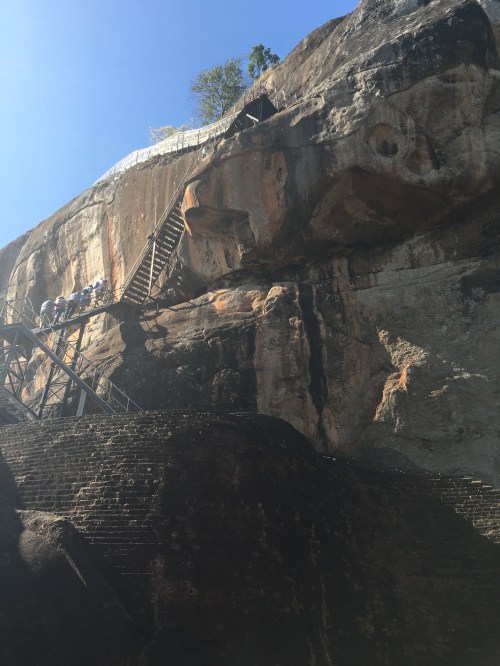
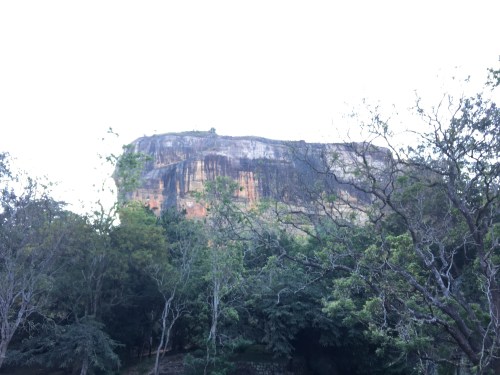

These signs didn’t make me to enthused — “Noise may provoke hornet attacks” and “Keep still & silence in a wasp attack.” Fortunately, either we were really quiet or there were no hornets today.


My guide left to park the car at the back entrance so we could exit a different way. While I was waiting, a man starting chatting with me and when I climbed up a few stairs he held on to my arm to help. I didn’t want to pay for another guide but his assistance really helped with climbing these ridiculously narrow steps. When my guide came, the new guy offered to help me both up and down for about $21. I offered $7, he countered with $14 and I offered $10.50. He said we’ll see and we started up. I was congratulating myself at a rare negotiating victory. Meanwhile another couple of guides started following asking if I wanted even more guides and my regular guide got very upset and almost came to blows with one of them as you see below. This was my first negative experience like this in Sri Lanka.
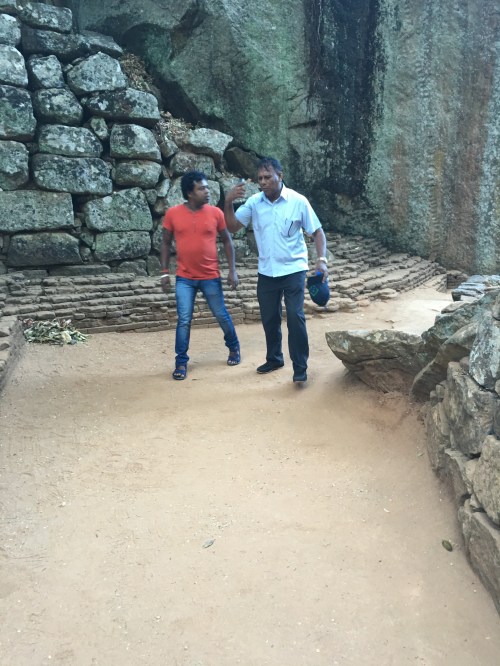
The guide who I had negotiated the price with turned out to be excellent, better than my regular one in fact. Steadying my arm made it so I could climb normally rather than with my feet turned sideways. I asked him how many more times he would go up the rock today and he said this was his only time as there are over 100 guides who take their turn. I asked him about his family and he has a wife who stays at home and two children in school. At the end of the day, I gave him the full $21 he had asked for. He needed it more than me. So much for my negotiations victory.
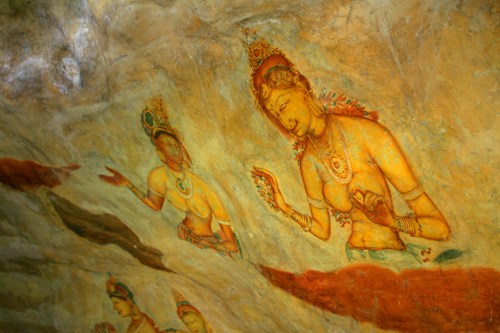
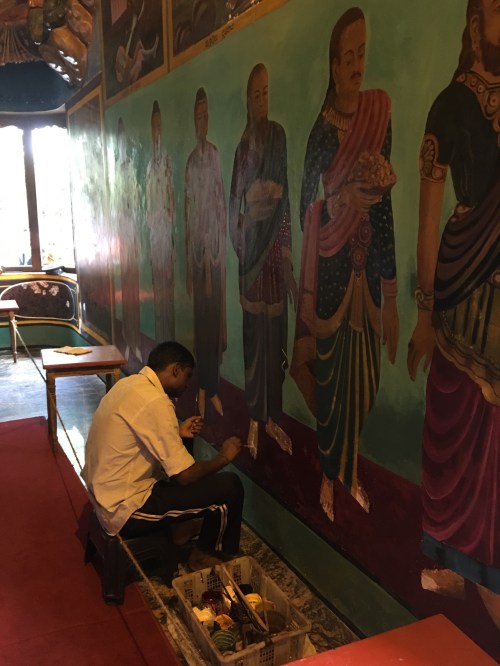
The elevation change was actually more than 200 meters since we climbed an additional couple of hundred steps to get to the famous frescoes. Supposedly, the King had 500 wives and painted them all on the side of the rock but only a few are left.
According to wikipedia, the Mirror Wall below was polished so the king could see himself. The wall has graffiti from visitors going back to the 8th century. Here’s one from over a thousand years ago in translation — “I am Budal [the writer’s name]. Came with hundreds of people tо see Sigiriya. Since аll the others wrote poems, I did not!” (https://en.wikipedia.org/wiki/Sigiriya). Fortunately, new graffiti is banned.

Here are some images looking up.


Here are some images looking down from the top.
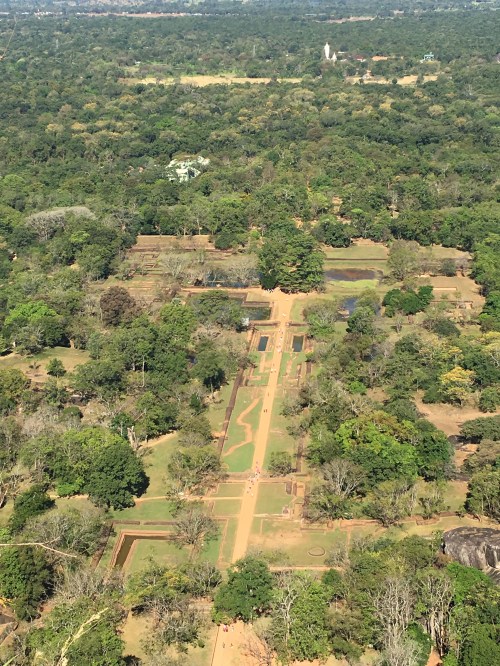
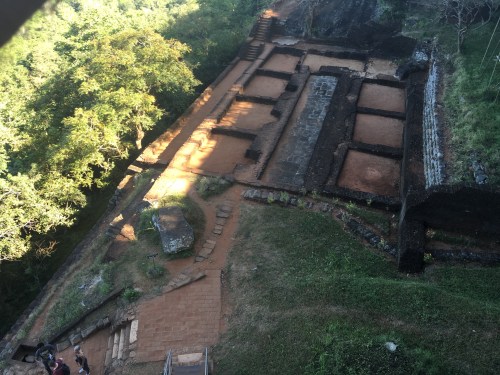
Jumping from the very highest spot.

Here’s from the bottom with my thoroughly soaked shirt.

I can’t really show the extent of the multiple stairways. I’m amazed that I was able to climb it. Having my arm steadied made a big difference. I don’t foresee mountain climbing as a new career option but maybe I’ve been underestimating my capacity. I’m thinking of trying to walk more in the hilly woods near Indiana, PA because of this experience. This rock makes me think of Ayer’s Rock in Australia that definitely would be on my bucket list if I had one. Sigiriya Rock is shaped like nothing else that I’ve seen anywhere in the world. Not surprisingly it’s been a sacred rock for centuries. It’s sacred in a way to me too. I’ll never forget this place.
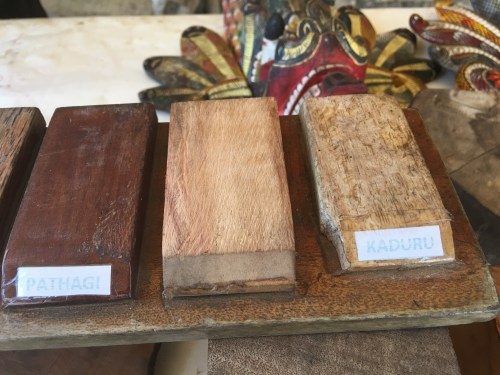
On our way to the ancient capital of Anuradhapura, we stopped at a carving workshop that the travel agency considers to be very authentic. A guide showed me the different types of wood they use, which are ebony, royal ebony (with white streaks), teak, mahogany, mara, jack, coconut, pathagi, and kaduru.
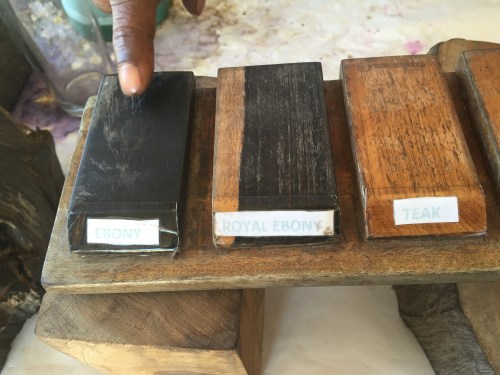

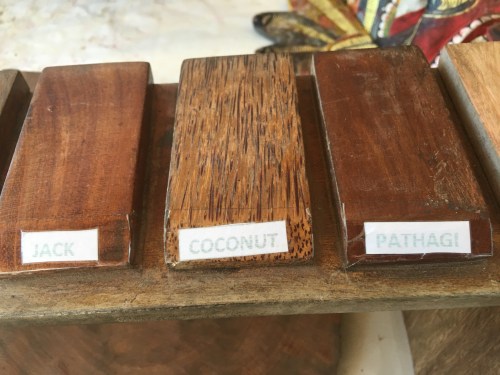
The video below explains how they create the colors they use in their sculptures. They add hot water to pathagi wood (also called rainbow wood) to get red. Sandpaper is rubbed on a piece of iron treated with lime then added to the red mix to get black. Lime is added to the black to get yellow. He then added chalk particles to that mix to get purple. He quickly described how other colors are made. Finally he showed me a mask done with the natural colors and the same mask done with chemical colors. The natural one had much richer colors.
Here are some scenes of artists at work. I love using the elephant foot as a table.
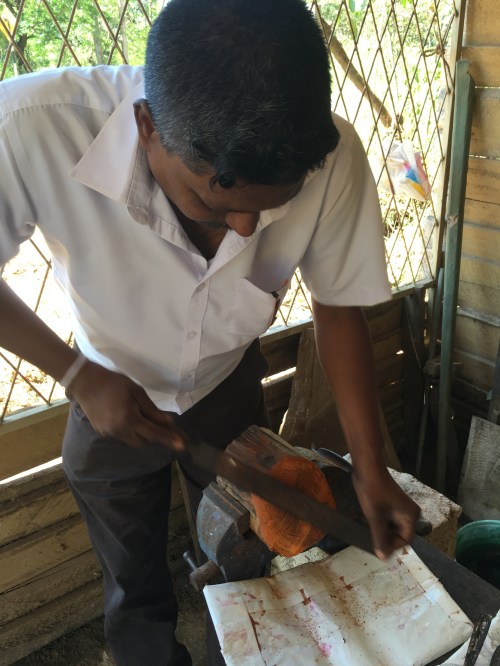
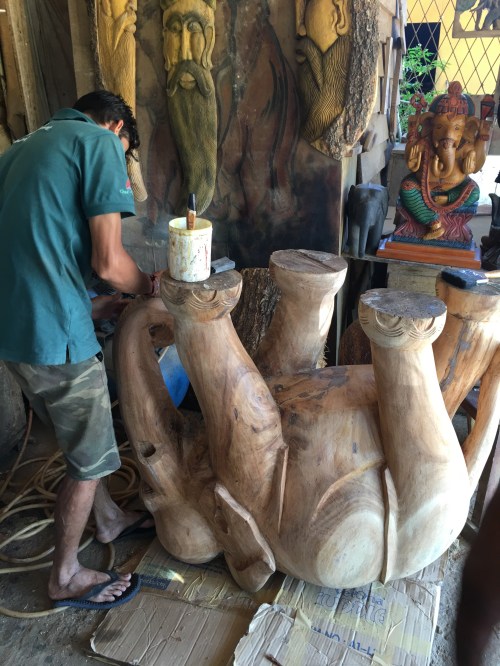
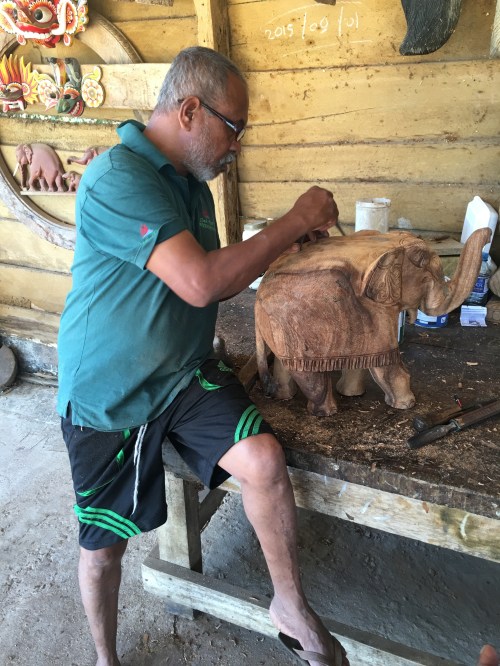
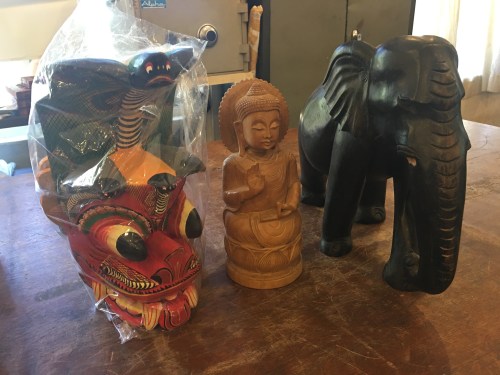
I ended up buying an ebony elephant with white ebony on the tusks to make it look more realistic. It takes about 20 days to make. It was very heavy so I had it shipped which added considerably to the cost.
I had thought of getting my brother and sister something to commemorate the three of us having been here in 1956/7. When they told me that the shipping would be the same for three pieces as for one, I found something for them here.
My sister wanted a Buddha since she is intrigued by the religion. The one I got her is made of jackfruit wood and is the teaching Buddha, which makes sense since she was a teacher as were most of my family. It takes about 20 days to make.
I got my brother a Cobra Mask that is used in the Perahara festival from Kandy that our family saw in August 1956. This festival with the exotically decorated elephants is one of the few distinct memories I have of Sri Lanka from 1956. The cobra above the mask’s head signifies protection. It’s made of Kaduru wood, similar to Balsa and uses all natural colors. It takes about 15 days to make.
Here are the three pieces I bought. They’re supposed to arrive in a month. They claim to wrap them really well and are insured. Somehow I don’t think they would have fit in my suitcase.
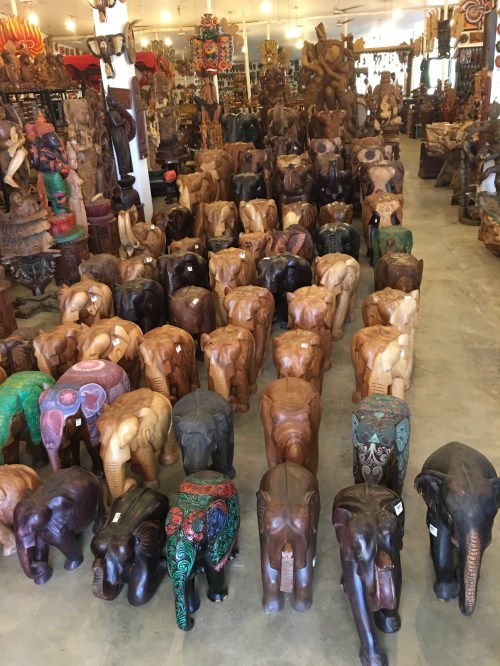
Some of the carved elephants getting ready to stomp on me.
I hate shopping and bargaining, I did bargain it down somewhat but my father would have paid much less. He had a passion for bargaining. I did use a trick he taught me about walking away when the negotiation stalls. They usually will come back with a lower price. I did that years ago when I really didn’t want an item and the seller followed me around and seemed to get some respect for my willingness to keep walking. I just didn’t want it.
Our afternoon was spent at Sri Lanka’s ancient capital, Anuradhapura. It’s a vast site with several stupas, which are decorated holy mounds, along with temples. This is the Abhayagiri Stupa built in the 1st century BCE.
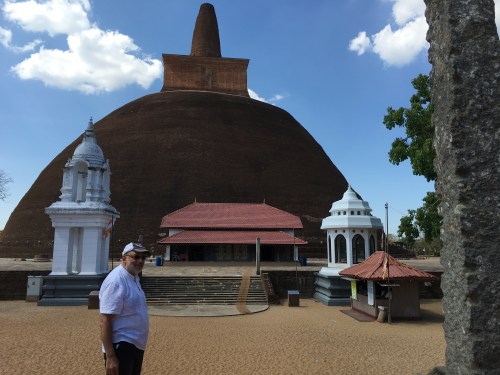
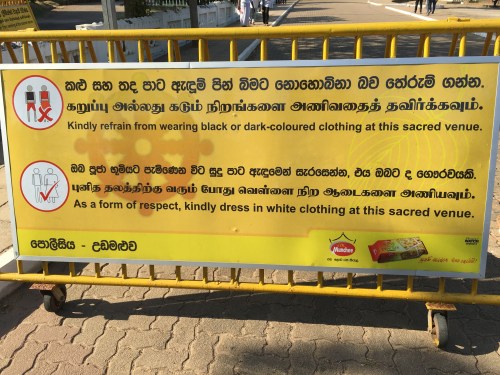
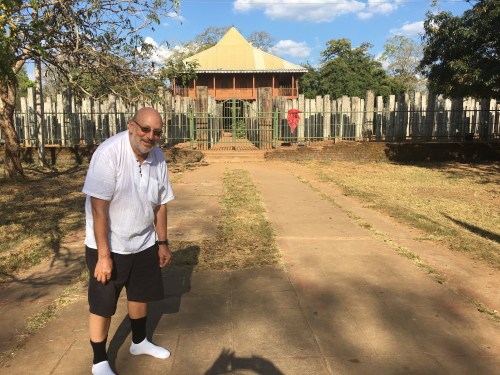
Fortunately, I was wearing white as this temple did not allow dark clothing.

At one temple, they just barely allowed me in with my shorts. I had to undo my belt and push the shorts down to cover my knees. Remember Bill Cosby telling young African-Americans to pull their pants up? He would not have approved, not that anyone cares what Bill Cosby says anymore. I’m wearing three pairs of socks because shoes are not allowed and the pavement and sand is extremely hot. Two pairs were not enough, my feet still burned.
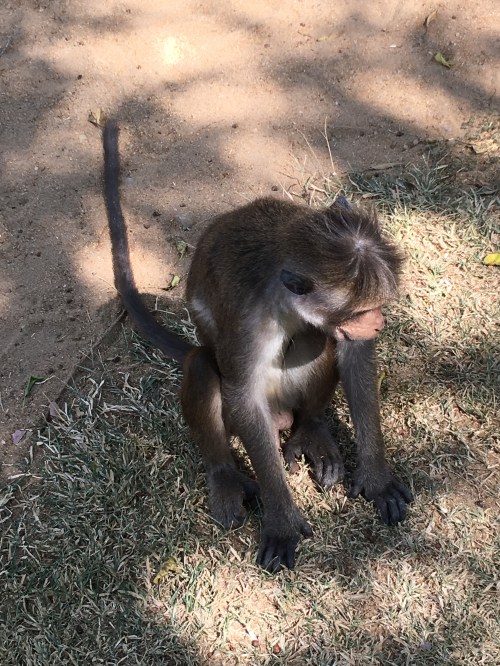
This monkey came right up to me.
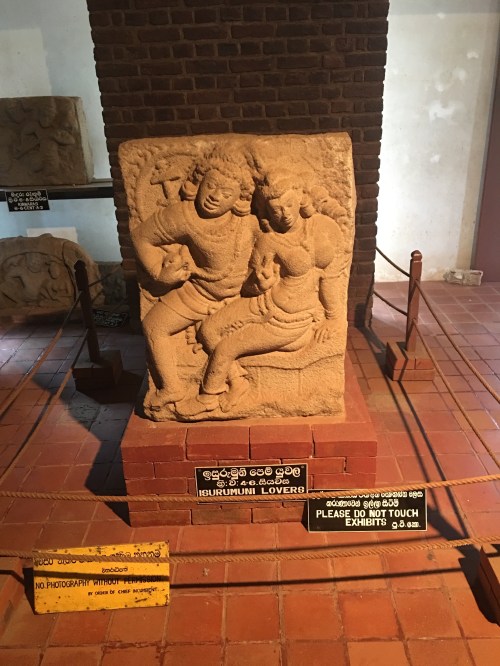
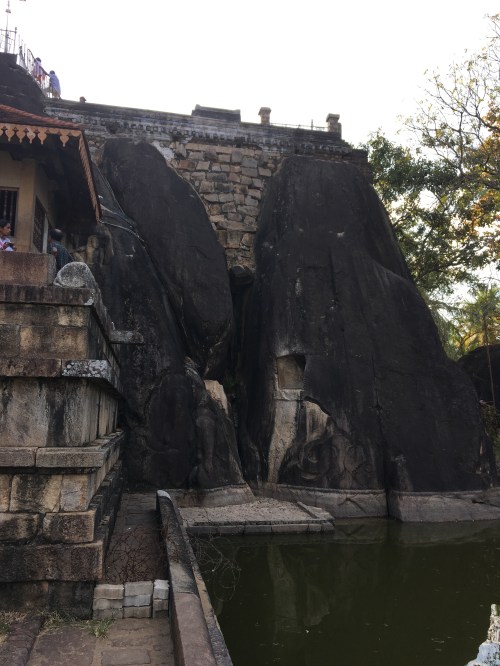
Here are some scenes from Anuradhapura. The first one is the “Burumuni Lovers.” According to Wikipedia, it’s a “6th Century Gupta style carving. The woman, seated on the man’s lap, lifts a warning finger, probably as a manifestation of her coyness; but the man carries on regardless. The figures may represent Dutugemunu’s son Saliya and the low caste (Sadol Kula) maiden Asokamala whom he loved. It’s known that he gave up the throne for her.” https://en.wikipedia.org/wiki/Isurumuniya
Four elephant sculptures bathing.
Buddhist prayers.


A row of elephants.
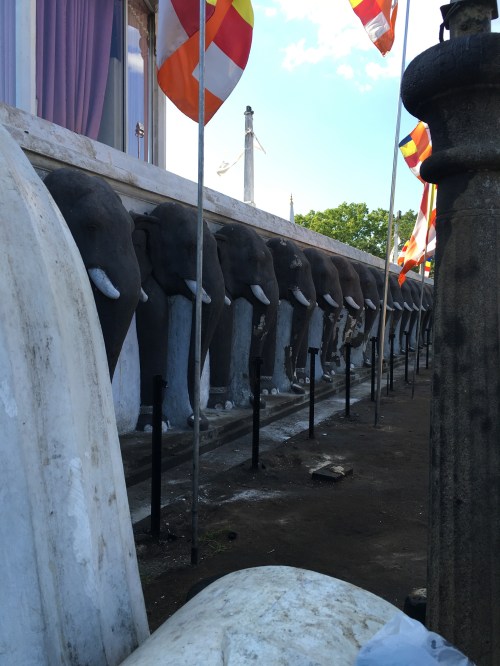
I was worried about having nightmares of these sculptures.

This is just one of the many unexcavated sites that are all over these massive grounds.

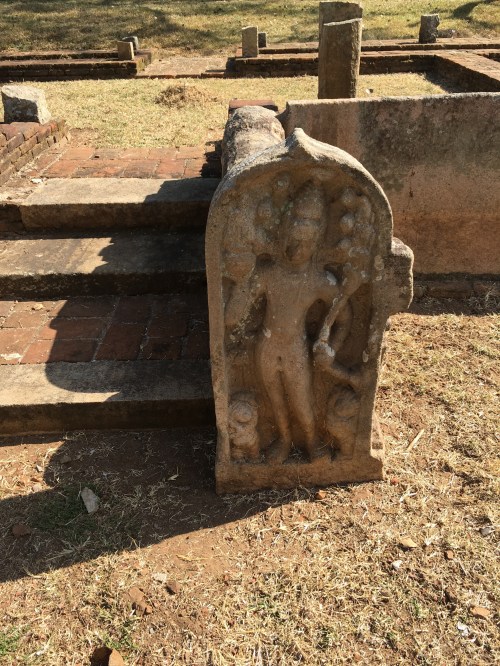
This sculpture was in the grounds, away from the major areas.
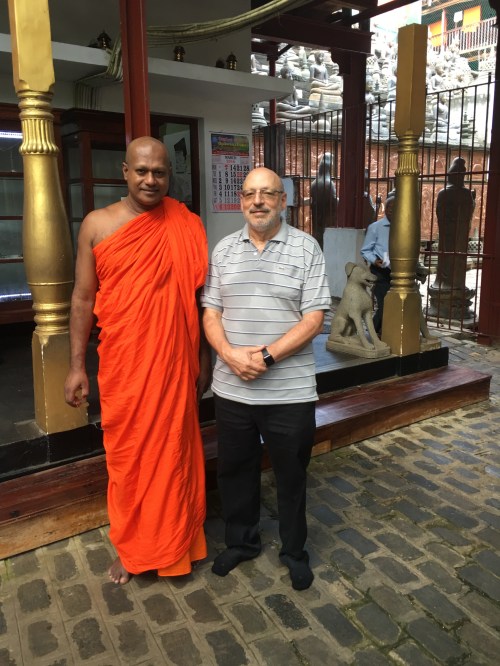
A monk was standing at the entrance to another temple and wouldn’t let me get away with pulling my shorts down to cover my knees. Does the sarong make a good fashion statement?

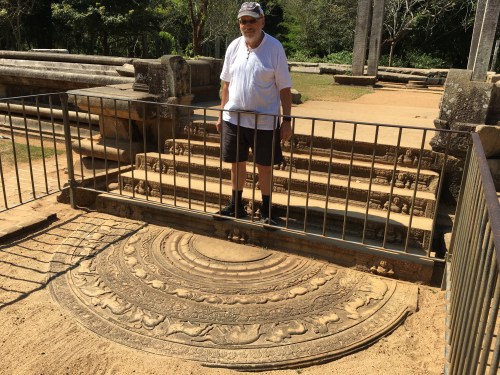
An original moonstone from many centuries ago.
Some local tourist kids enjoying a drink with the temperatures in the upper 90’s.

These are twin pools called Kuttam Pokuna, which according to wikipedia “are considered one of the significant achievements in the field of hydrological engineering and outstanding architectural and artistic creations of the ancient Sinhalese” (en.wikipedia.org/wiki/Kuttam_Pokuna).


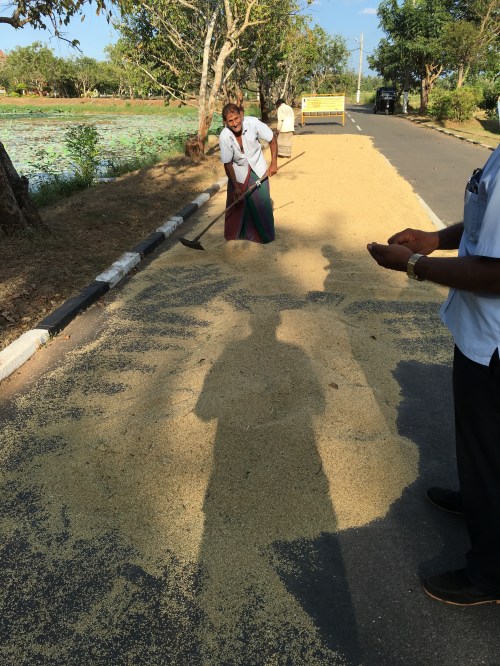
Somehow it’s OK to use the road to dry rice.
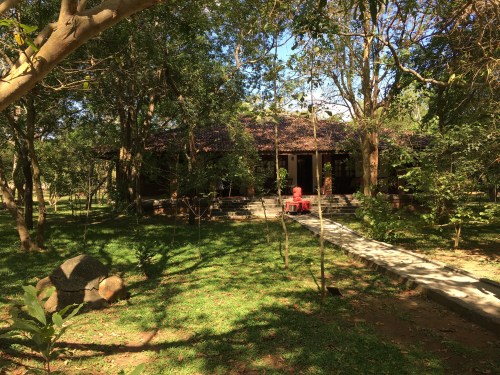
After this exhausting day with the contrasting sites of the rock and the series of temples, it was time to find my hotel. My room was maybe a quarter mile behind the restaurant building. The resort was laid out as a small village with bungalows spread out with paths all over the place. My bungalow was half of this building.
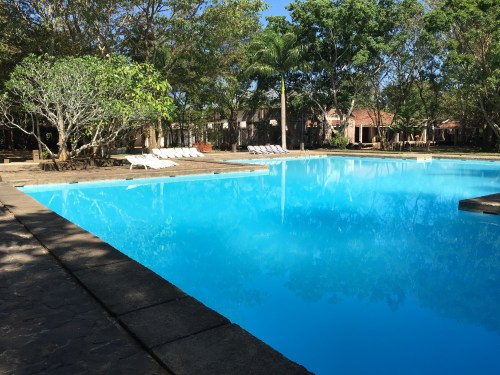
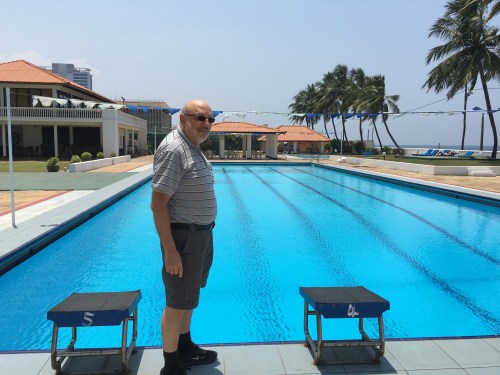
The food was probably the worst I’ve had in Sri Lanka but the food overall has been excellent. The hotel was designed for large tour groups to go through so it had a drab buffet. The swimming pool was ridiculously large and I had to keep my tradition going of swimming after each of these long days.
Every day in Sri Lanka was exhausting except for the few days at the beach. No day was more exhausting than this one. The US Marines had an ad showing people doing wild physical activities with the tag line that marines do more before breakfast than most people do in an entire day. I’ve often thought of that as the least appealing commercial of all time. However today, I had climbed 66 stories before noon followed by miles of waking in 95 degree plus weather in high humidity. I’ve almost never experienced the need to sleep from physical activity. Today, after dinner I slept well. A day like today would not work for me more than a few, if any, times a year. However, as I write this a few weeks later I still feel the “highs” of this day (high elevation, temperature, visual experiences, energy).



















 feldmanlarry