The highlight for me today was my guide’s story about his grandfather and father. Fortunately, I took notes on my iPhone as we were driving (thank you autocorrect).

- His grandfather worked for the Vietnamese monarchy well before WW2.
- He joined Ho Chi Minh’s forces that were fighting against the Japanese during WW2 and was one of the people that freed the rice that the Japanese had stolen from the Vietnamese. Many Vietnamese had died of hunger because the Japanese exported Vietnamese rice to Japan.
- In 1945, Ho Chi Minh got the king in Hue to abdicate. He then declared the foundation of the Democratic Republic of Vietnam.
- In 1947 the French came back after surrendering Vietnam to the Japanese during the war.
- His grandfather was part of the revolutionary forces and was fighting to get the land back from the foreigners.
- His father was born in 1931. He moved to the jungle with his grandfather in 1947 and joined the revolutionary Viet Minh forces.
- The Geneva Convention in 1954 set the 17th parallel as the boundary between the Ho Chi Minh forces in North Vietnam and the US-supported forces in South Vietnam. Elections were supposed to be held in 1956 but the US cancelled them when they realized Ho Chi Minh would easily win.
- His grandfather and father were living near Hue, just south of the 17th parallel. They were afraid to stay in the south in 1956 so the two of them moved across the border to the north.
- He had two uncles who were too small to join the revolution so they stayed in the south with relatives.
- His father became a Viet Cong soldier. but his uncles were conscripted into the pro-American South Vietnamese army during the “Vietnamization” era when the US decided to replace US soldiers with Vietnamese soldiers.
- After the Ho Chi Minh forces defeated the US supported-government in 1975, his two uncles were arrested and sent to reeducation camps.
- He also has an aunt who also stayed in the south but didn’t join the war.
- The two uncles weren’t in the re-education camps for long since they were not high-ranking officials.
- One of his uncles was a technician for the South Vietnamese navy. He stole a boat after leaving the camp and tried to get to another country. My guide does not know what happened to him after all these years.
- The other uncle is still alive and working as a guard for a military airport.
- His father is 83 has earned many medals as a fighter for the Ho Chi Minh forces. His mother died at 35 years old in 1976. The guide feels she would have lived if medicine was available but during that chaotic time it was not possible to get good medicine. The war was supposed to be over but fighting was still going on.
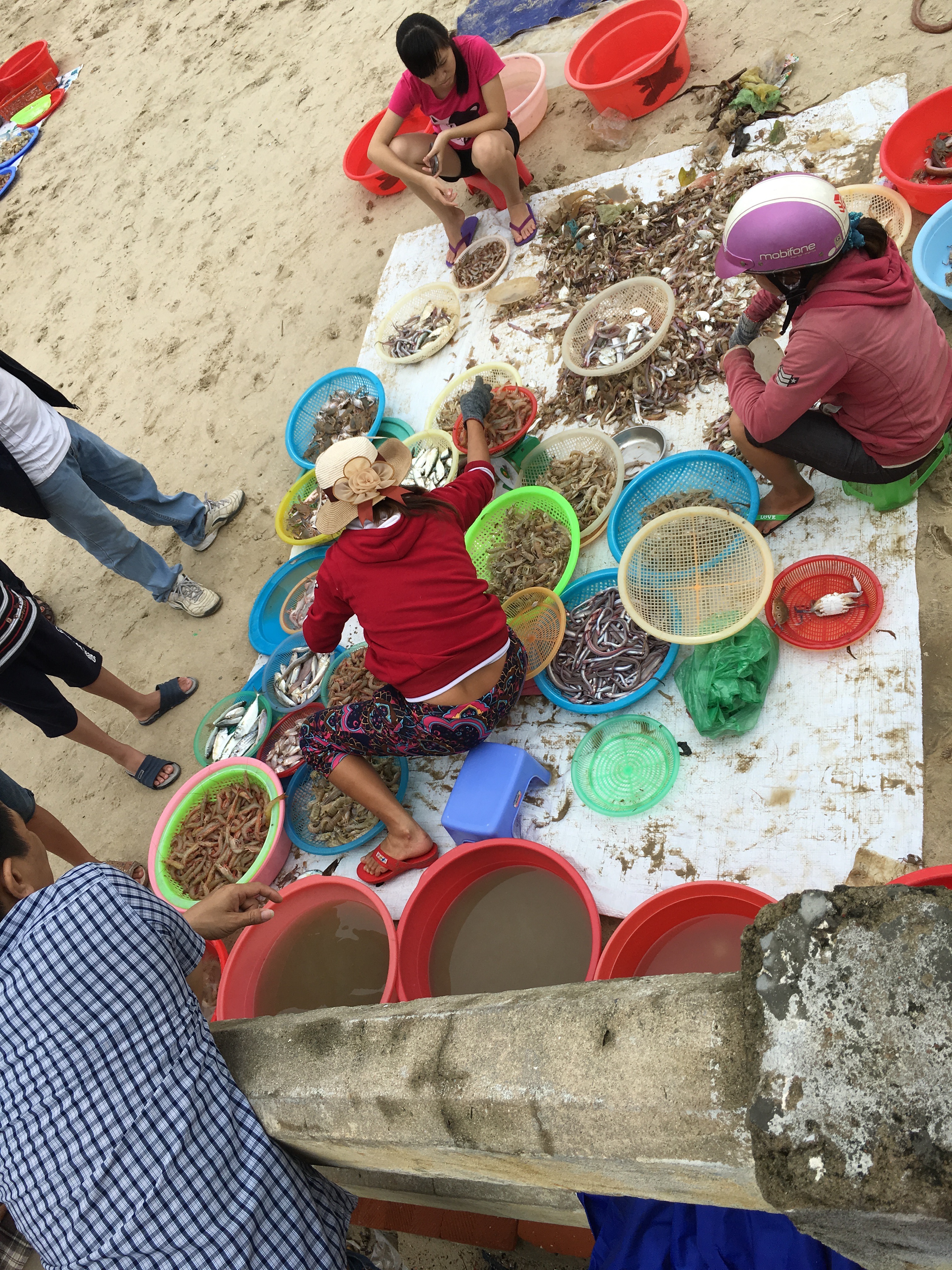
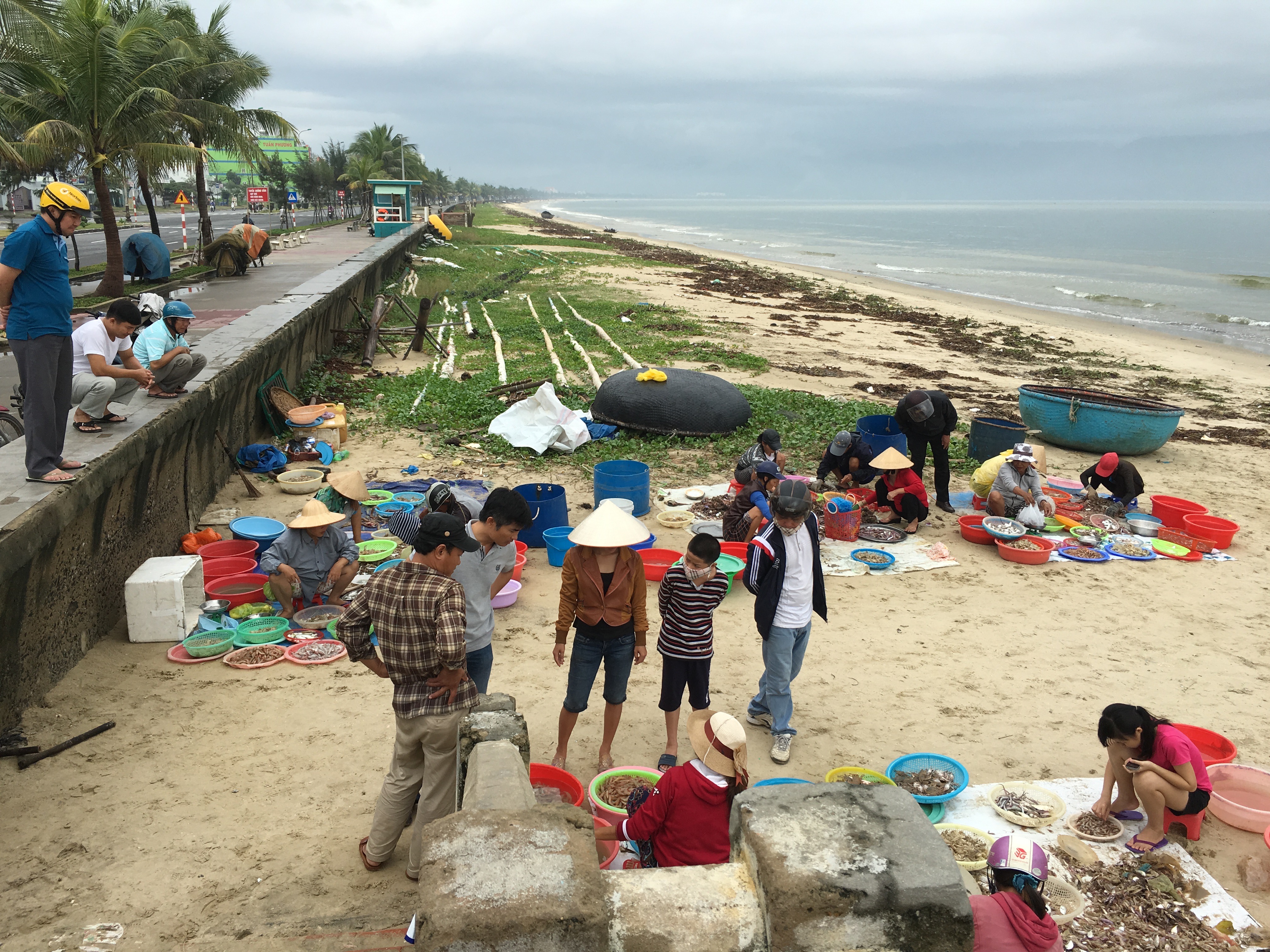
What a story! In the picture above, my guide is standing next to a hemispherical boat that is made of simple materials easily available. It’s used for shrimp fishing. We were at the beach just as they were processing the shrimp for sale.

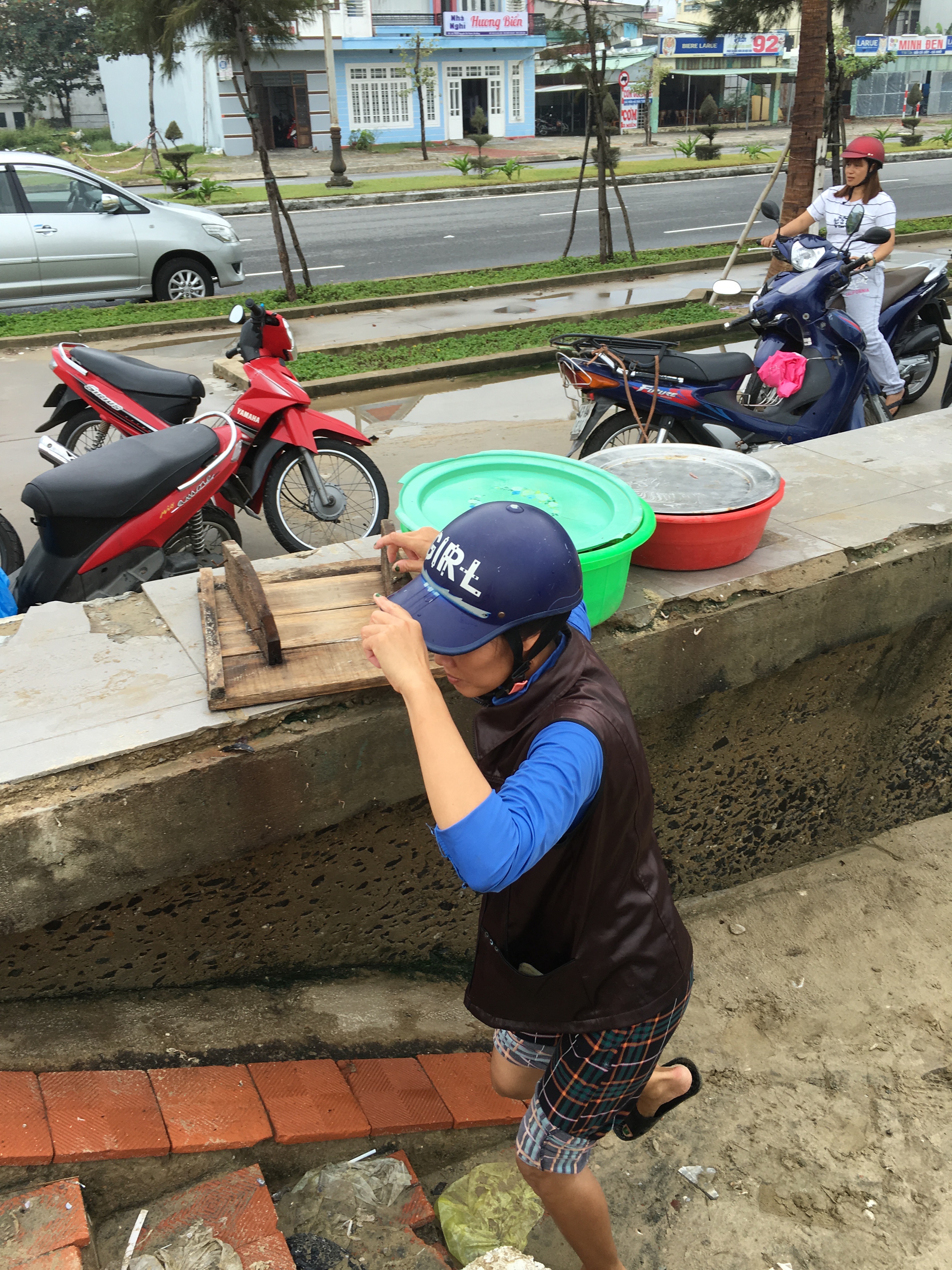
Women in Vietnam work very hard and seem to be very capable. I liked the helmet of this woman with “Girl” on it. She carried two massive bowls of shrimp and a large basket on her motorbike.

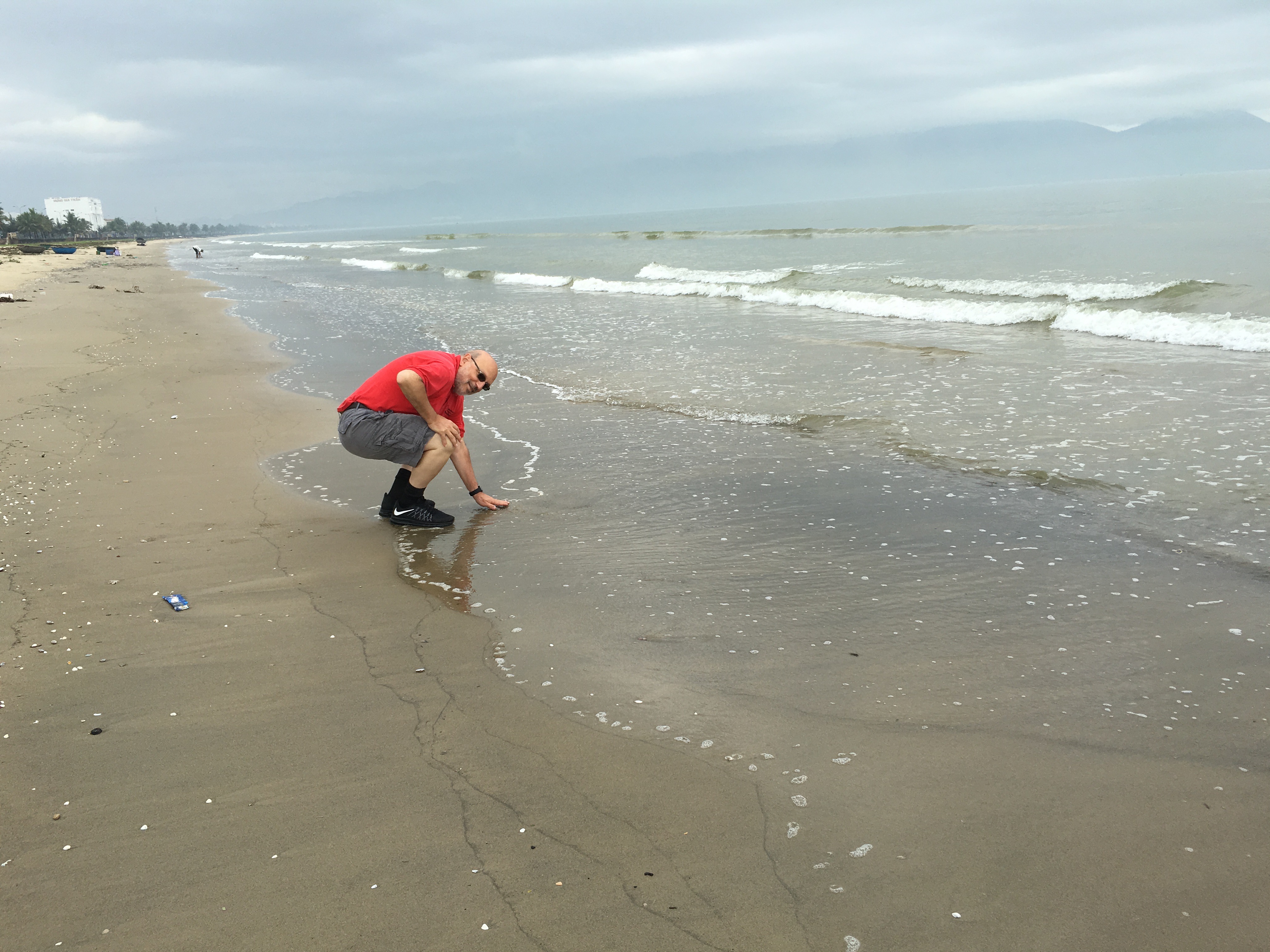
I had to keep my tradition of touching water, this time the “Red Beach” on the Pacific near Danang. Near here is where the French landed in 1885 and where the US military landed in 1963.
We went up Marble Mountain that we were supposed to go up yesterday but the guide wisely postponed it due to the monsoon. My guide joked that we should take the elevator up instead of walking. I often make this comment when there’a big climb.

To my surprise, he wasn’t joking. There really is an elevator.
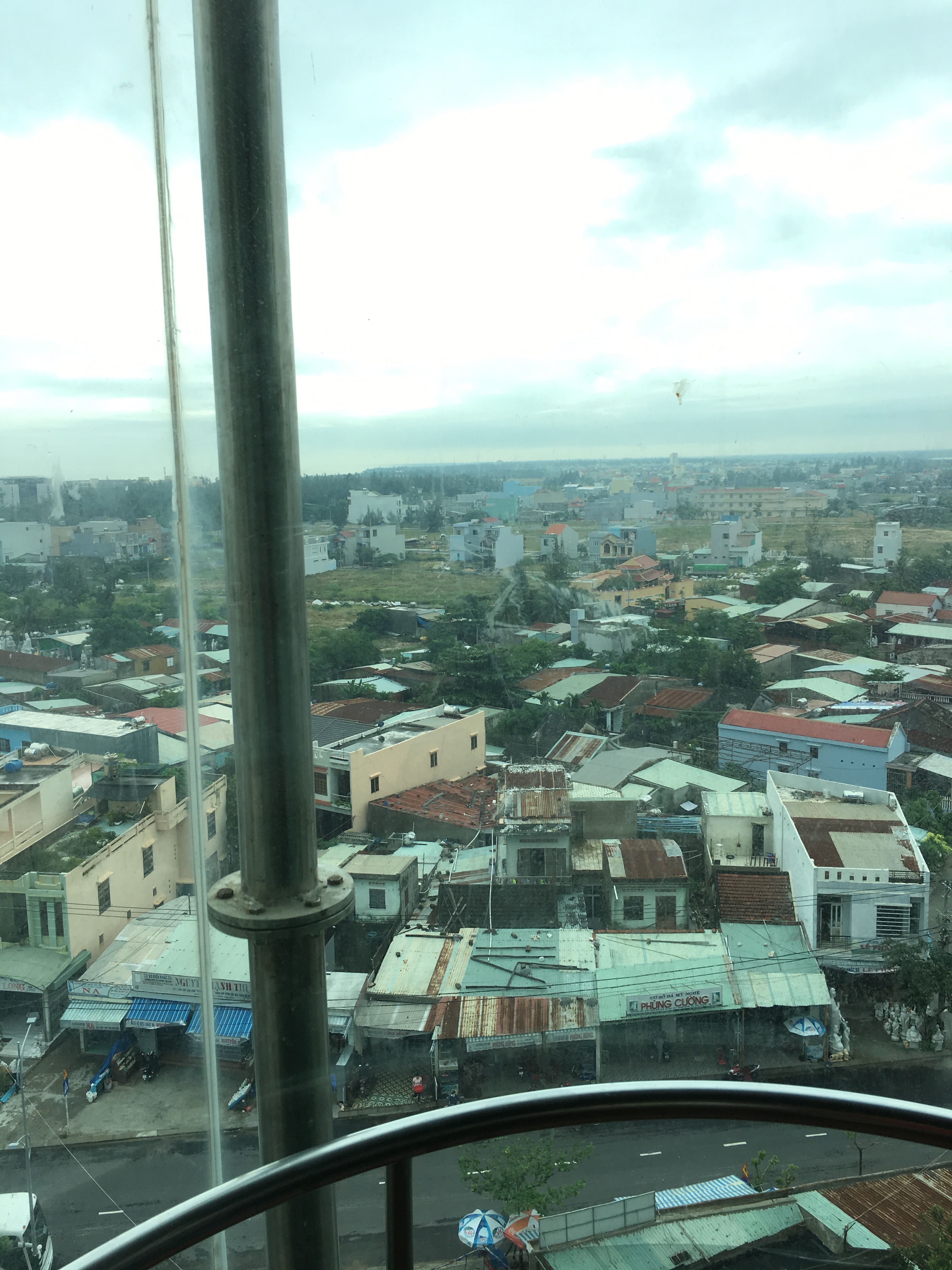
The views of the Danang area were great from the top.


There were several beautiful temples at the top. This was has 7 levels, which I think is reserved for someone who has reached the 7 levels of Buddhism. I believe only Buddha has reached this level.

I’m more into the War stories and there was another fascinating one here at the top of Marble Mountain. The guide had recently taken a group of US veterans jointly with veterans from Vietnam. One of the Vietnamese had hidden in this cave at the top of the mountain. It has been made into a small shrine. It;s hard to see but a picture here shows that the cave actually goes fairly deep.
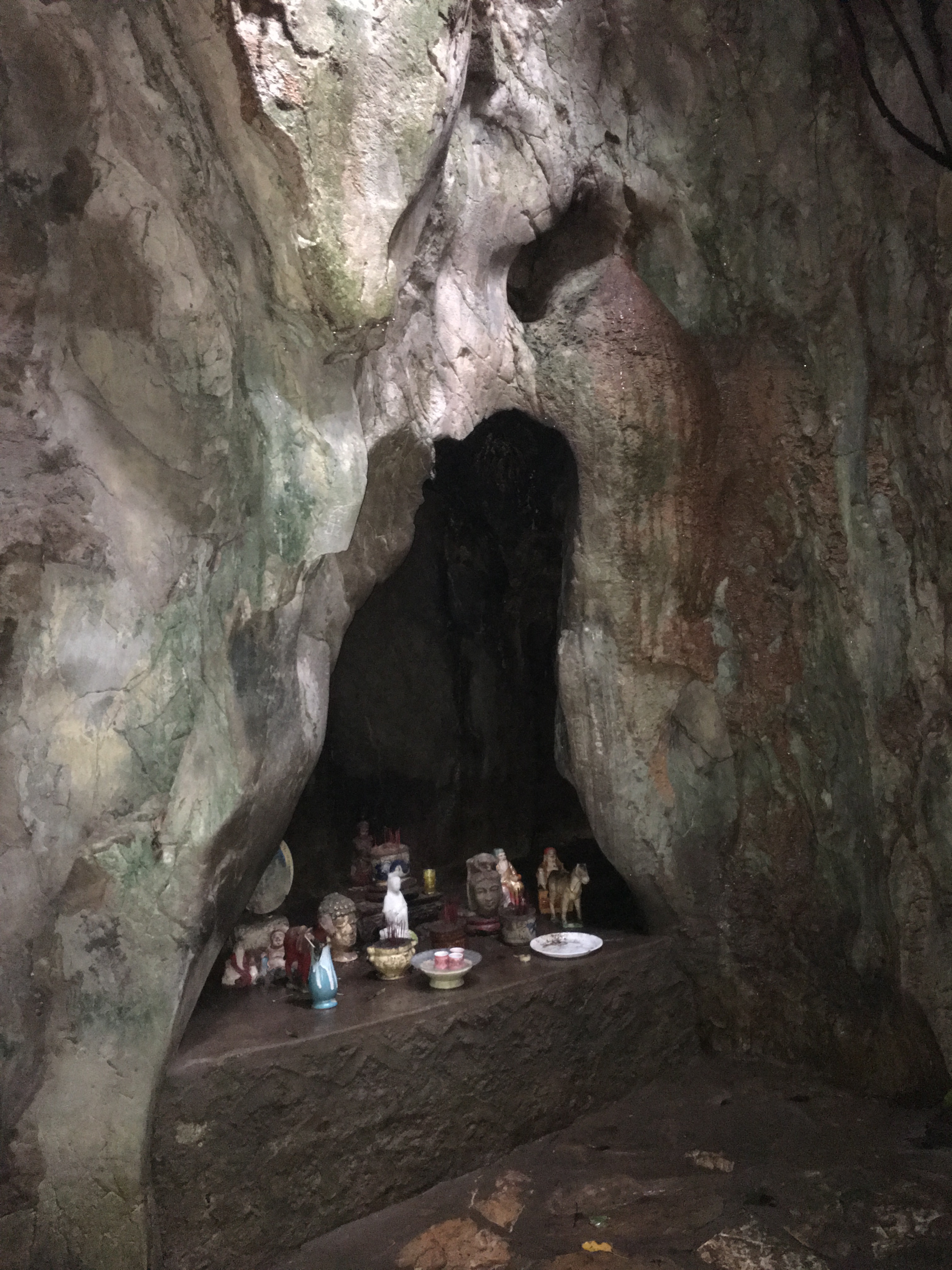


The man who hid here was captured by the US forces in 1968. He had been shot with an American AR 15 rifle and flame throwers destroyed half of his face. He had no food or water when he was captured. He was released in 1975 when the war ended.
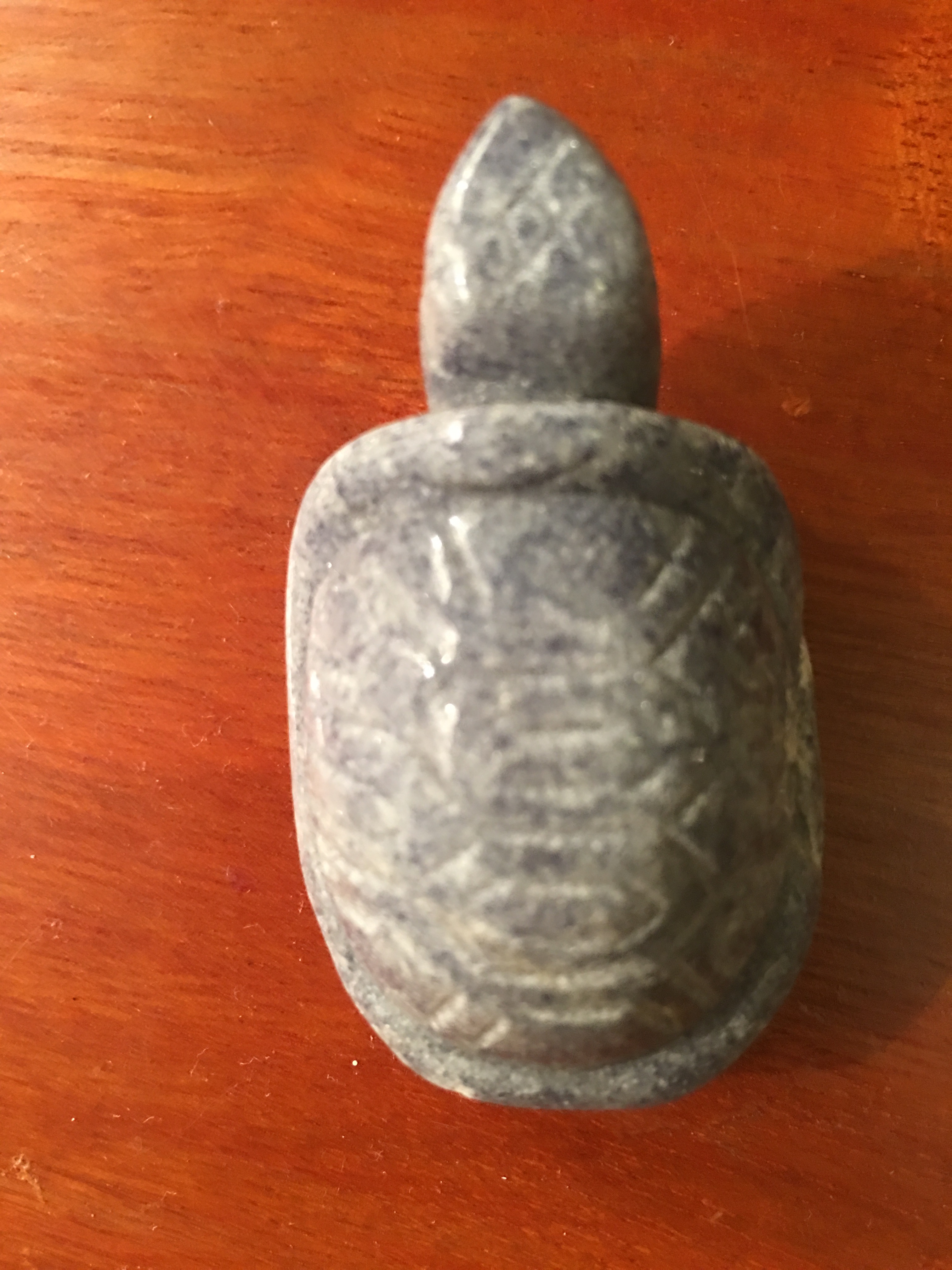
This mountain has a lot of marble, which explains the name. I bought this little marble turtle to weigh down my overcrowded suitcase.
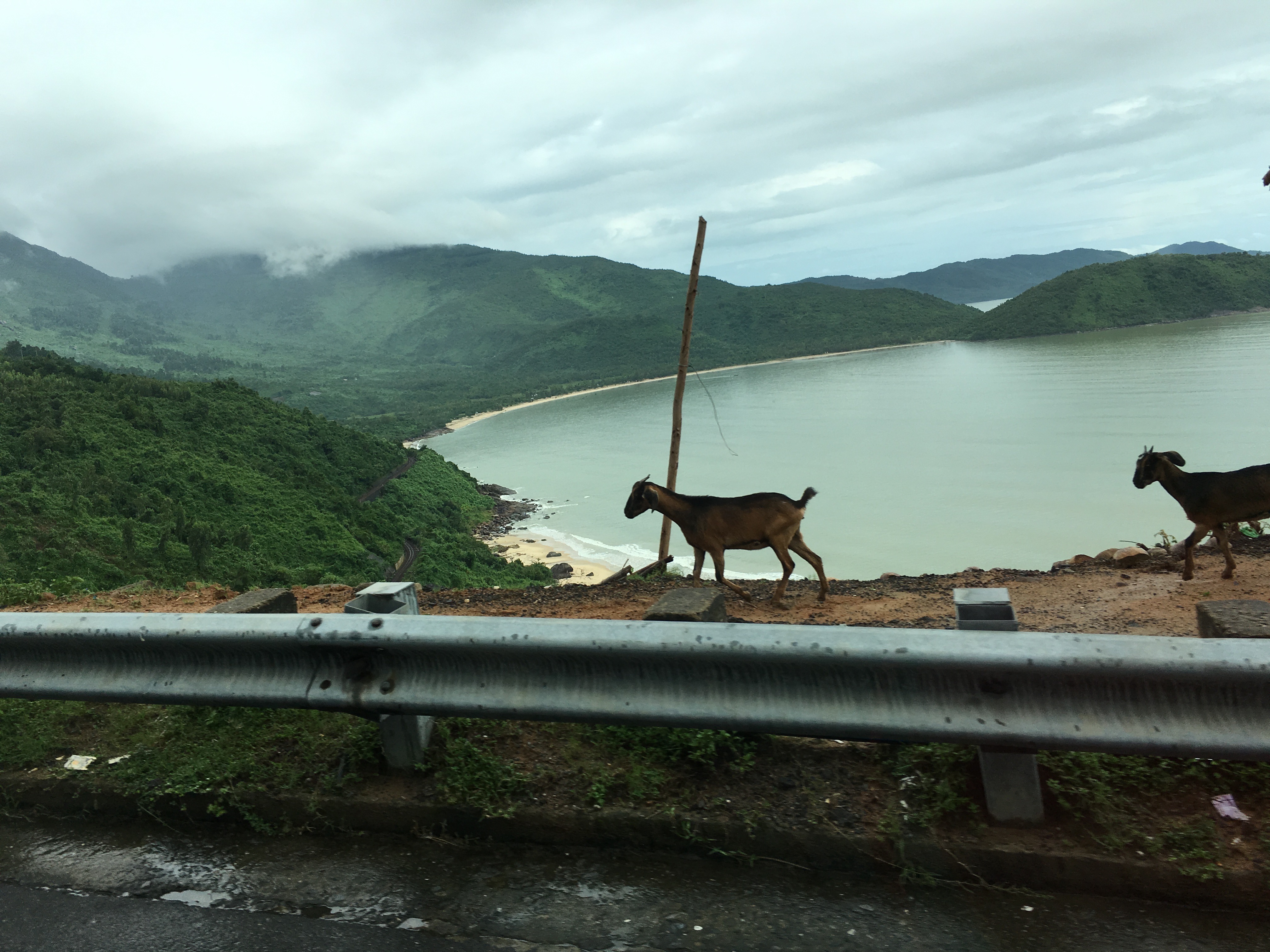
We stopped every so often to take pictures during the drive up the “Cloudy Pass”.

We stopped for Vietnamese drip coffee (served with sweetened condensed milk on the bottom). I had a pleasant conversation with a woman at the roadside stand. Pleasant until she started to beg me to buy one of her bracelets to help her feed her family. I was unable to fight and paid too much for a bracelet supposedly made of Water Buffalo horn.

We stopped at a bunker site at the top with amazing views.
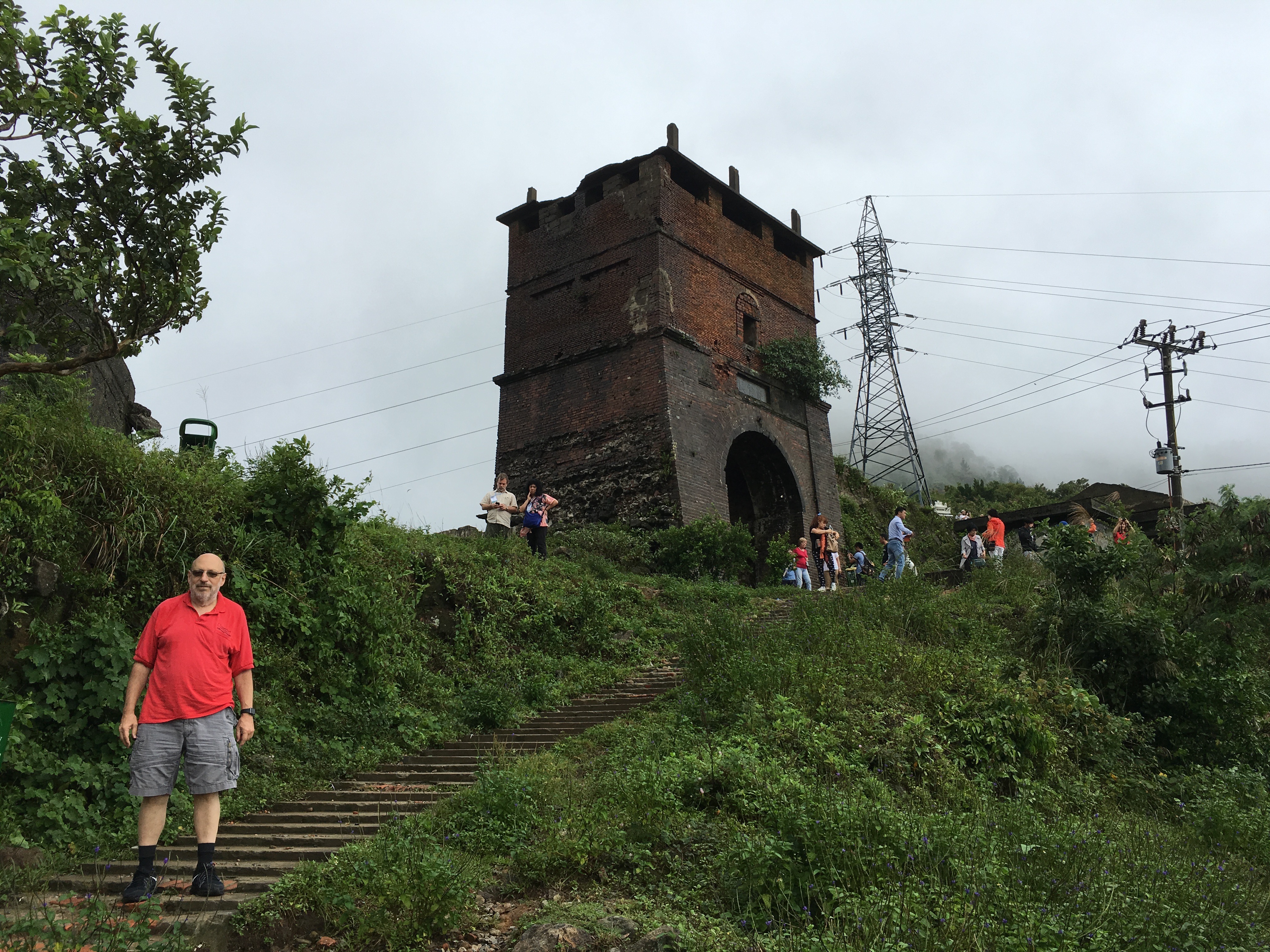
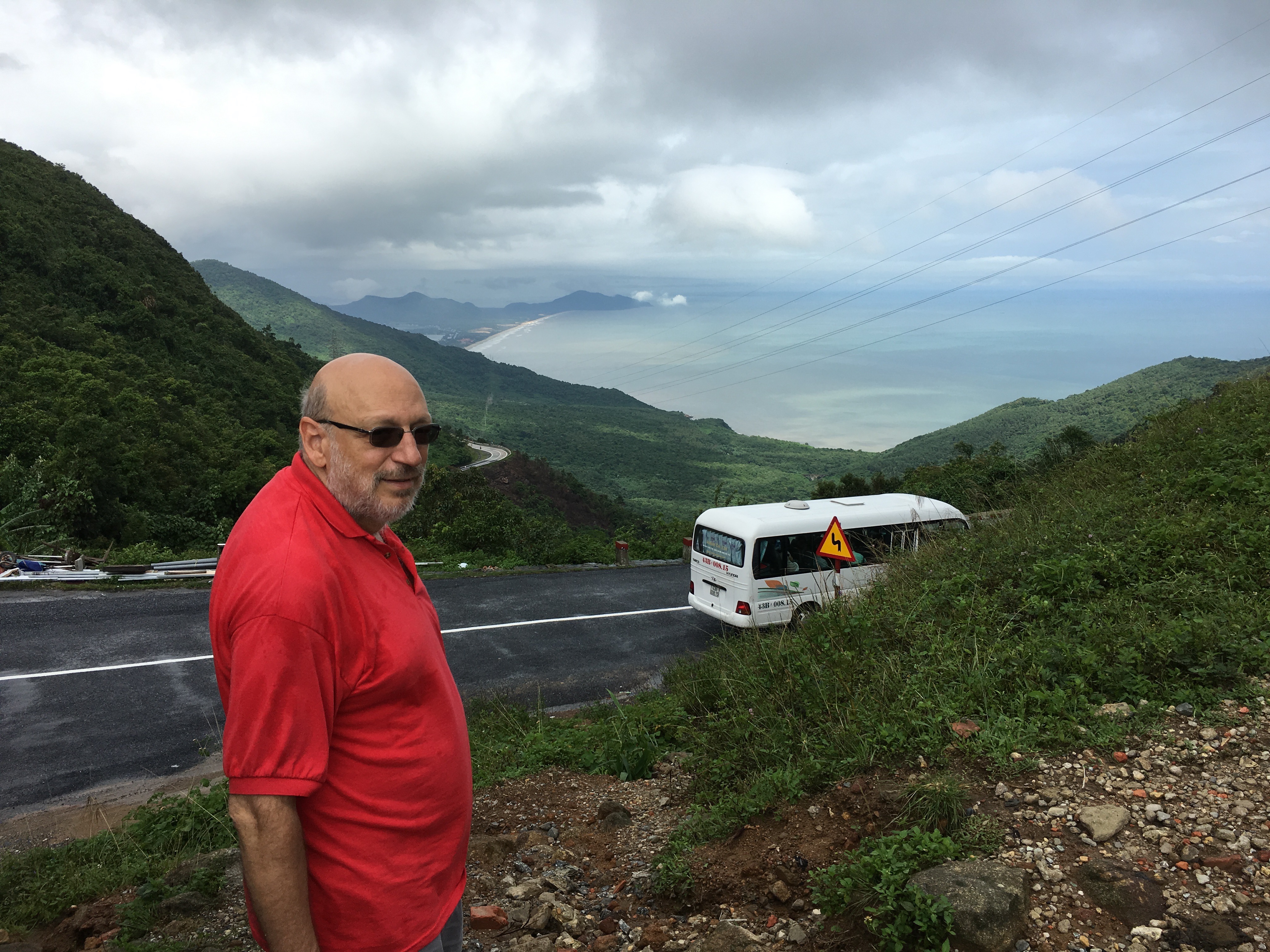
I needed to go to the bathroom but my guide discouraged me from going to the WC here since they would just try to sell me stuff and we would be delayed. We pulled off on a side road and he told me to go here but to be careful of the Water Buffalo droppings, which were everywhere. He also told me not to leave the road since there may be unexploded landmines around. Message received and fully obeyed!

I haven’t shown a picture of the large advertisizing posters for the upcoming party congress or something like that. These posters are everywhere.

I had lunch in Hue and ordered what were supposed to be specialties of Hue. One is Banh Nam, which is “Rice Flour, Shrimps, Pork, Steamed in Banana Leaves and Fish Sauce”.


The other Hue specialty was Bun Bo Hue, “Traditional Rice Noodle Soup, Pork, Beef, Crab, and Hue Noodles”. I’ve had many dishes in Vietnam that are similar to this — soup with noodles, meat, and vegetables. You eat it mostly with chopsticks but also with a spoon for the broth.

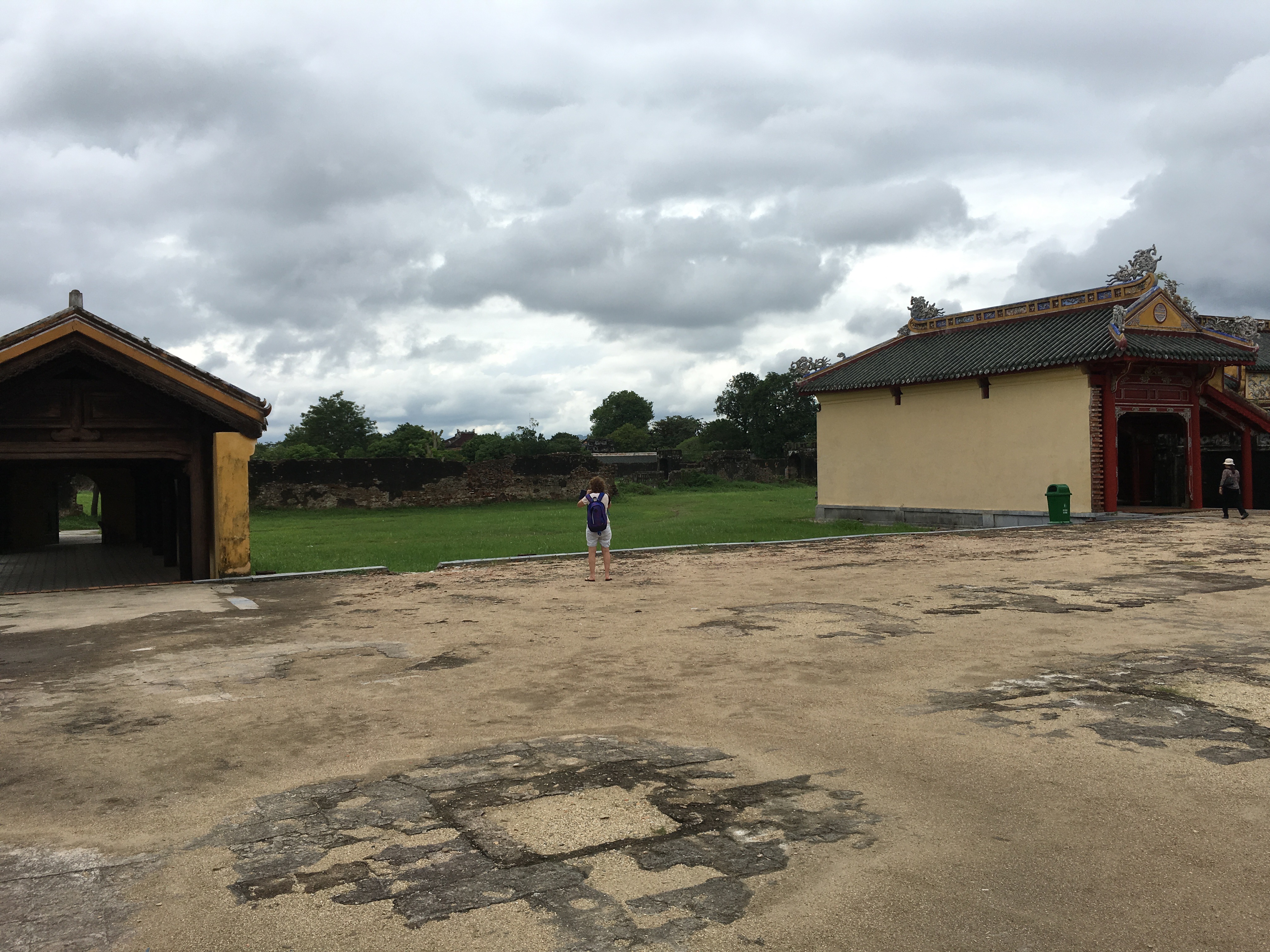
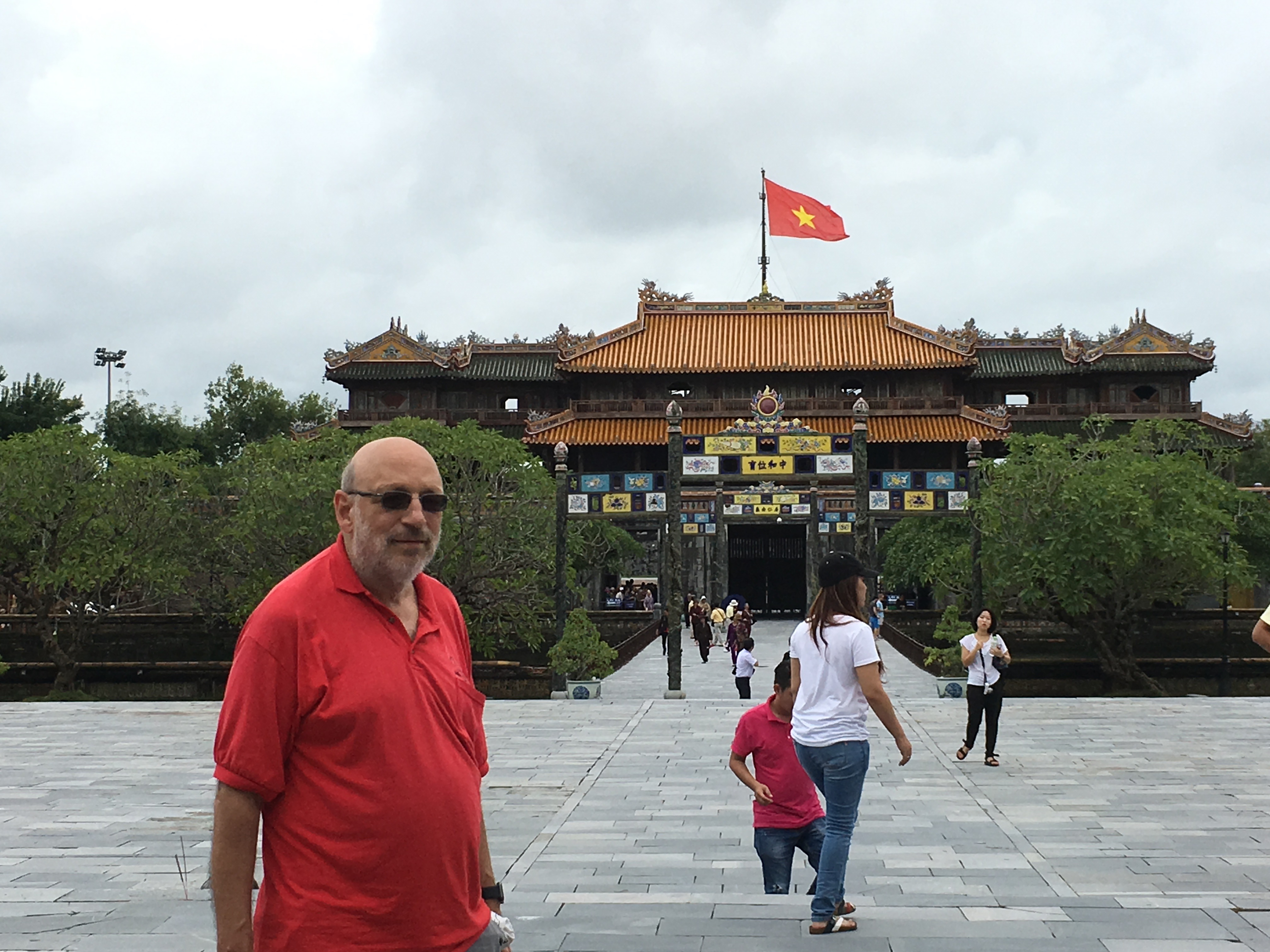
Our next stop was the featured attraction for the day (even though the story of the guide’s family was my highlight), which is the Hue Royal Palace, which reminds me of a smaller version of Beijing’s Forbidden City.
This was where the ruling Nguyen dynasty ruled from 1802 to 1945. In 1945, Ho Chi Minh got the King to abdicate.
I took this from Wikipedia (en.wikipedia.org/wiki/Huế). “During the Vietnam War, Huế’s central location very near the border between the North and South put it in a vulnerable position. In the Tết Offensive of 1968, during the Battle of Huế, the city suffered considerable damage not only to its physical features, but its reputation as well, due to a combination of the American military bombing of historic buildings held by the North Vietnamese, and the massacre at Huế committed by the communist forces. After the war’s conclusion, many of the historic features of Huế were neglected because they were seen by the victorious regime and some other Vietnamese as “relics from the feudal regime”; the Vietnamese Communist Party doctrine officially described the Nguyễn Dynasty as “feudal” and “reactionary.” There has since been a change of policy, however, and many historical areas of the city are currently being restored.”
There are bullet holes everywhere but the beauty comes through.



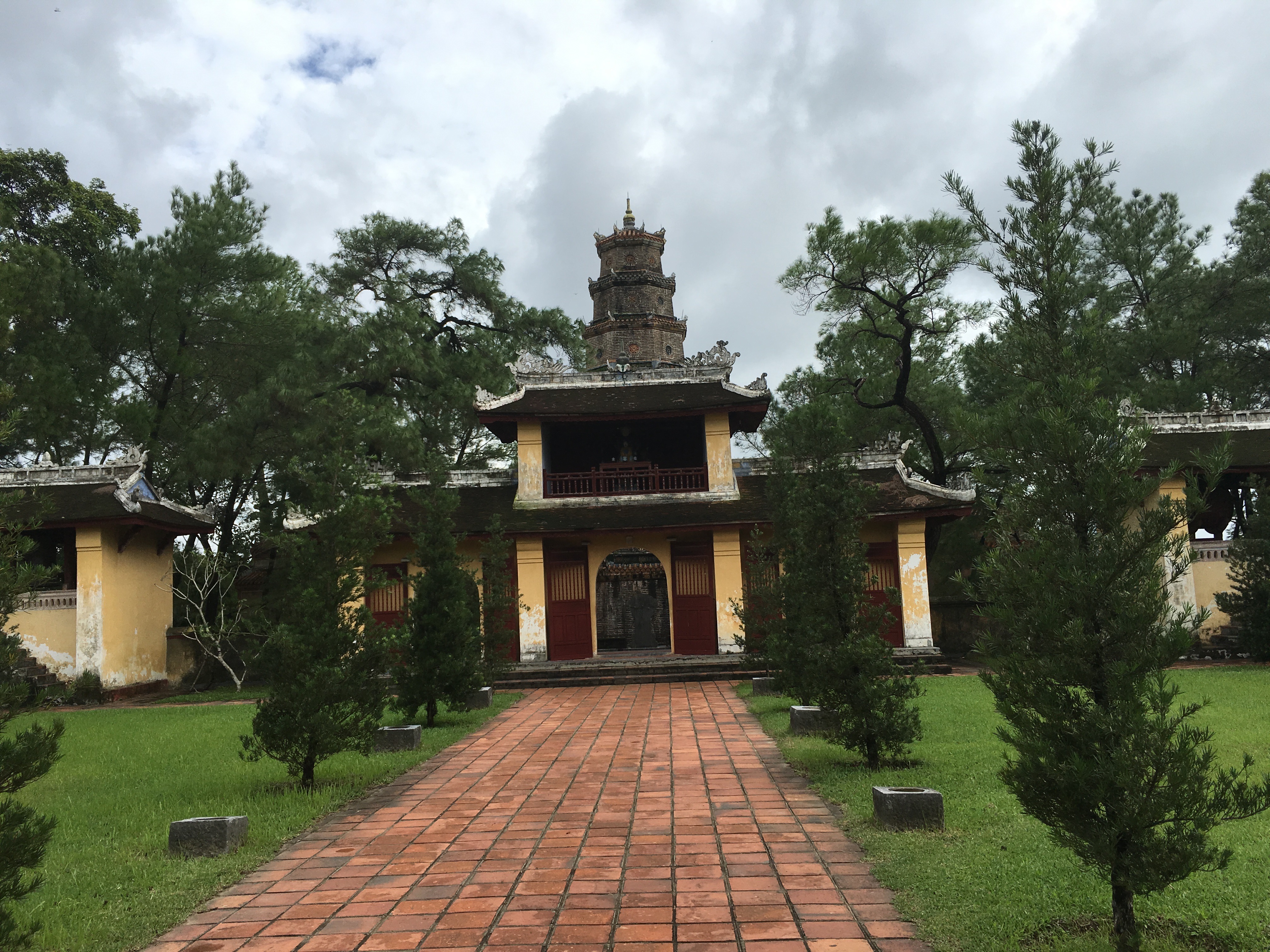
We went on to the Thien Mu Pagoda (“Heavenly Lady Pagoda”), which has only 6 levels so it’s for someone who was as enlightened as is possible, short of Buddha’s 7 levels. My enlightenment level could be represented by a tarp on the floor.

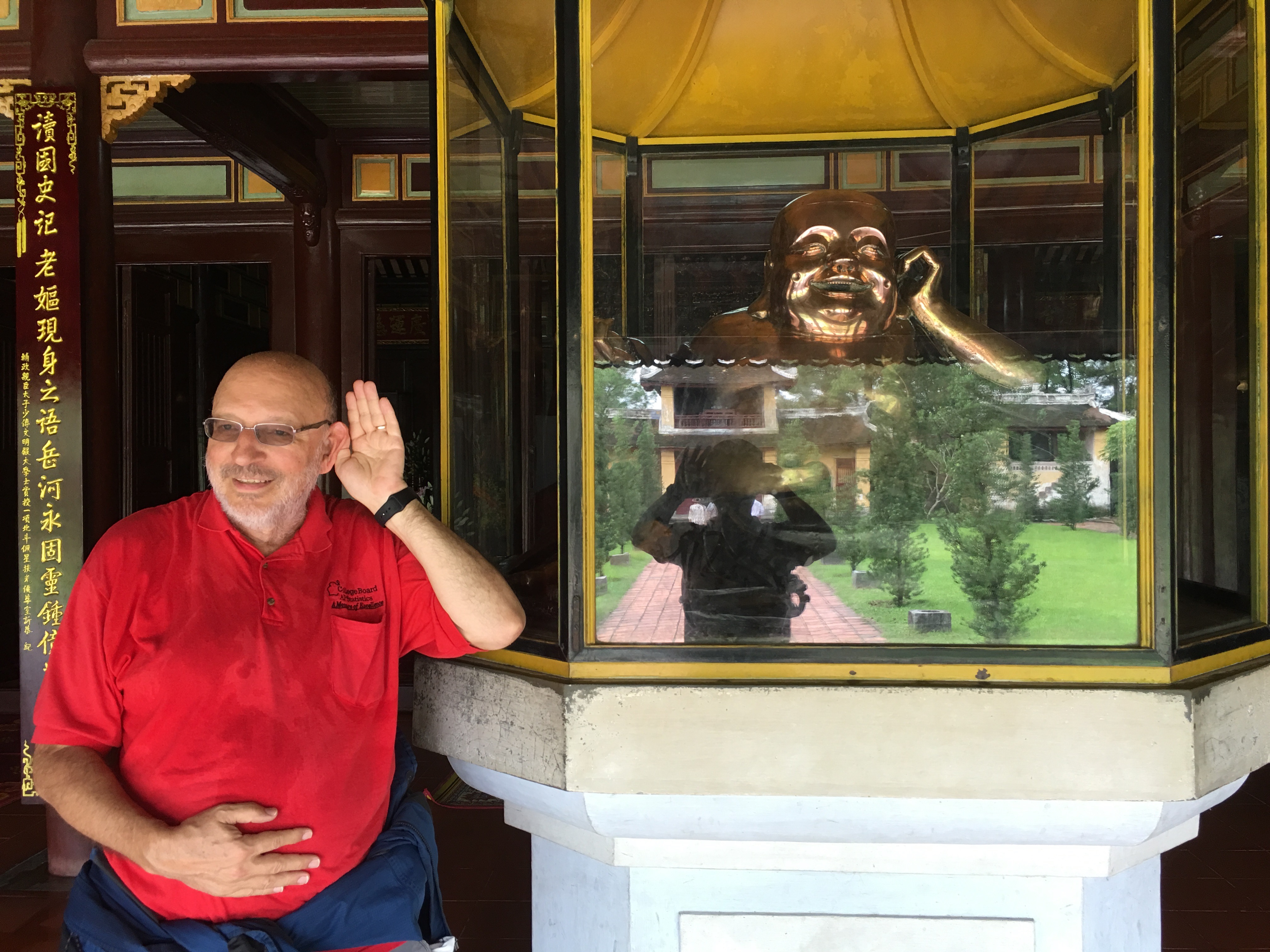
At times, I enjoy displaying the obnoxious tourist that I am. Notice how I’ve messed up my imitation of the Buddha.
The monk Thich Quang Duc from this temple is well known in the history of the Vietnam War. This is the actual car he took to his self-immolation in 1963 Saigon. The flames in the picture of a picture are of him burning. My guide said the American supported President of South Vietnam, Diem, treated Buddhists very badly. The guide said Diem decided that Catholicism should be supported to better integrate Vietnam with the West. Buddhists had a hard time getting government jobs and were treated bad in other ways. Given that over 80% of Vietnam is Buddhist, this may not have been a wise decision by Diem.


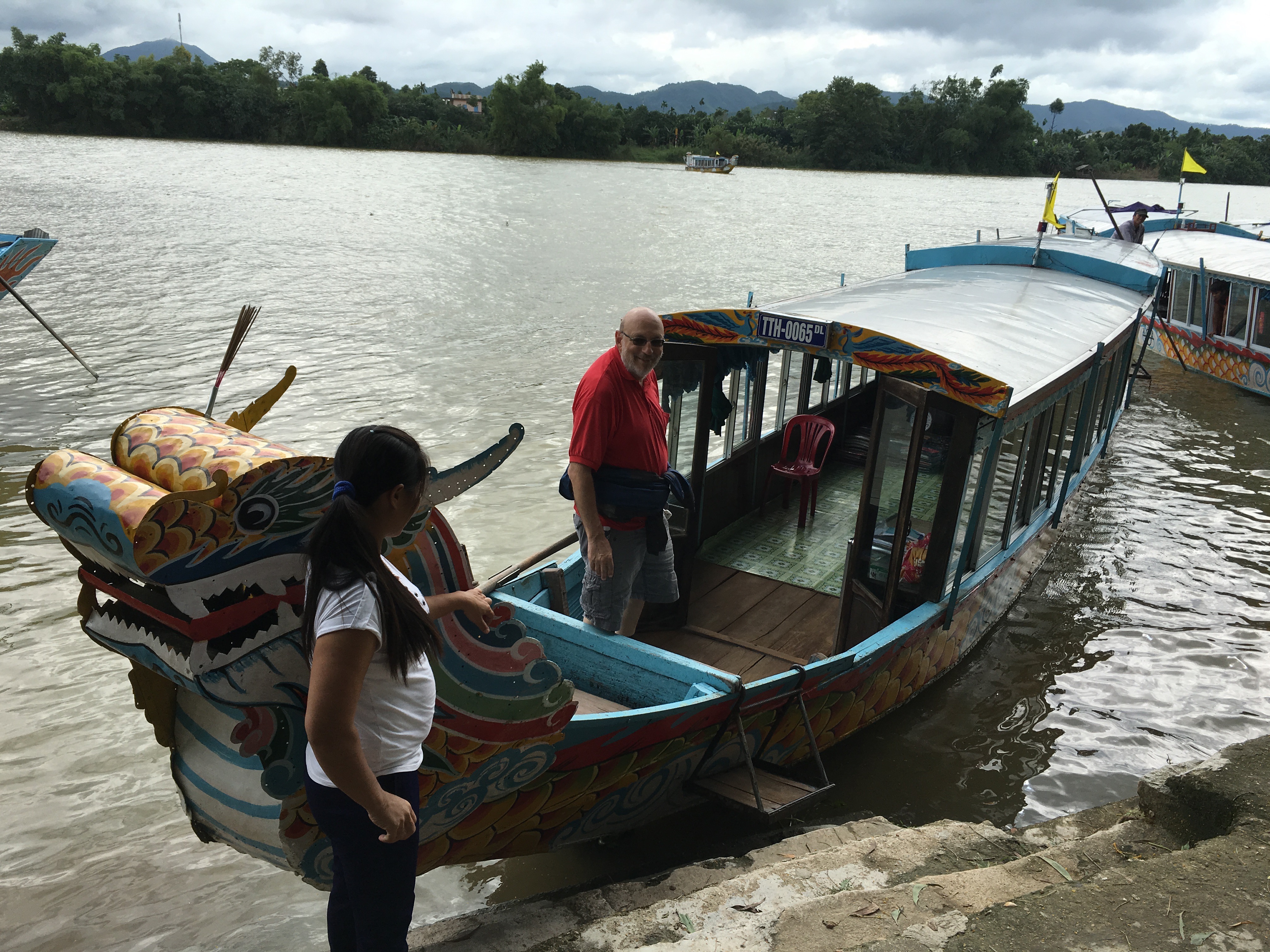
the last event for the day was a boat ride on the Perfume River here in Hue. The woman running the boat convinced me to buy a silk shirt. She accepted the amount I wanted because the boat was landing. However, I probably was offering way too much. I am still a terrible negotiator.

On a day that is supposed to be about the beautiful sites of the mountain, the Hue Citadel, and the temple, we were still dominated by the war. It’s impossible to get too far away from the war, even though it was essentially over 40 years ago. Tomorrow will be different in that it will be almost solely about the war.
 feldmanlarry
Leave a comment