In 2007 the largest poll ever conducted, with over 100 million votes, came up the New 7 Wonders of the World. It was an unscientific poll and people could vote as many times as they wanted. There were 20 finalists plus the Pyramids of Egypt, which were removed from the polling and given an honorary status as the only remaining one of the original 7 wonders of the ancient world. I’ve been to two of these new 7 wonders before — Chichen Itza (3 times), the Coliseum in Rome (a long time ago), and the Taj Mahal (when I was 5, there’s a whole story to that, which I will tell another time). I’m planning to go to the Taj Mahal again and the Great Wall of China on my upcoming trip. I’ve also been to 5 of the 13 that didn’t make it to the final 7 — Stonehendge (over xmas of 2010), the Acropolis (on this trip), Hagia Sophia (on this trip), the Eiffel Tower (in 2002 and other times), and the Statue of Liberty (a few times). See http://en.wikipedia.org/wiki/New_Seven_Wonders_of_the_World for info about the contest. I’m not sure I would have made the effort to go to Petra if it hadn’t won one of the spots.
The 7 are:
Chichen Itza, Mexico
Christ the Redeemer, Brazil
Colosseum, Italy
Great Wall of China, China
Machu Picchu, Peru
Petra, Jordan
Taj Mahal, India

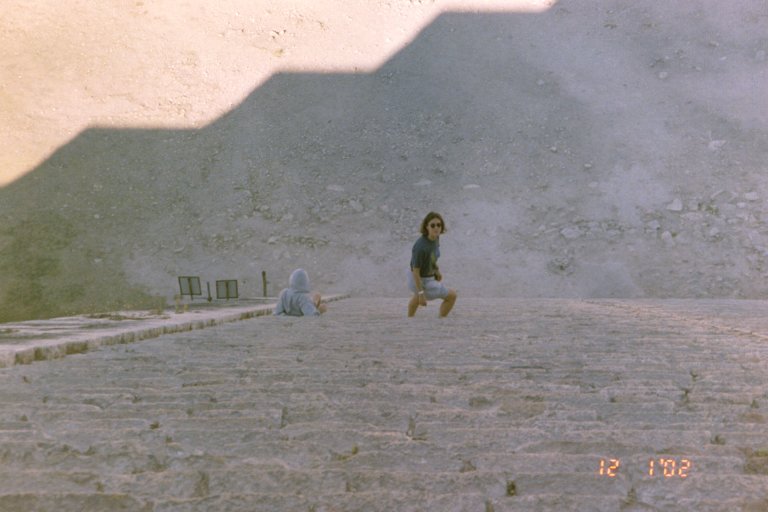
Margaret and Keith on their way down the Pyramid at Chichen Itza in 2002, one of the wonders of the world (their climbing is not one of the wonders, the pyramid is the wonder. If I had climbed it that would be a wonder)
The overwhelming lesson of these wonders and of many of the other sites I’ve been to on this trip is the genius of the ancients. There’s a feeling in many people that what is modern is best. We know how to build better than they did in the past, we have the best technology, the best food, the best of everything. If it’s old it’s out of date and worthless except maybe to people who like to go to museums. Certainly there is some truth to that point of view. We do have the most advanced technology, whether it’s made life better is another question. I’d rather travel by airplane in a day than by a sailing ship over several months (if it gets there at all). Yet clearly the people who built these 20 finalists and the hundreds of other amazing places in ancient times did it without electricity or any other modern technology. I disagree with those who say creatures from outer space built those monuments. I think it’s a sign that we cannot imagine the extent of their genius, but who knows.
In any case, I’m in awe of the ancients and Petra was astonishing. When I see pictures of it, it’s just not like what it was like to be there.
The title of this day was “I wonder how you describe …” and I’ve been writing for too long, so here goes.
I got the first daylight view from my balcony. It was definitely low season and with the problems in neighboring Egypt the hotel was quiet. They gave me one of the best rooms with a great view in a massive balcony shared with 2 other rooms that seemed to be unoccupied.
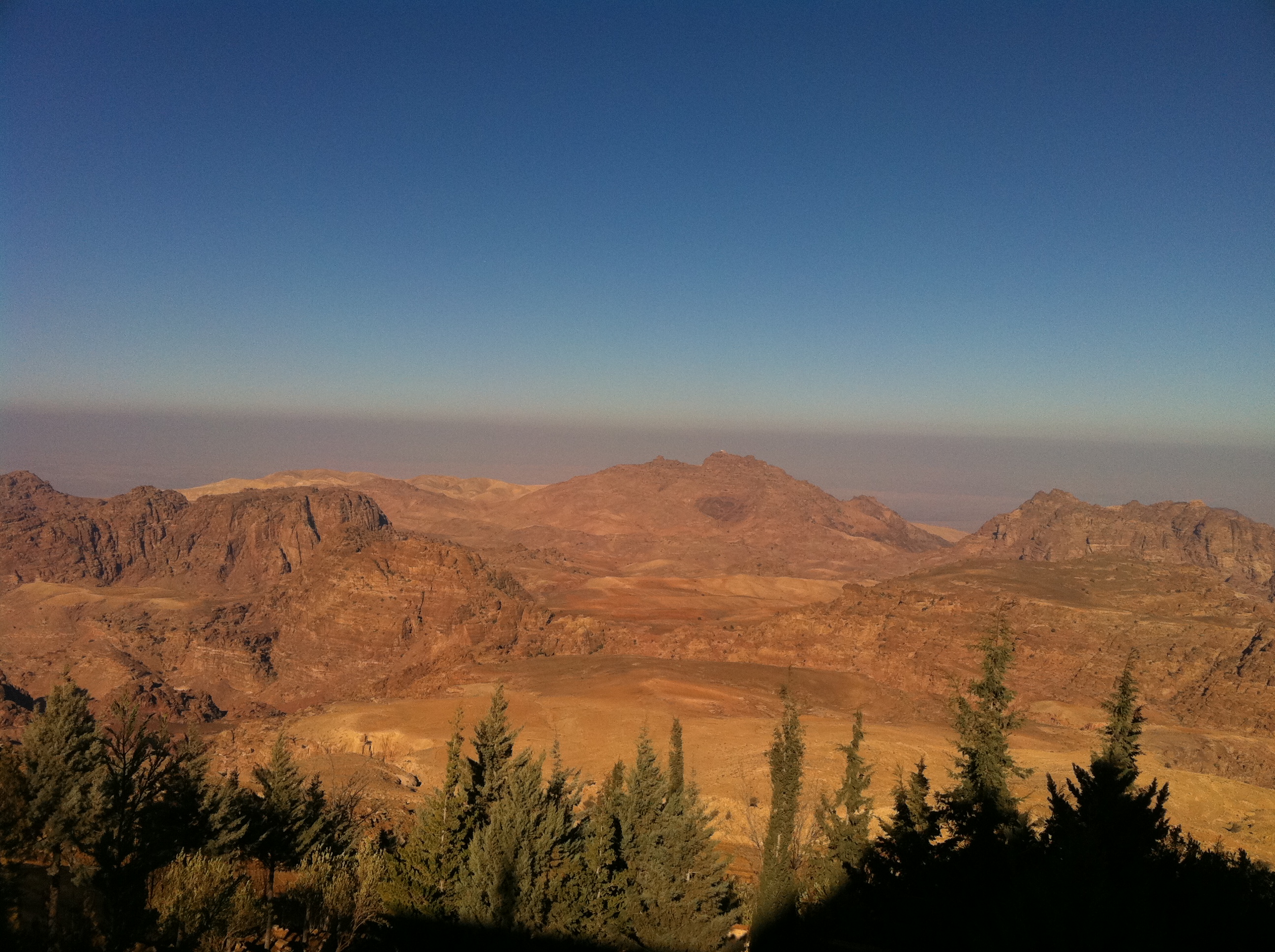
View from my balcony in Petra
View of my balcony. The view the other way was better.
The driver left Khalid and me off at the entrance to Petra. Khalid told me a bit of the history as we began the four mile walk through the site. It would take a while to get to the most famous monument called the Treasury. Petra was built from the 1st century BCE to the 1st Century CE by the Nabateans. Most of the monuments were tombs but some were temples and theaters. 80% is still not excavated, which is an amazing thought since there is so much there. The name of their god was Dushara, who looked like the mountains themselves and appears in many places.

One of the many monuments to the god Dushara
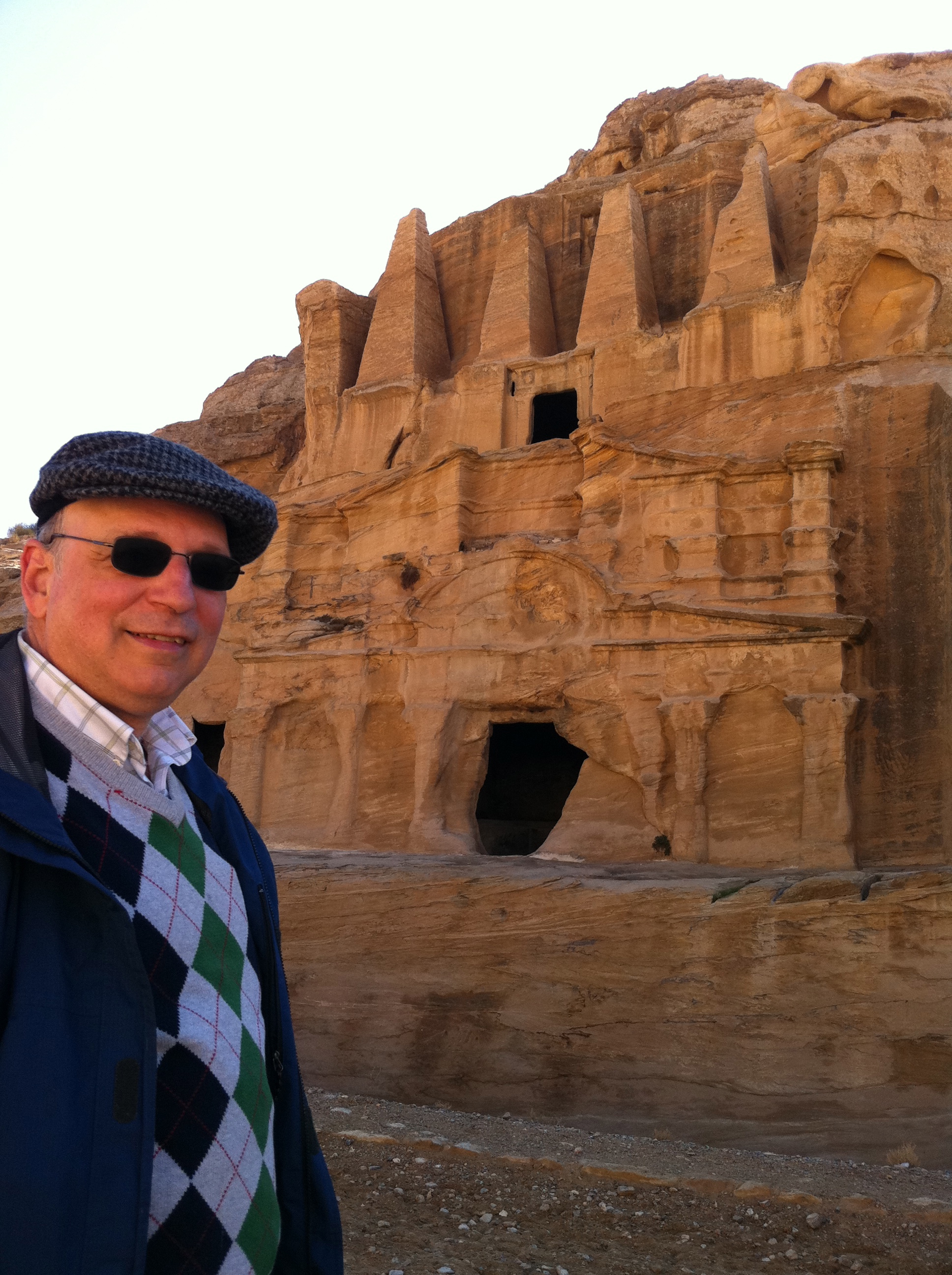
One of the amazing structures carved from the stone in Petra
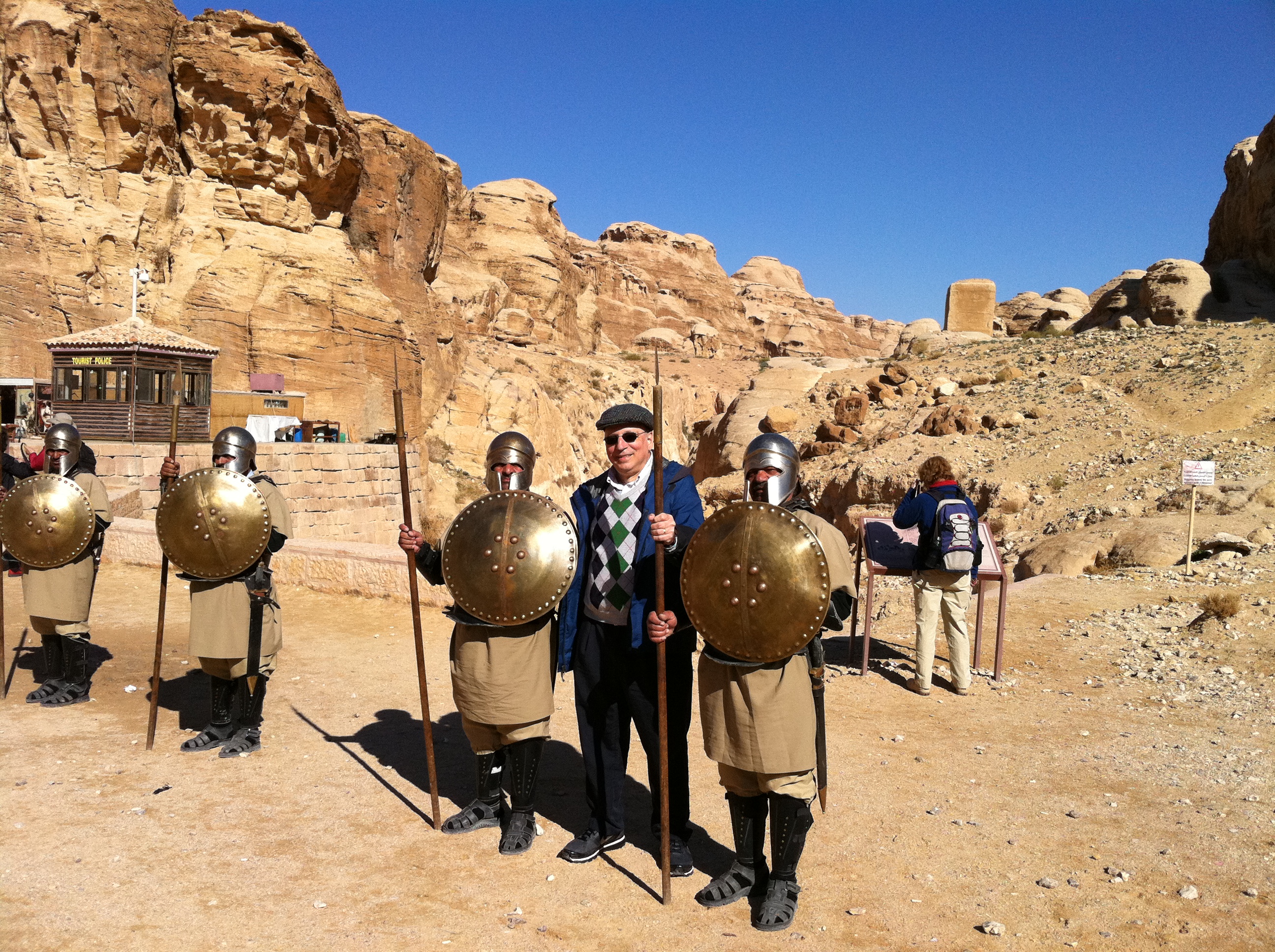
Time travelers from the past
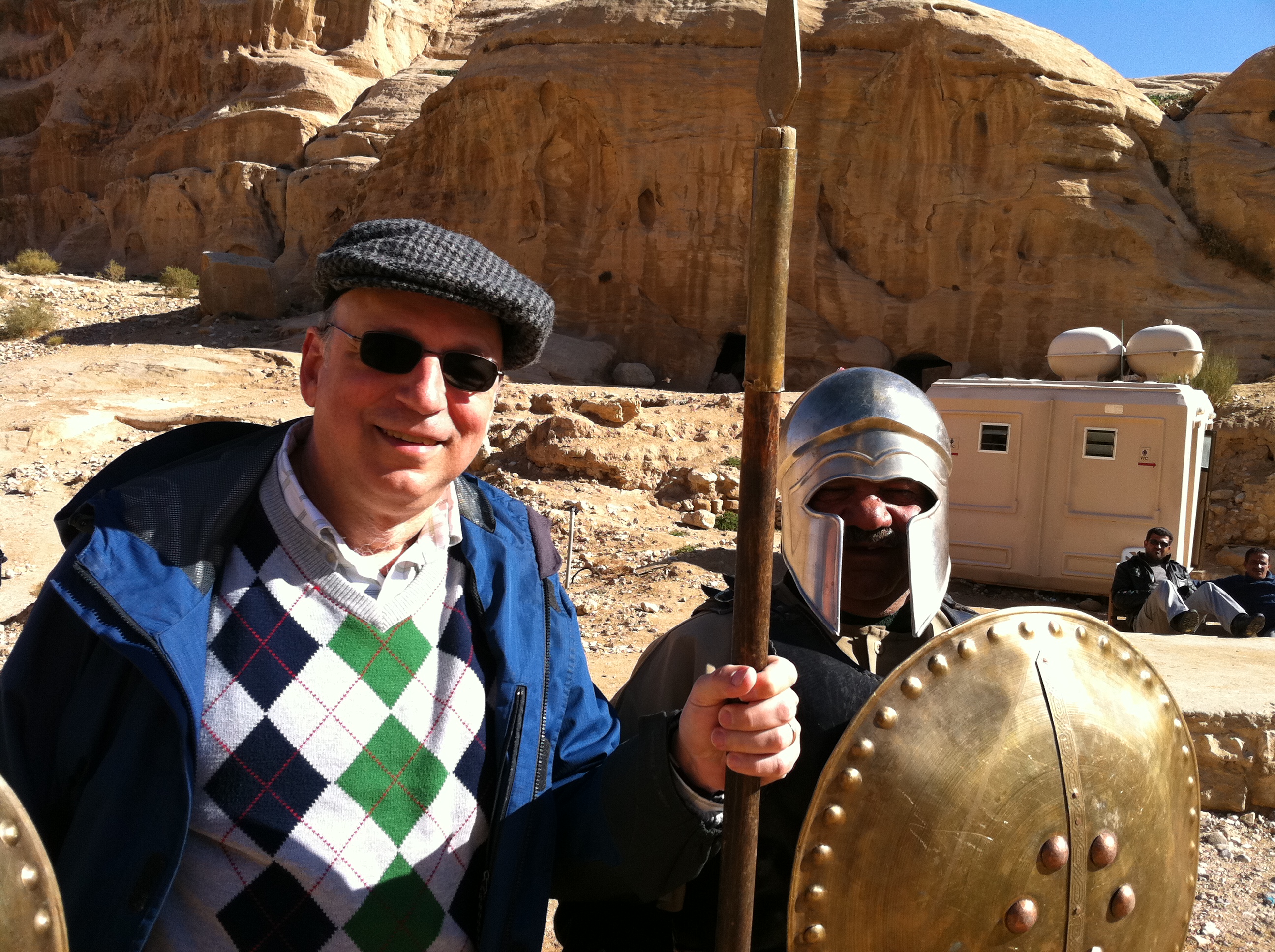
Trying to steal the spear. I never did find out what era they were dressed in.
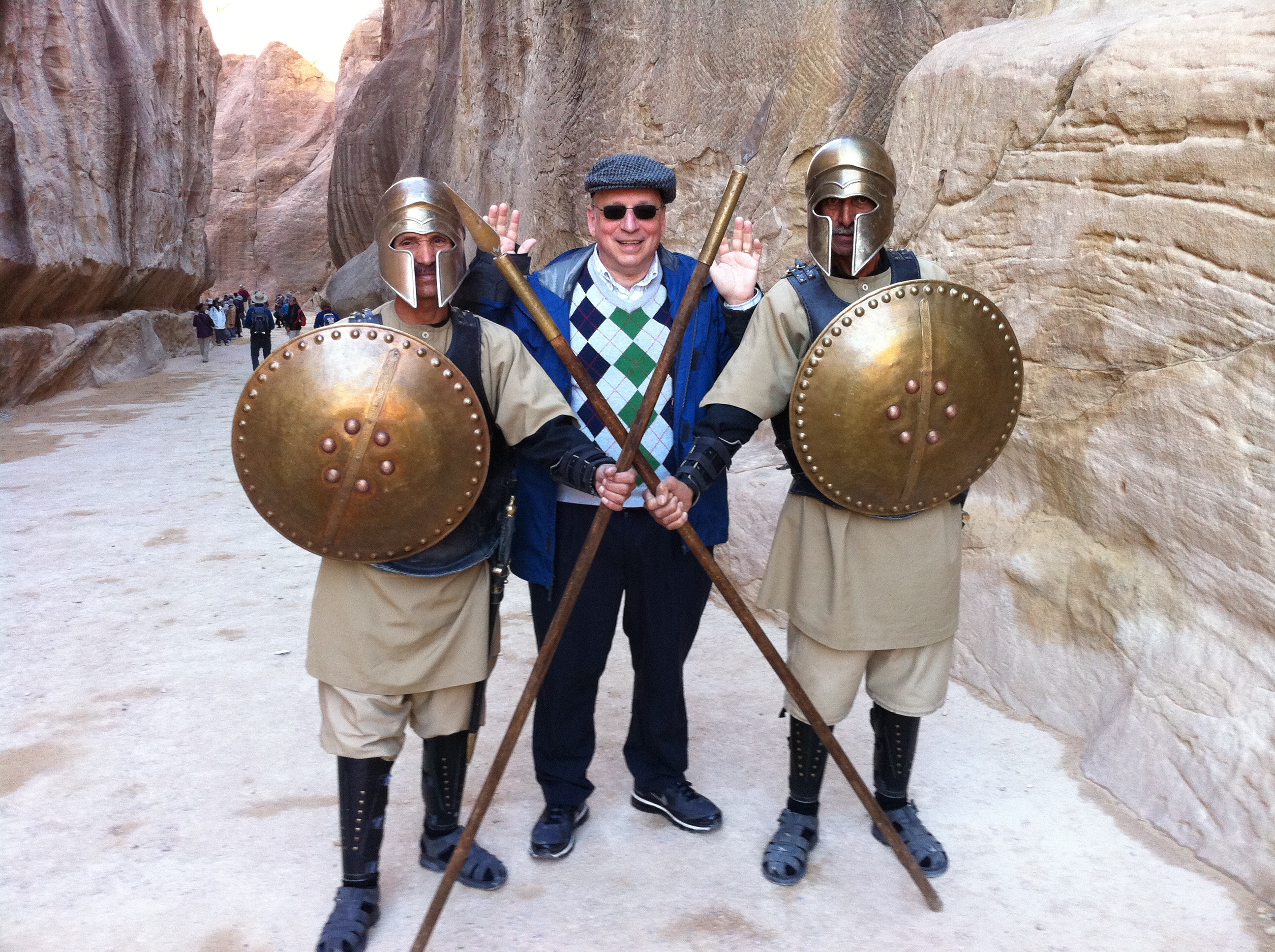
Why they tolerate idiots like me I’m not sure. I think it has something to do with money.
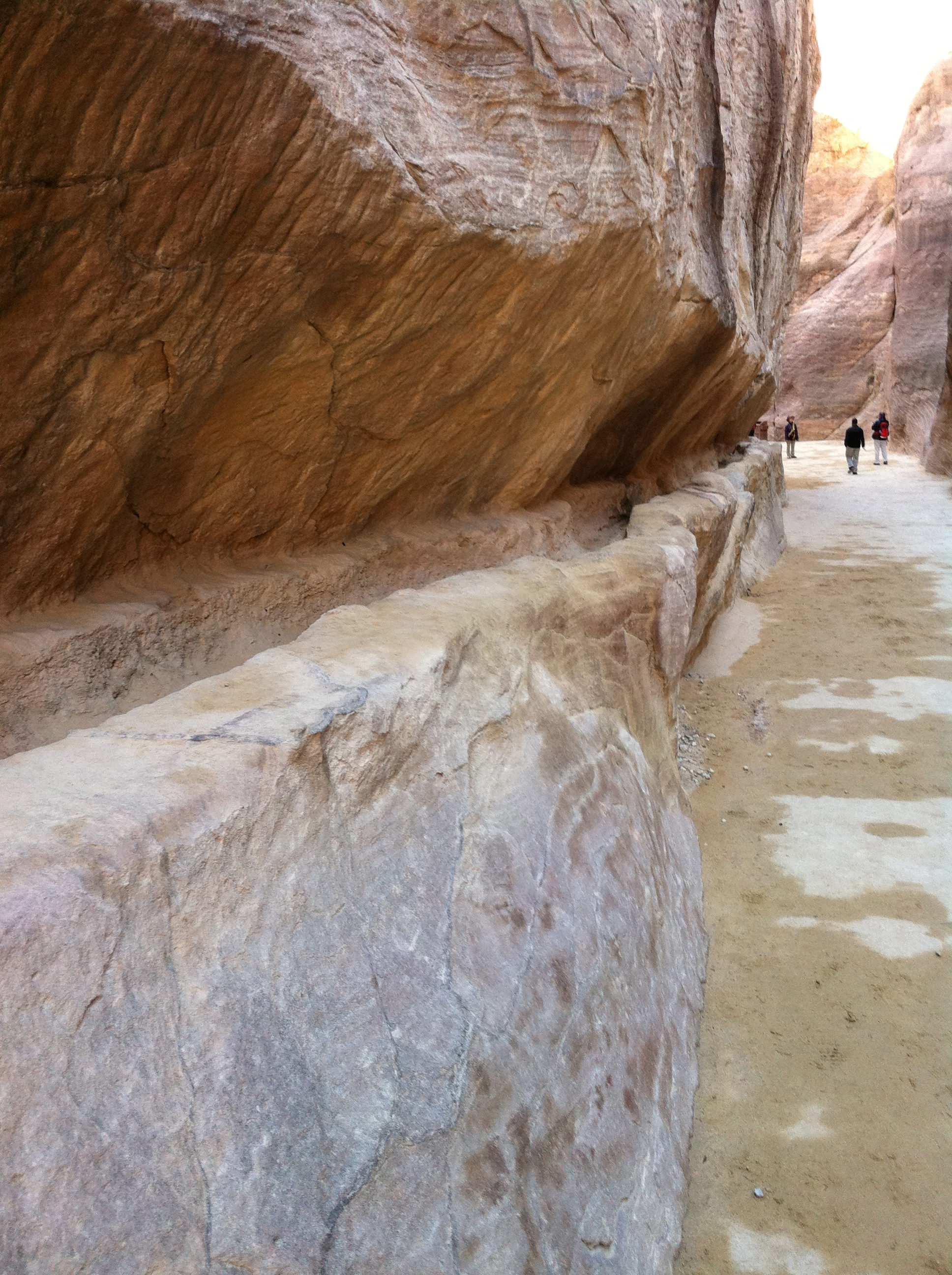

Ancient water viaduct (left), one of many beautiful rock formations (right)


Real police, not like the last set of pictures, I didn’t try to take their weapons (left); once again – wow (right)
I was impressed by how well organized the site is. It’s patrolled well by the police. There are few unauthorized vendors. A couple of times I saw someone just sitting on a stool and Khalid said their job is to clean up after the horses. The whole place is very clean.
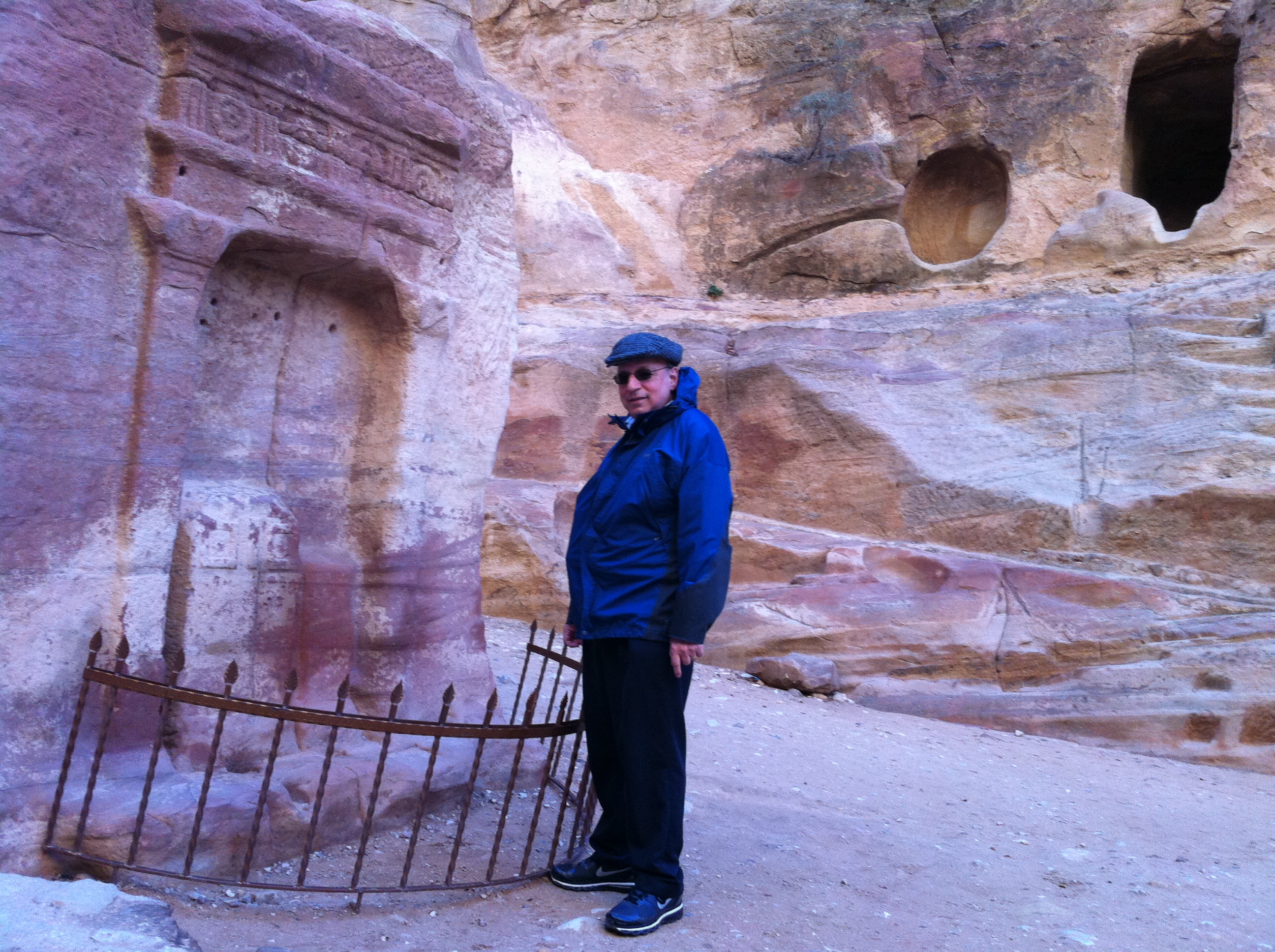
One of the few monuments with protection

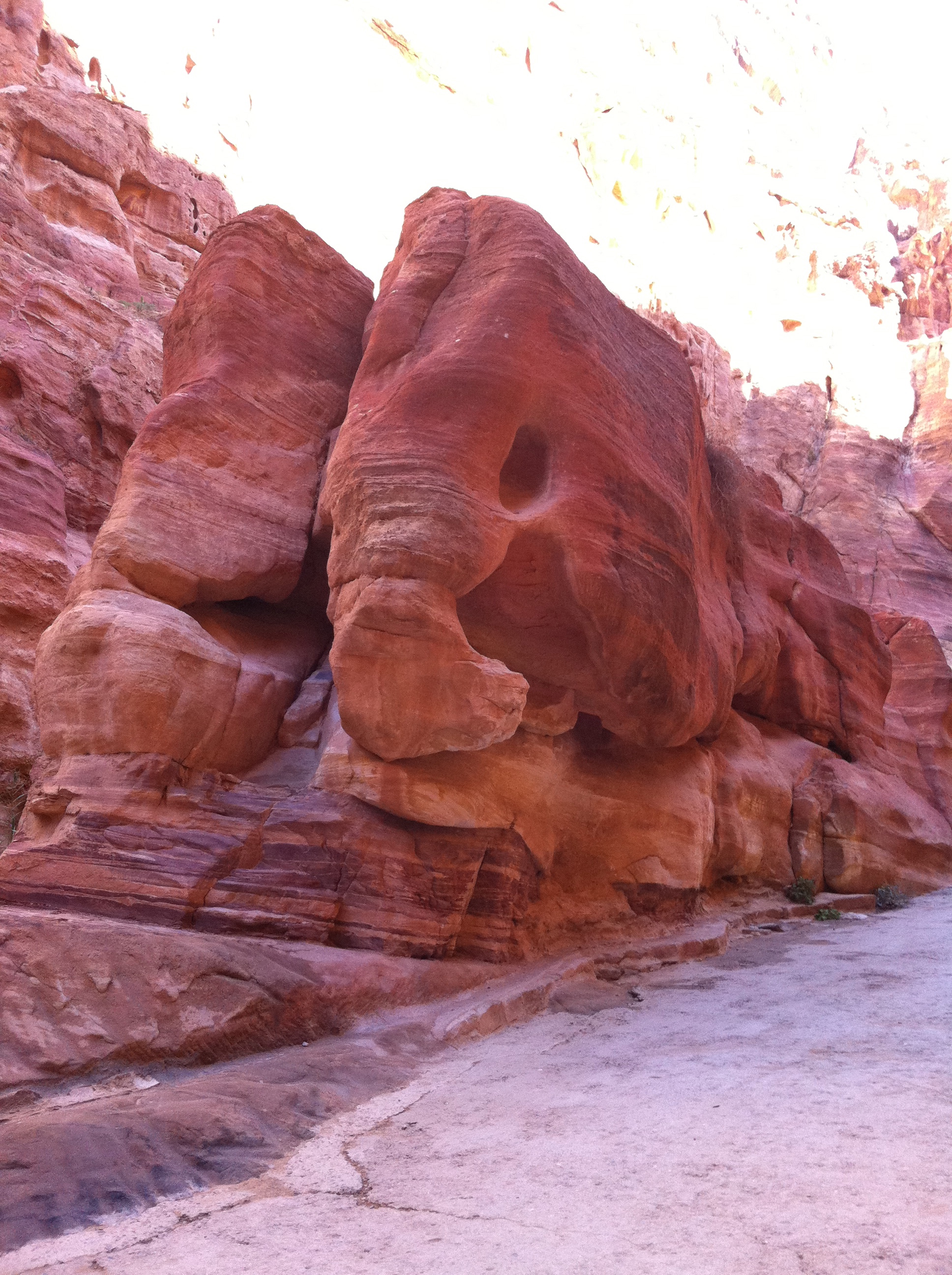
Rock formation that looks like a fish (left), same formation looks like an elephant from a different angle (right)
 Ancient Greek writing
In the following picture, Khalid explained that a priest would stand where he is. Two merchants about to enter a contract would each stand in one of the chambers. The priest would hold their hands as he is doing in the picture and seal the contract. All three of them were facing a stone figure of the god Dushara.
 Khalid demonstrating how the ancient priests sealed contracts
After another curve in the trail, the Treasury sprang into view. They used this for the “Temple of Doom” in the Indiana Jones movie. This is by far the most famous part of Petra.


My first views of the Treasury, used as the Temple of Doom in Indiana Jones
How long would it take to carve this out of a giant piece of rock? How would you feel if you carved too much and they had to start over again at a new location? How did they find the artists, architects, engineers, builders, and driving forces to see it finished over the many years it took? Why couldn’t we build something like this today?
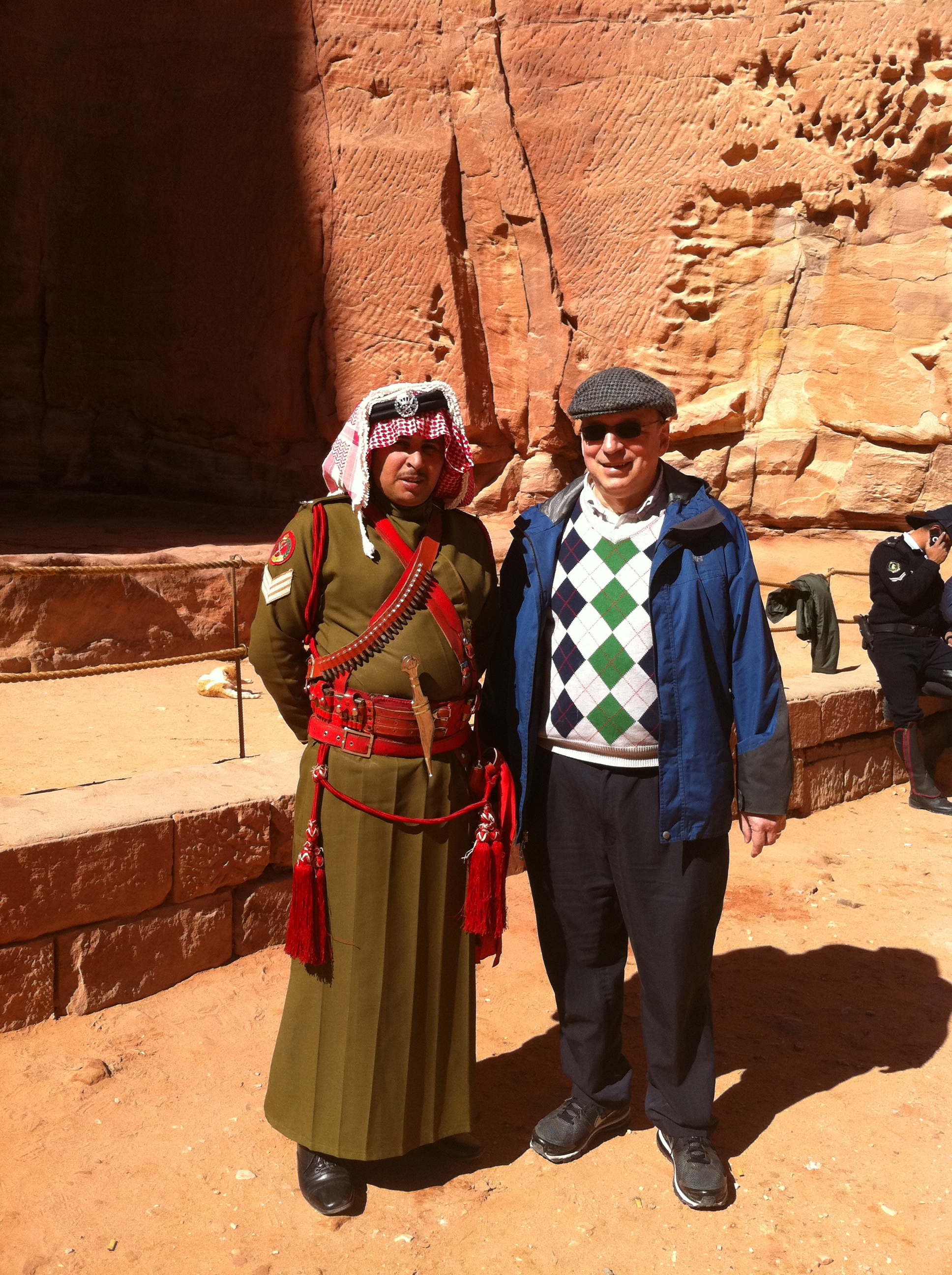
Not sure if he was actually a guard or just a ceremonial one. He was insistent that I either sell him my iPhone or we at least try to find him a good price on one.
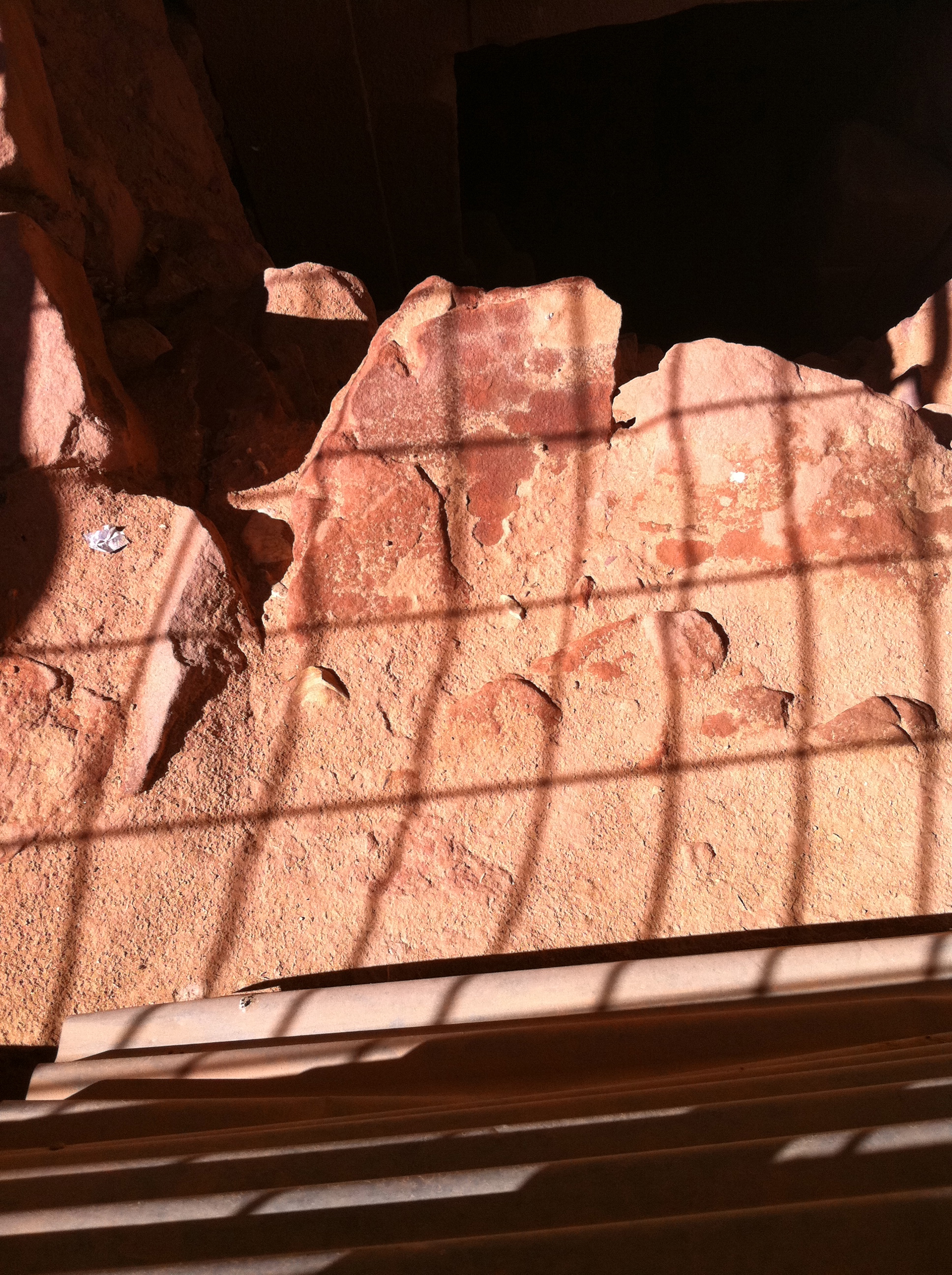
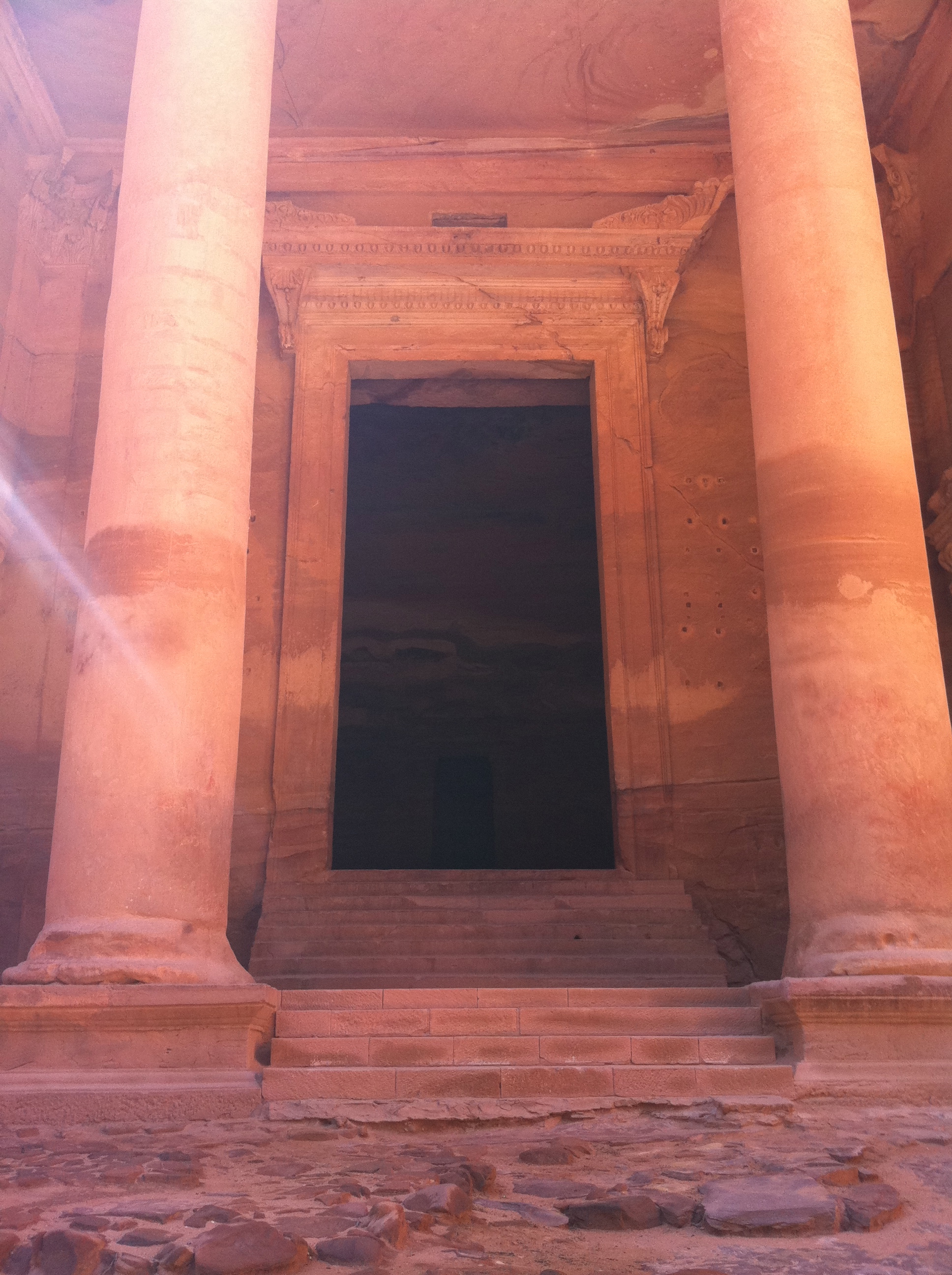
Looking inside the Treasury
The Treasury is not really a Treasury but a memorial tomb and a temple for a King, going back to the end of the first century BCE. People thought it must be filled with treasures because of its beauty.
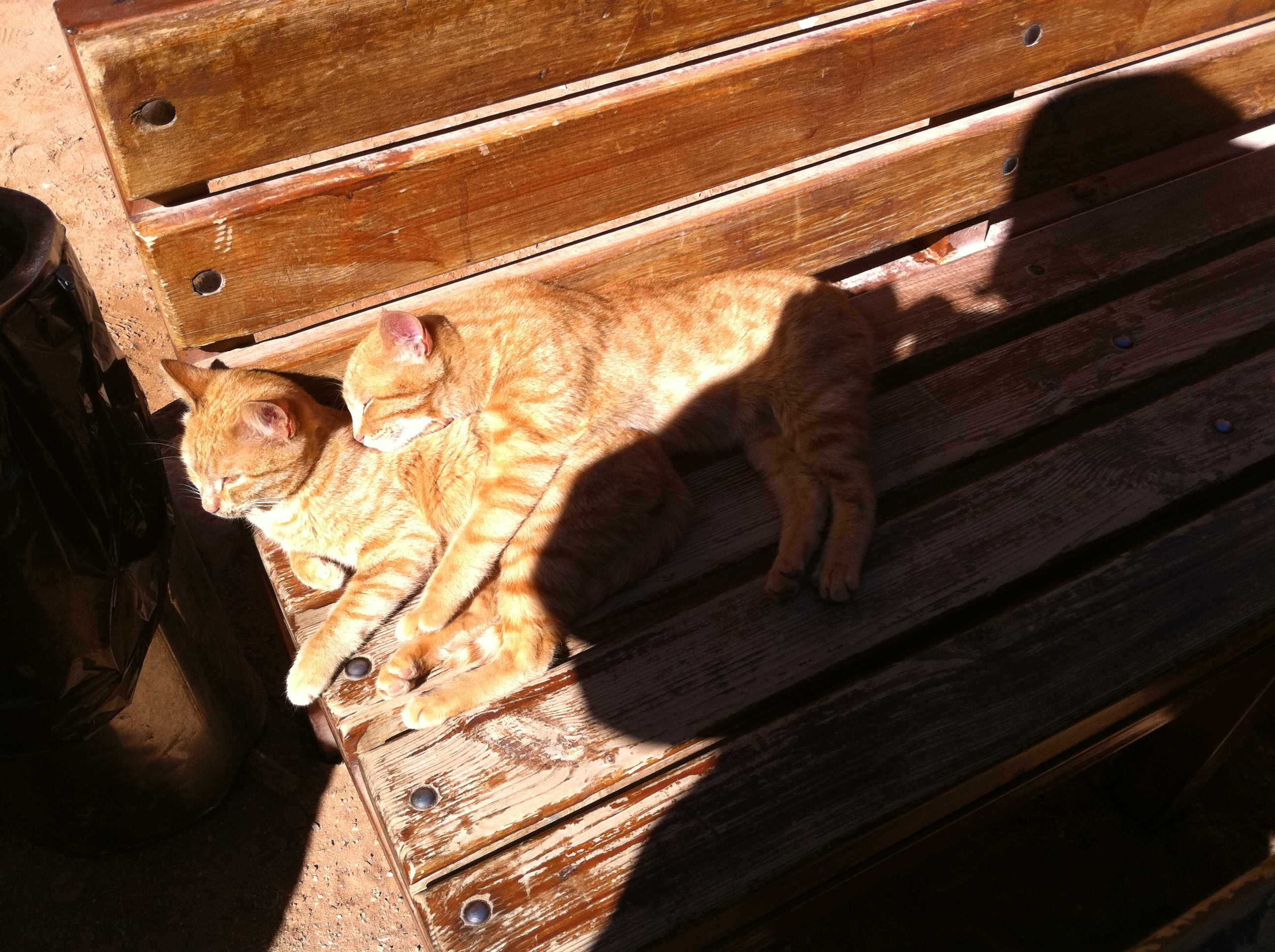
Two cats not impressed by the Treasury that is just a few feet away
I saw the camels right in front of the Treasury and had two conflicting thoughts. One is it doesn’t get much better than riding a camel in front of one of the wonders of the world. The other thought was that if I fell on my bad shoulder it would probably be the end of my trip. You can see what my choice was.
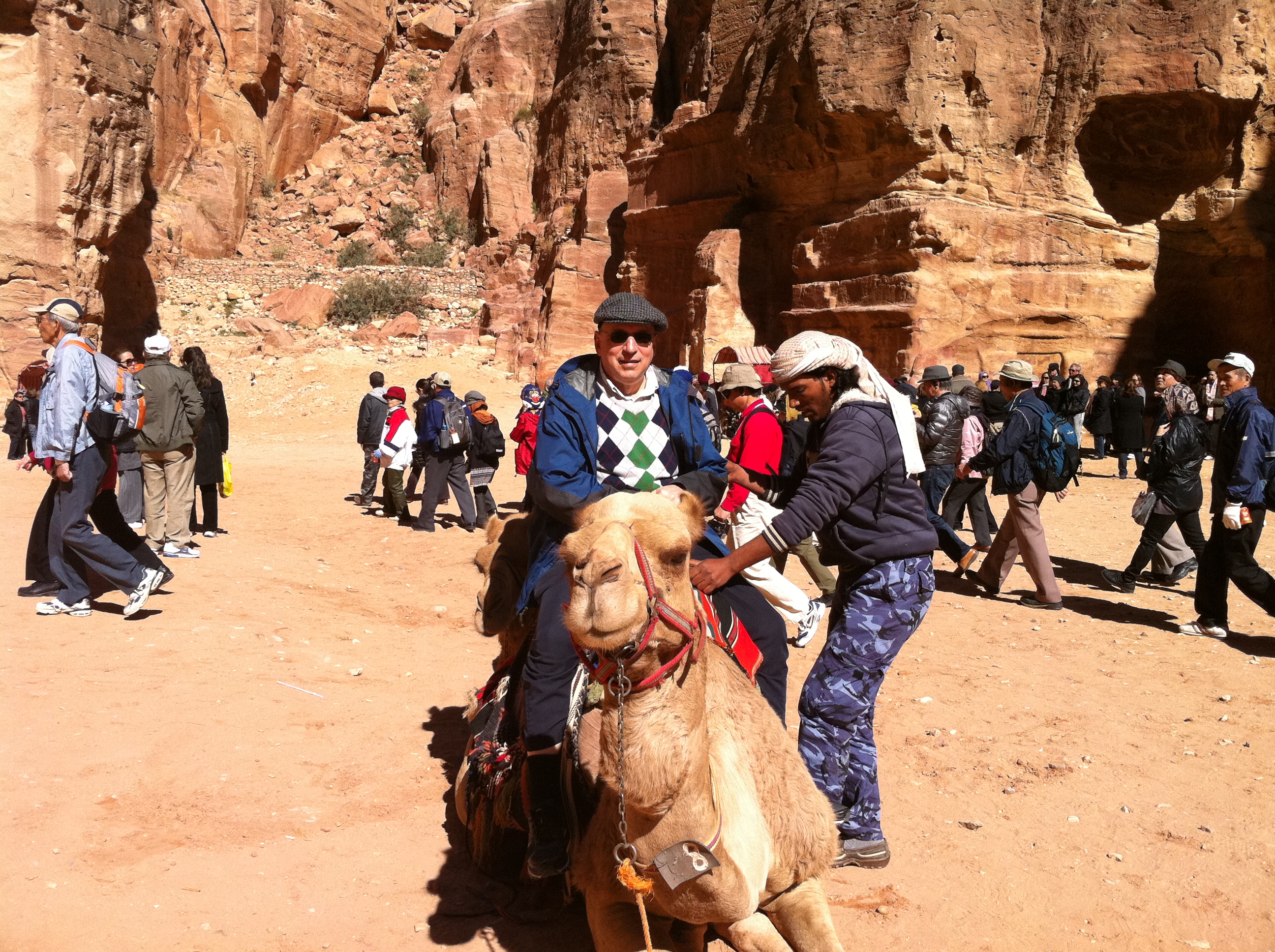
Looking a little worried
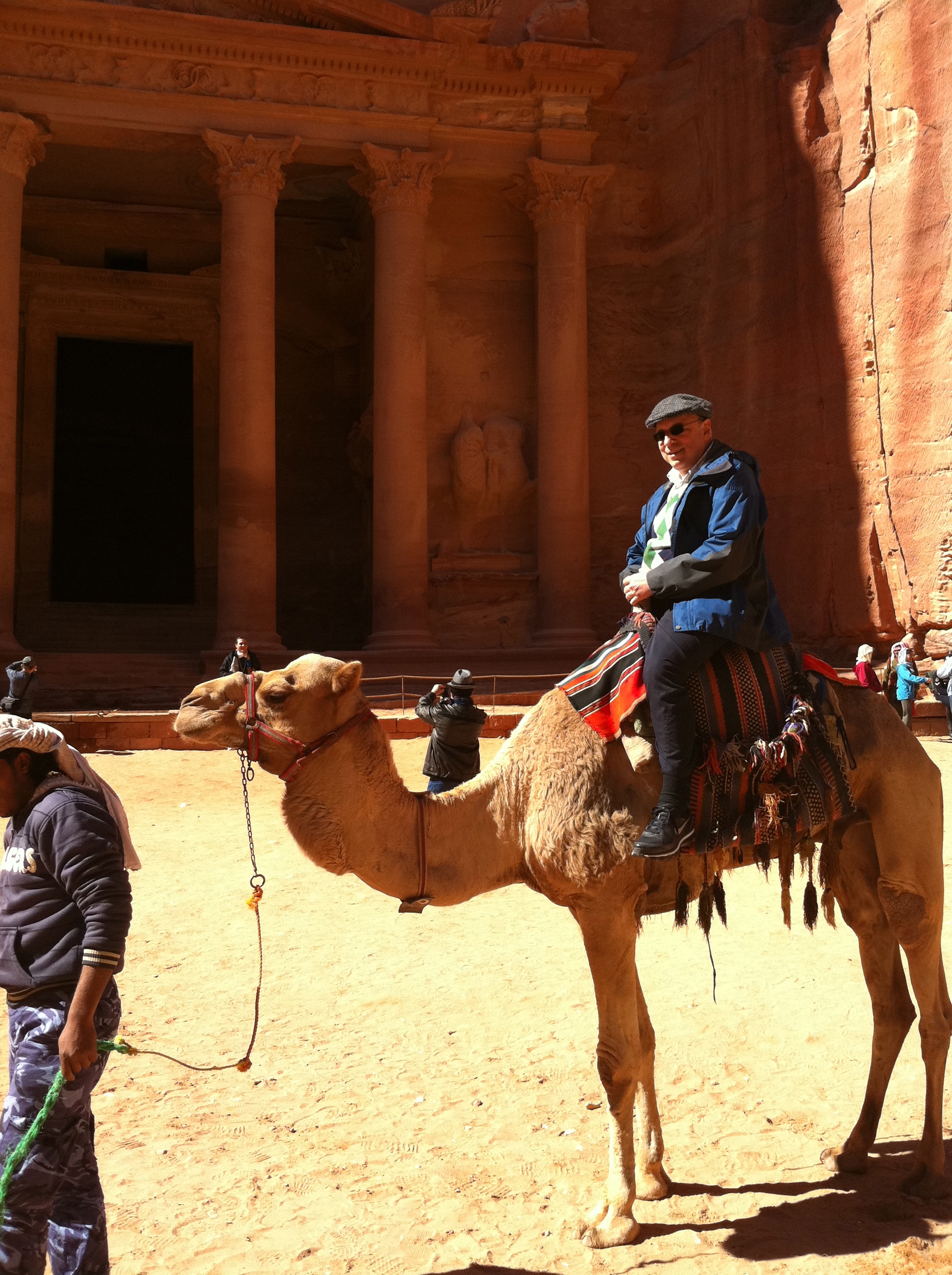

So comfortable now that I was ready to take the camel all the way back to the US
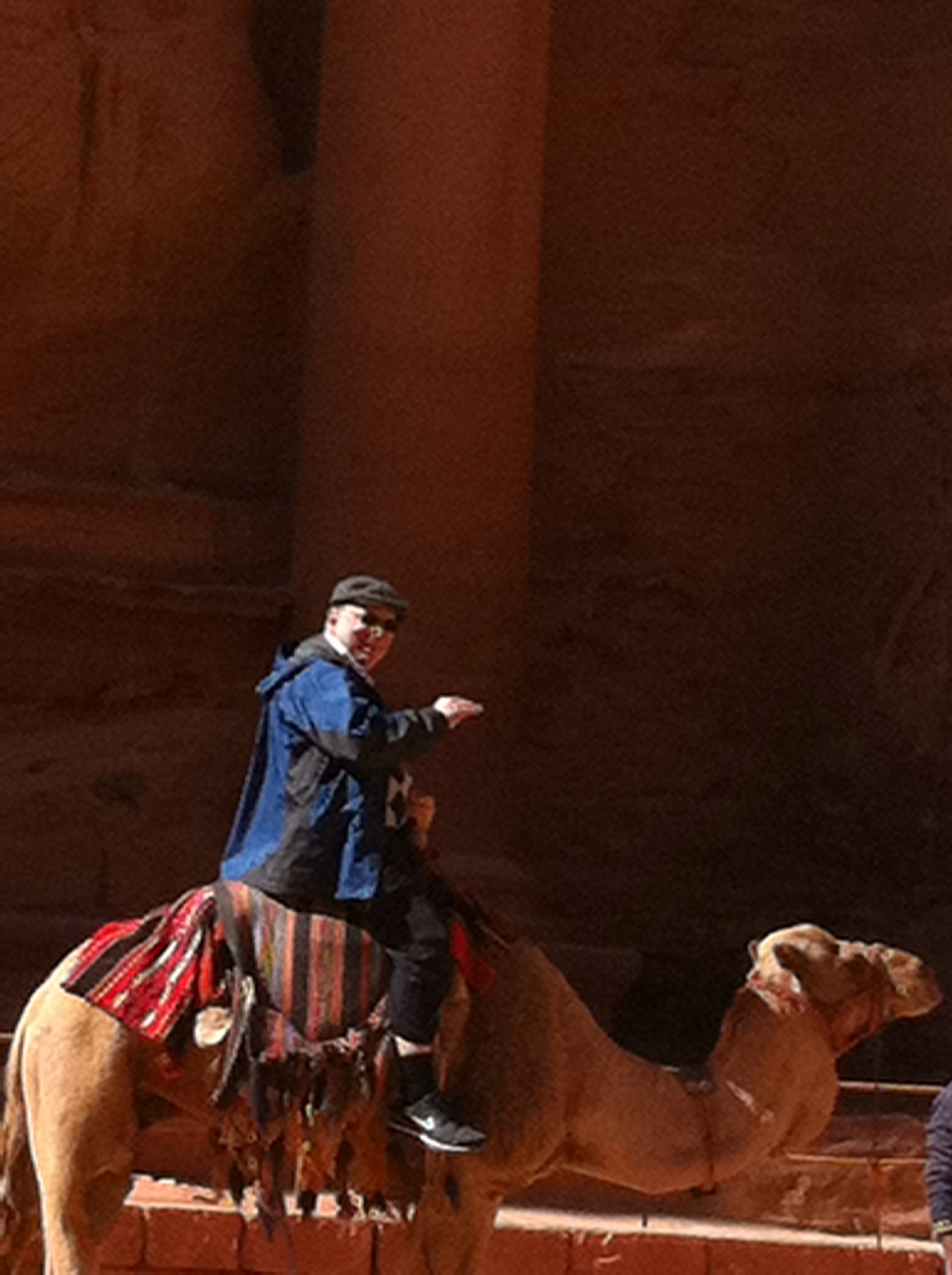

Put your hand down
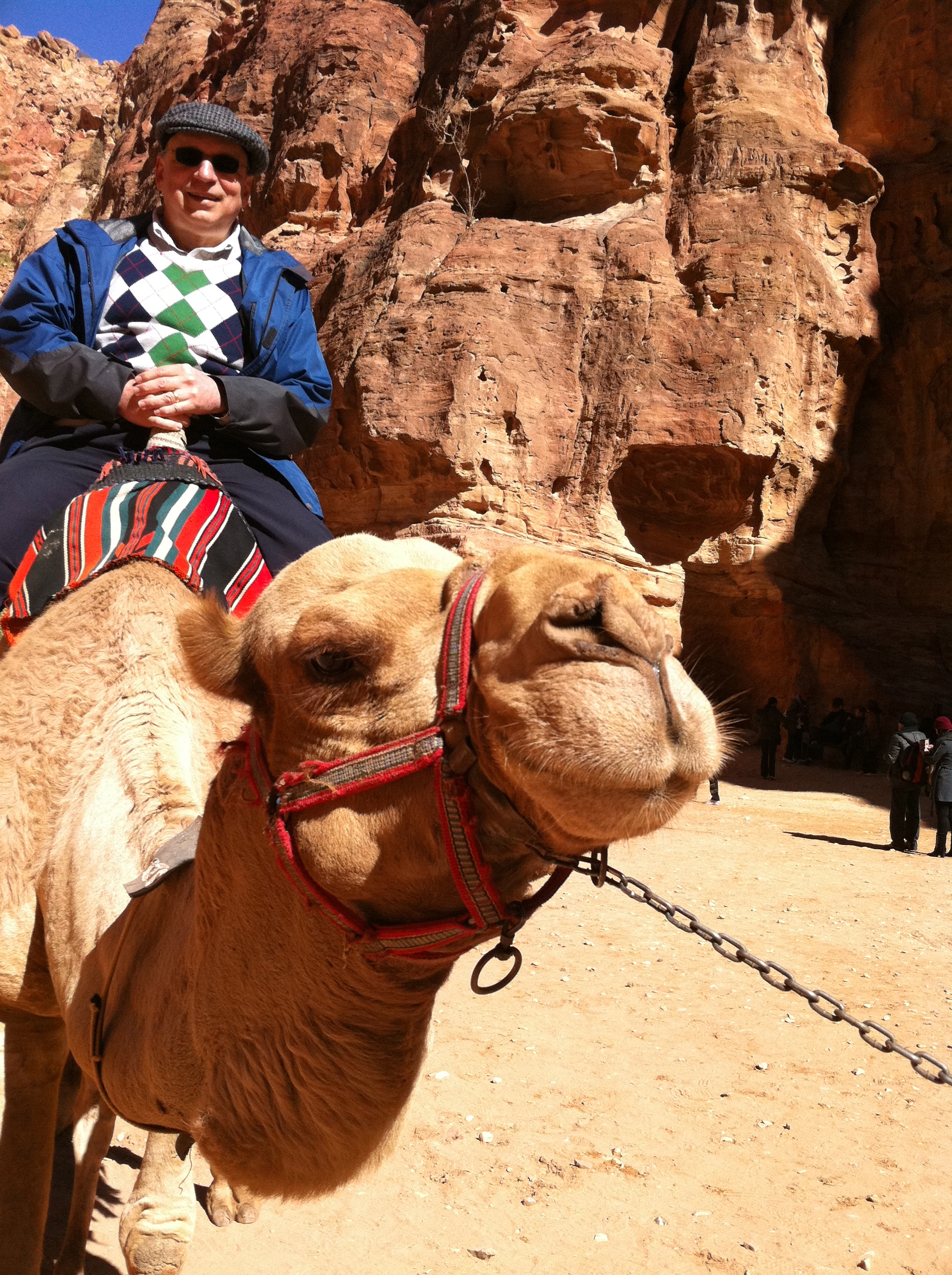
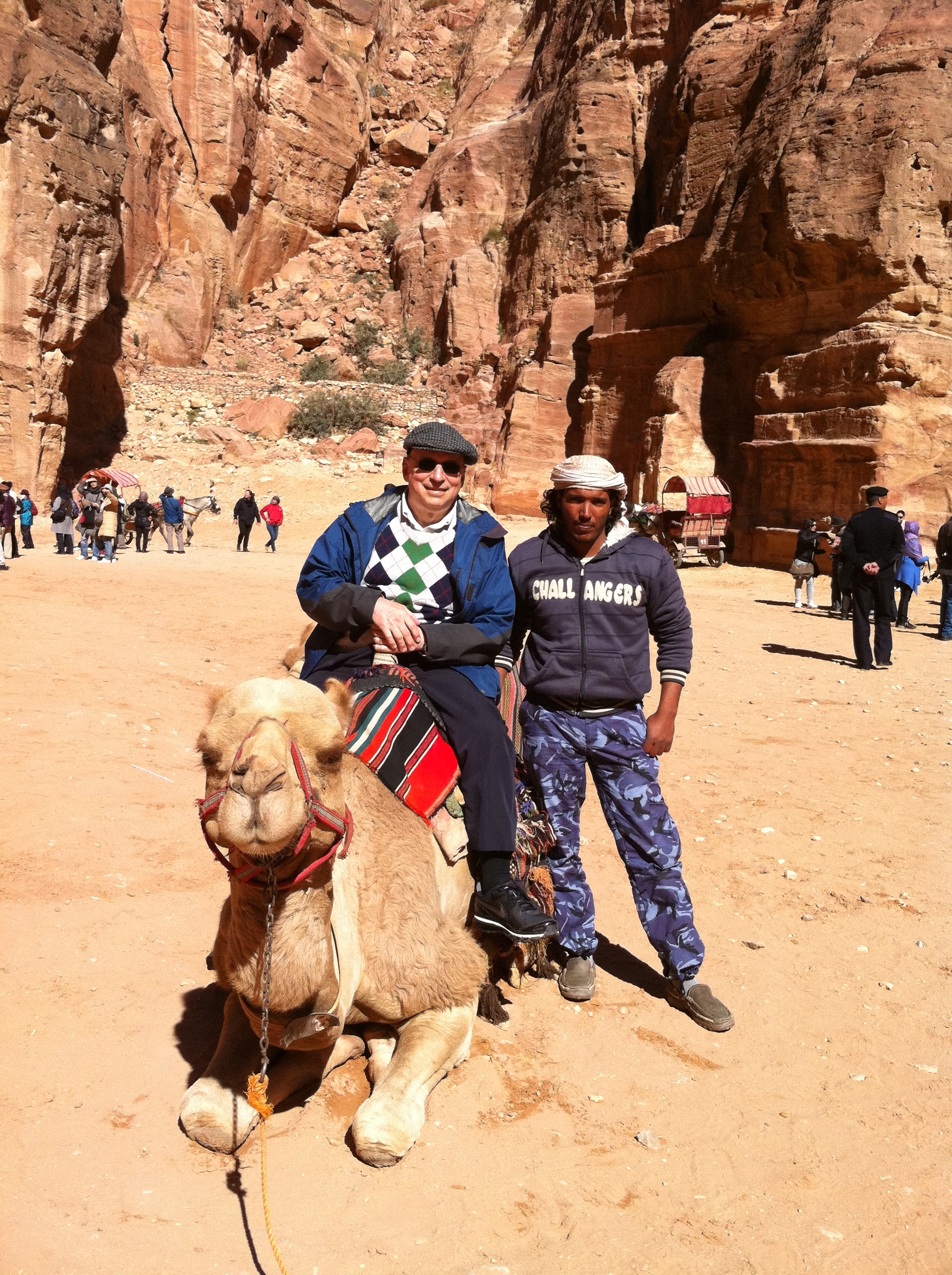
Do the camel and I look at little bit alike?
I felt sad to leave the Treasury but there was a lot more to see. I’ll never forget my camel ride.
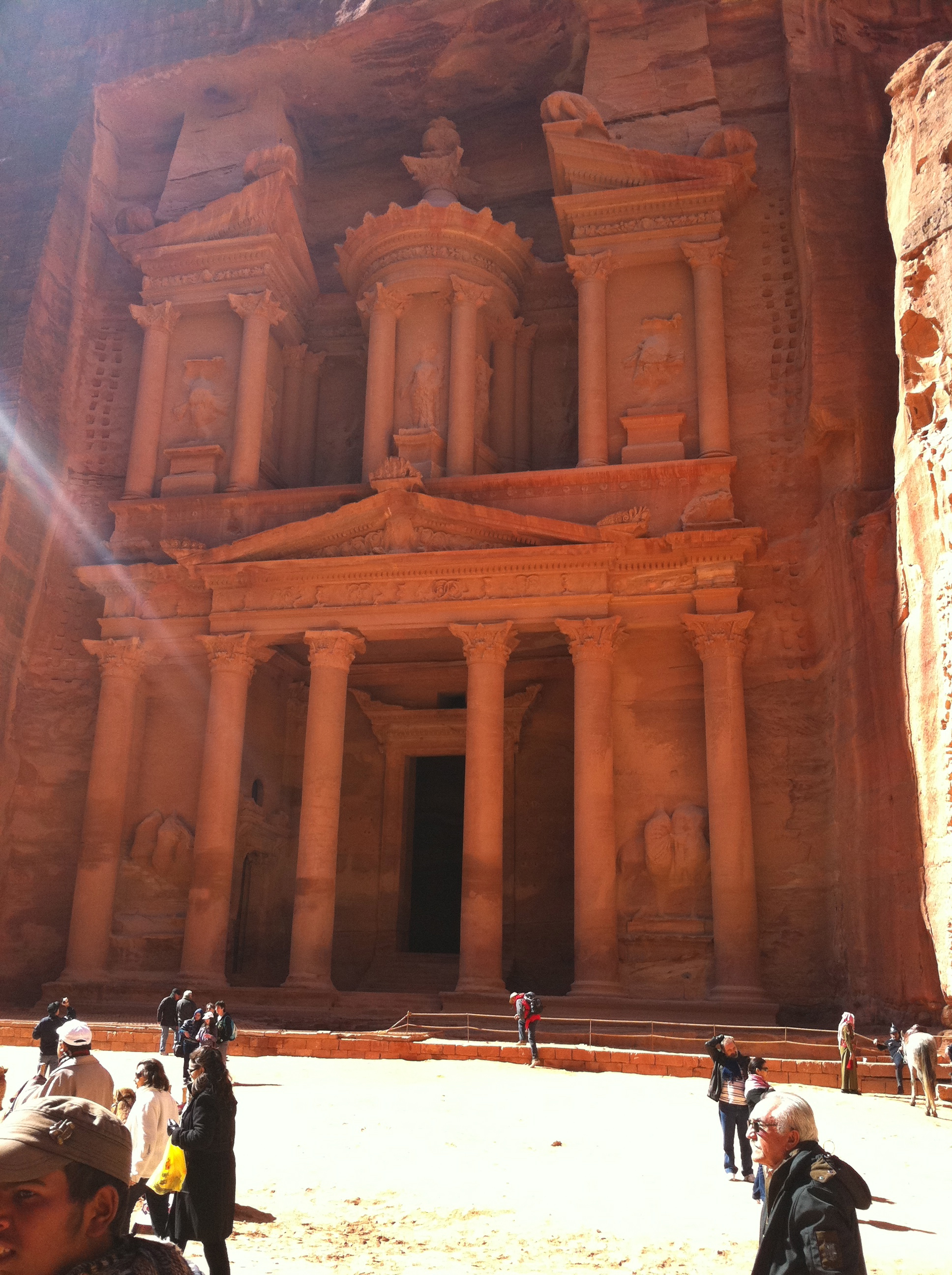 My last look of the Treasury
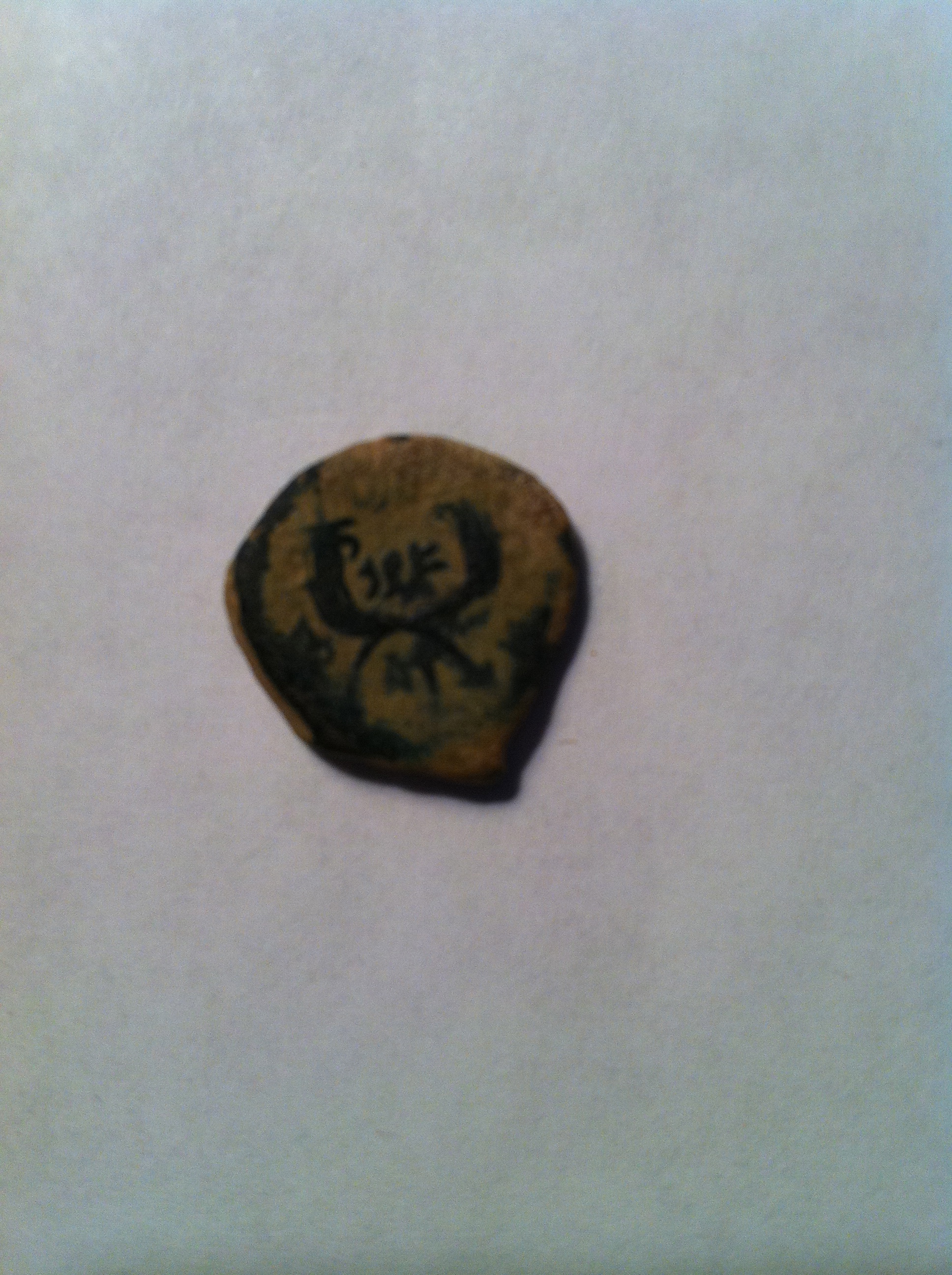
As we were going through the four mile walk, every so often someone would try to sell coins. Khalid has done a lot of research on these coins and has collected over 600 of them. He would spell out the word “f-a-k-e” if he thought the person could understand English but not spell it. Then when the person below showed a coin, Khalid said I should buy it. He felt it was from the Nabateans and about 2000 years old. Khalid bargained for me and gave me a price of 15 Jordanian Pounds or somewhere around $25. Khalid felt this was a reasonable price. He threw in two Roman coins, which Khalid said are valuable but not at the same level as the Nabatean coin. Of course, I know nothing about this but felt it would be a good gift for Keith. I found someone on the web who was able to identify the coins and said they’re not incredibly rare but I got a good price and they are worthy to keep as a momento.
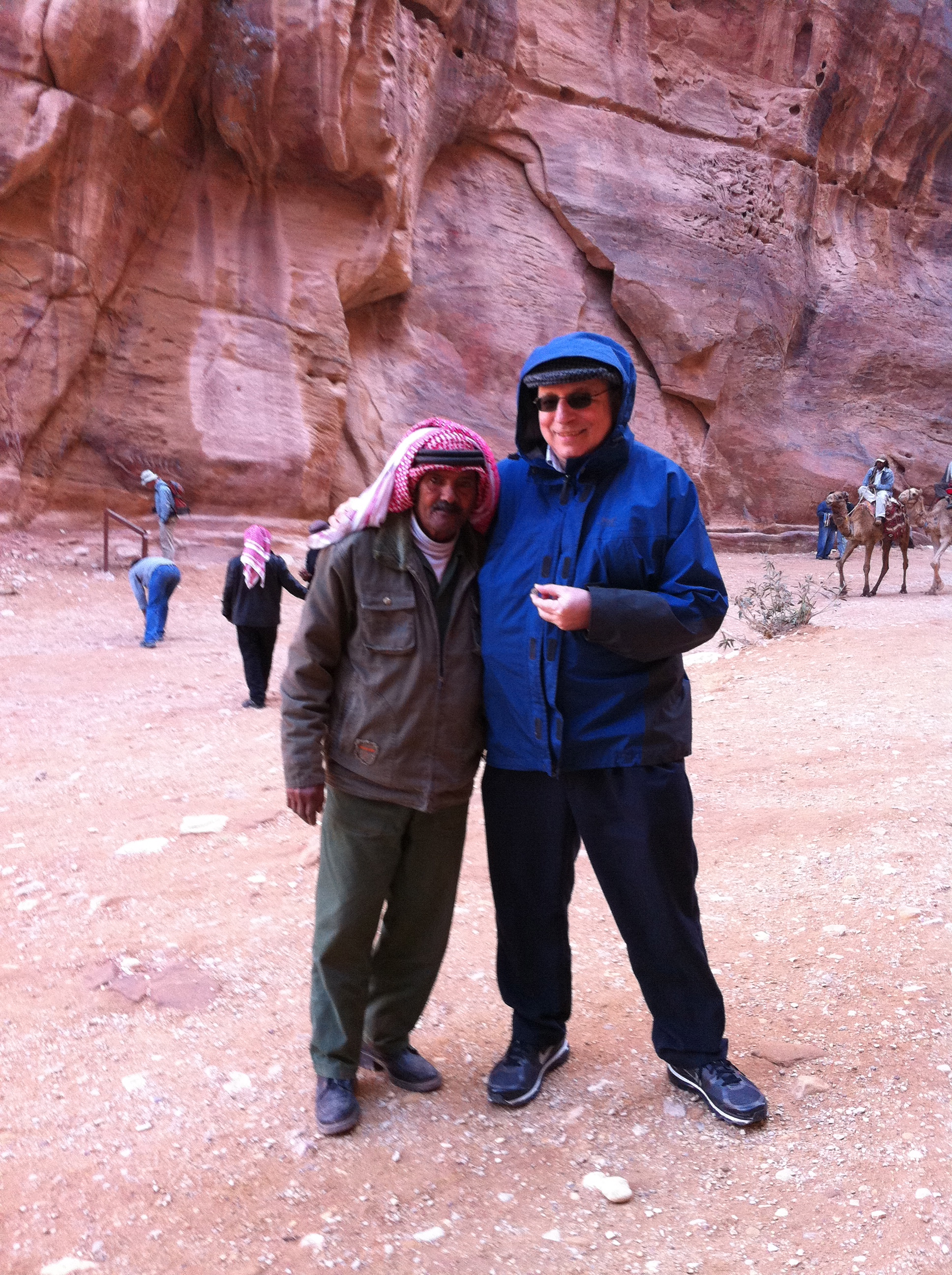
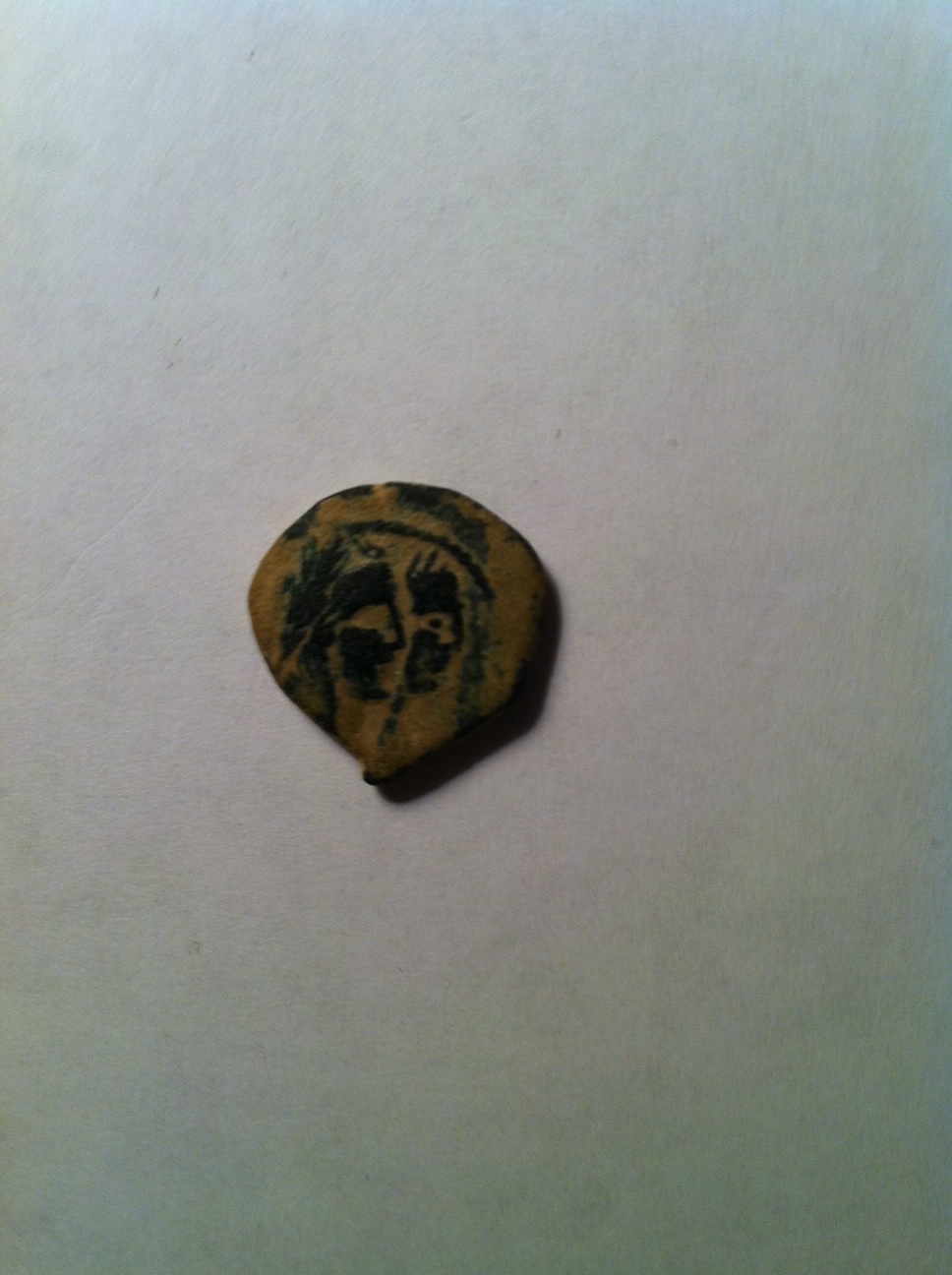
The coin seller (left) and the most unusual coin of Aretas IV and Shaquilath (right)
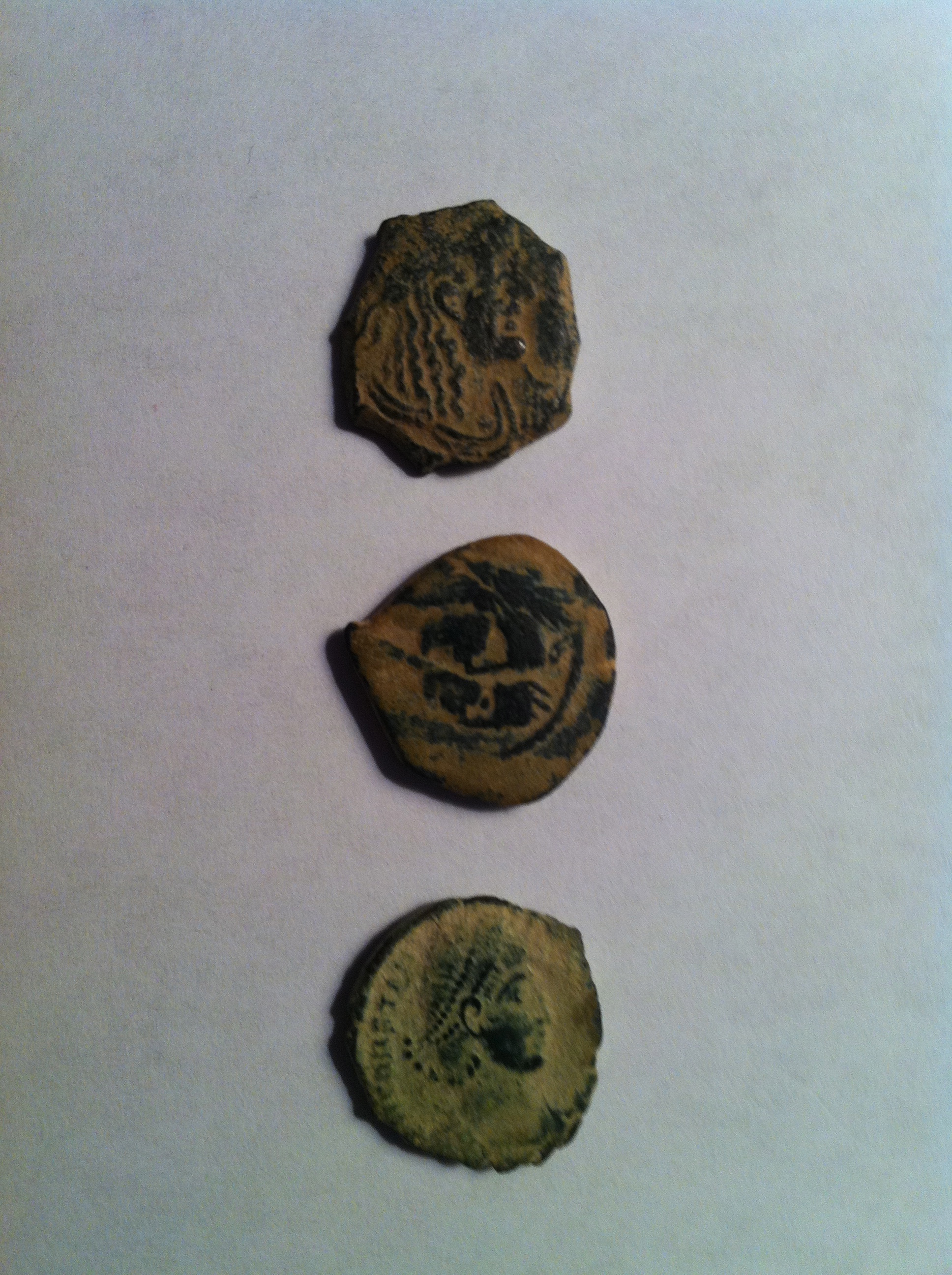
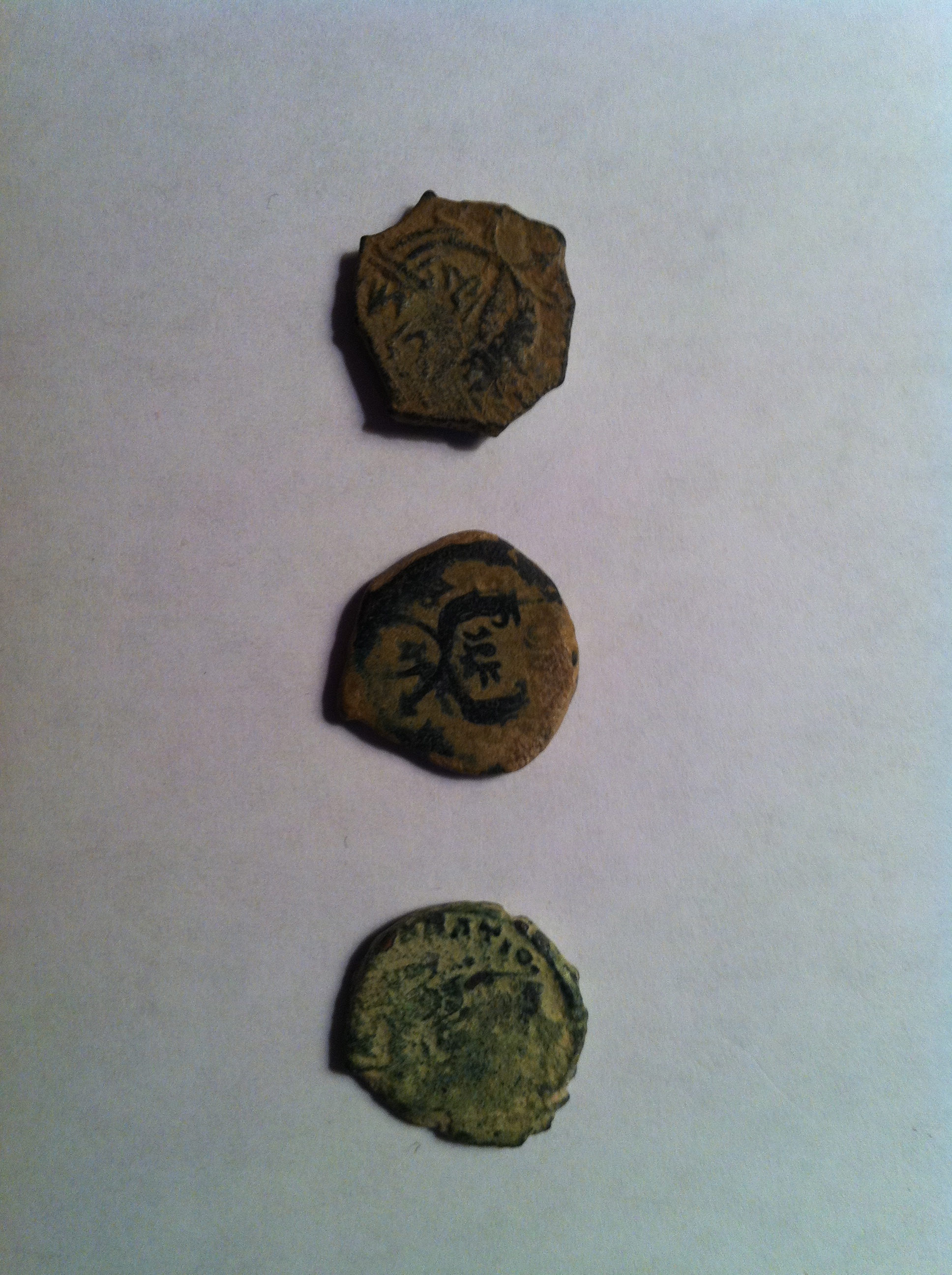
The two sides of the 3 coins I purchased from the seller. The top coin is of Rabbel II and Gamilath, the middle coin is of Aretas IV and Shaquilath and on the bottom is a Roman coin of Constantius II.
The way Khalid dealt with this Bedouin woman selling necklaces showed his classiness. He knew I would not be interested in buying one of her necklaces but he made it seem to her that I might be interested. He knew that she would not be willing to have a picture of her and me unless I was interested in buying something. Her son was selling pieces of rock and Khalid bought one for 1 Jordanian pound (about $1.50) then returned the rock to the pile when they weren’t looking. This was basically done to pay for the picture but in a way that was not insulting to her.
He really appreciated the 14 year old girl in the picture on the right. She knew the important words like 1 pound for a series of postcards in many languages and seemed very personable. Even though I had bought a series of post cards, he bought one for me just to support her.

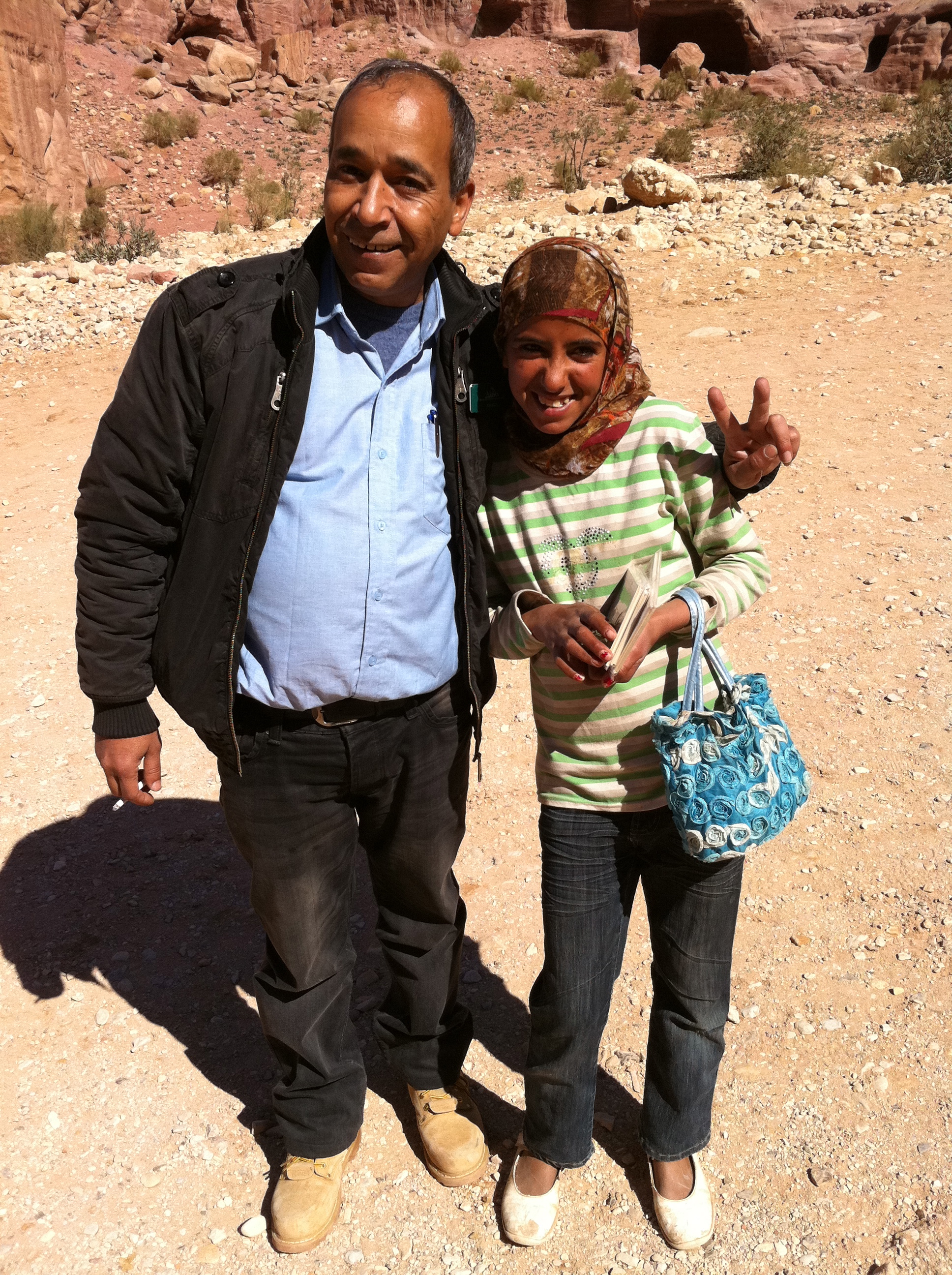
Bedouin woman and her son, worried that my wife would be jealous (left) and 14 year old girl selling postcards (right)

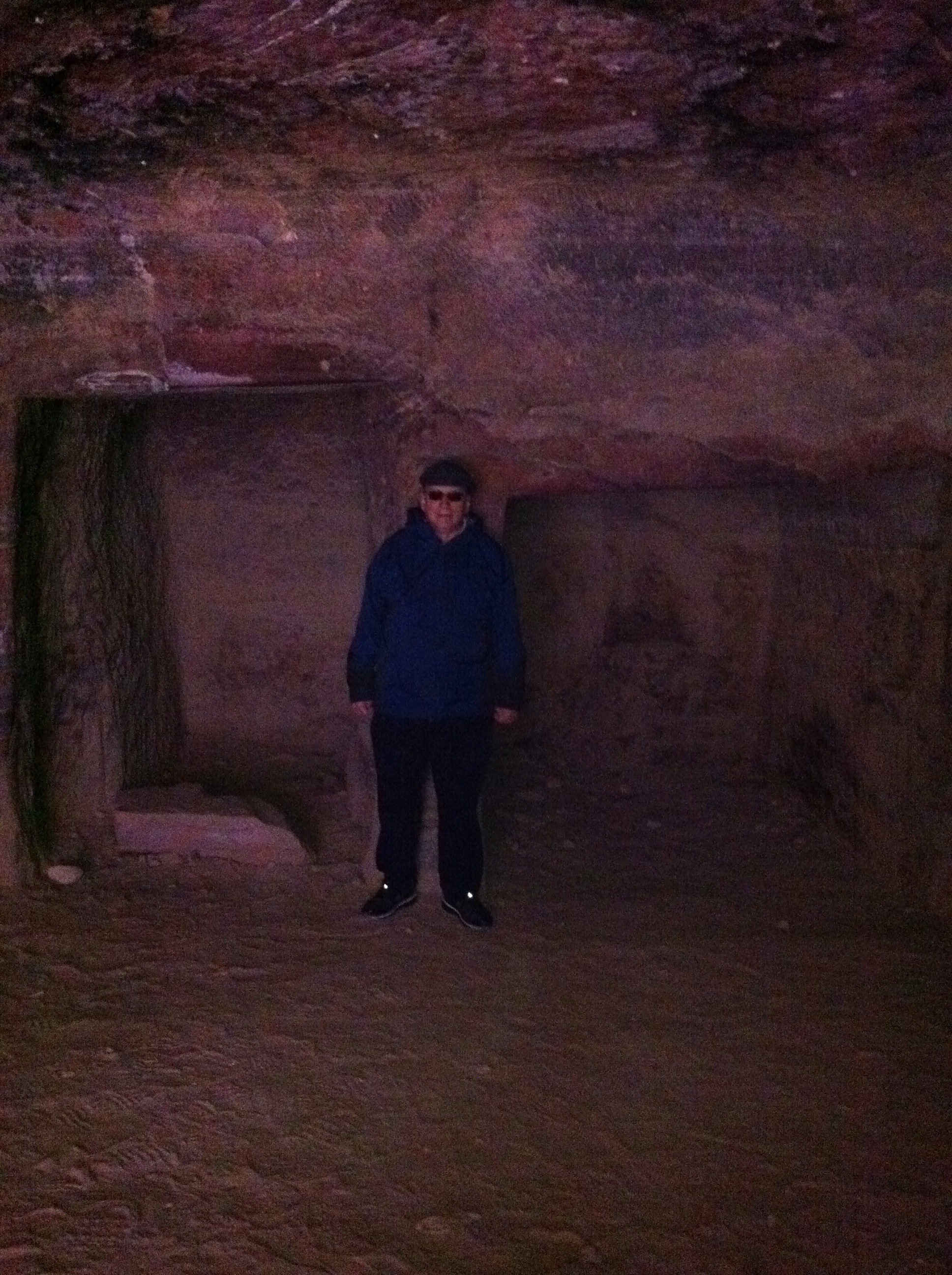
Outside (left) and inside (right) of one of the many Nabatean tombs
There were Bedouins living in the caves / tombs up to the 1980’s when they were removed in a deal that they would run all the concessions. The government built them a town nearby. The negotiations took many years but they now control the souvenir shops, the camels, horses, donkeys, and the restaurants. There are strict restrictions on where the camels are allowed and how many. For example only two camels are allowed where I rode them at the Treasury. I wonder if the Bedouins are happy with this deal since it gives some of them steady income or if they hate me and everyone like me for stealing their land. My guess is that most of them hate people like me.
Petra is really two amazing sites combined in one package. It would be an amazing site if there were no rock buildings sculpted by humans. The strange formations with the even stranger colors, impacted by different light conditions make for a wonderful experience. When you combine the rocks with one of the most amazing human creations in the world, you can see why it was declared one of the seven human-made wonders of the world. Here are a bunch of pictures.
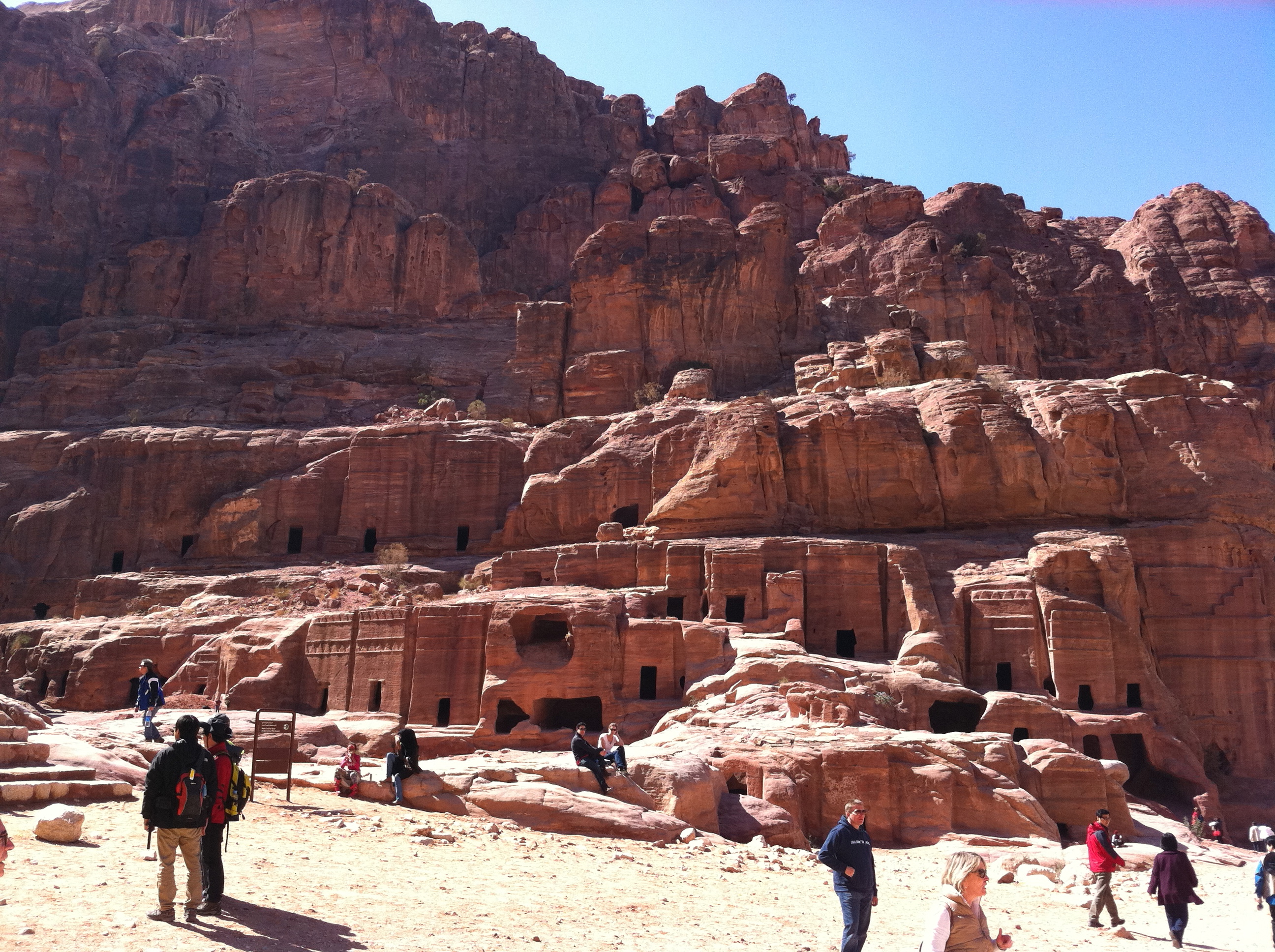


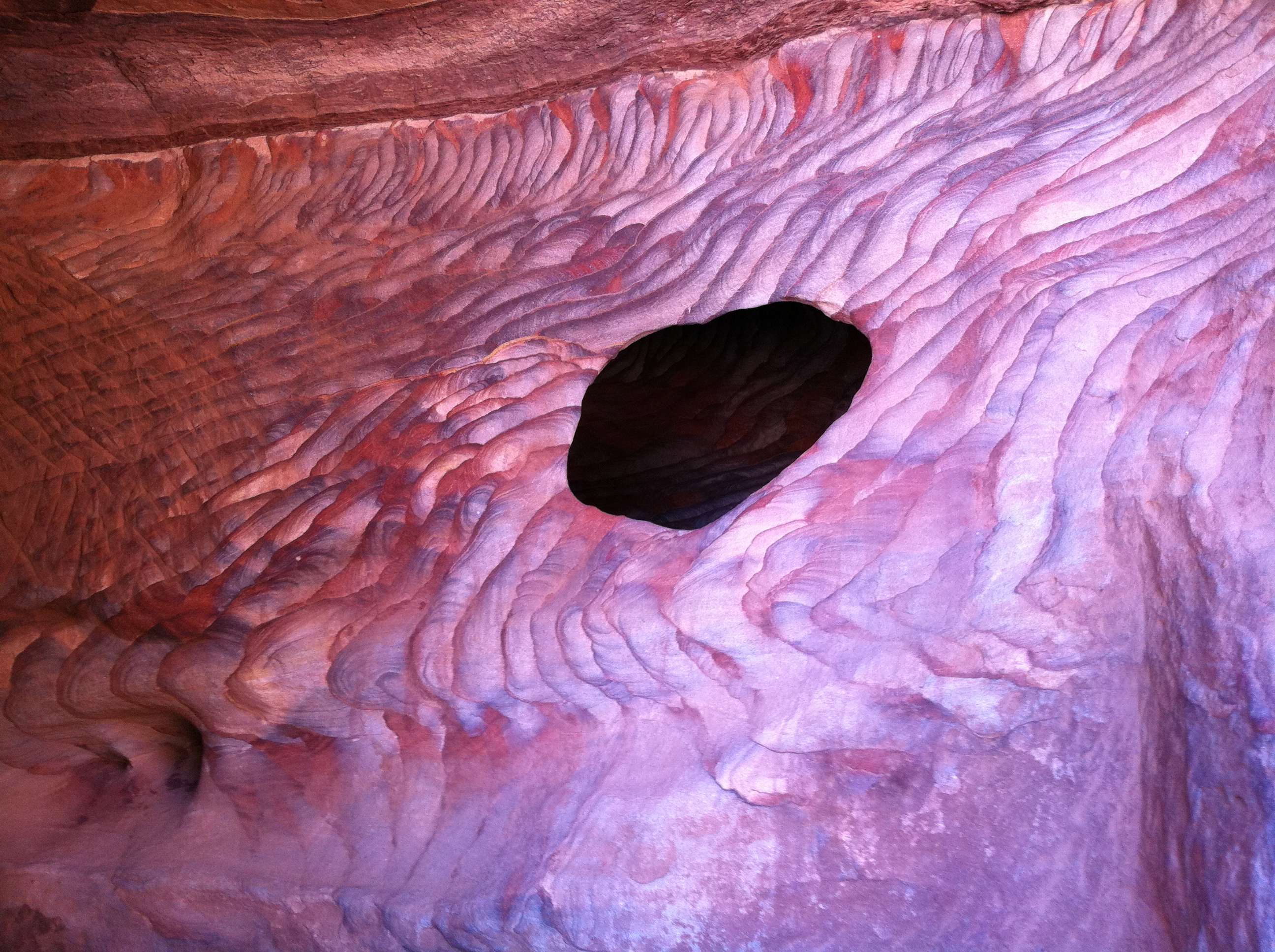
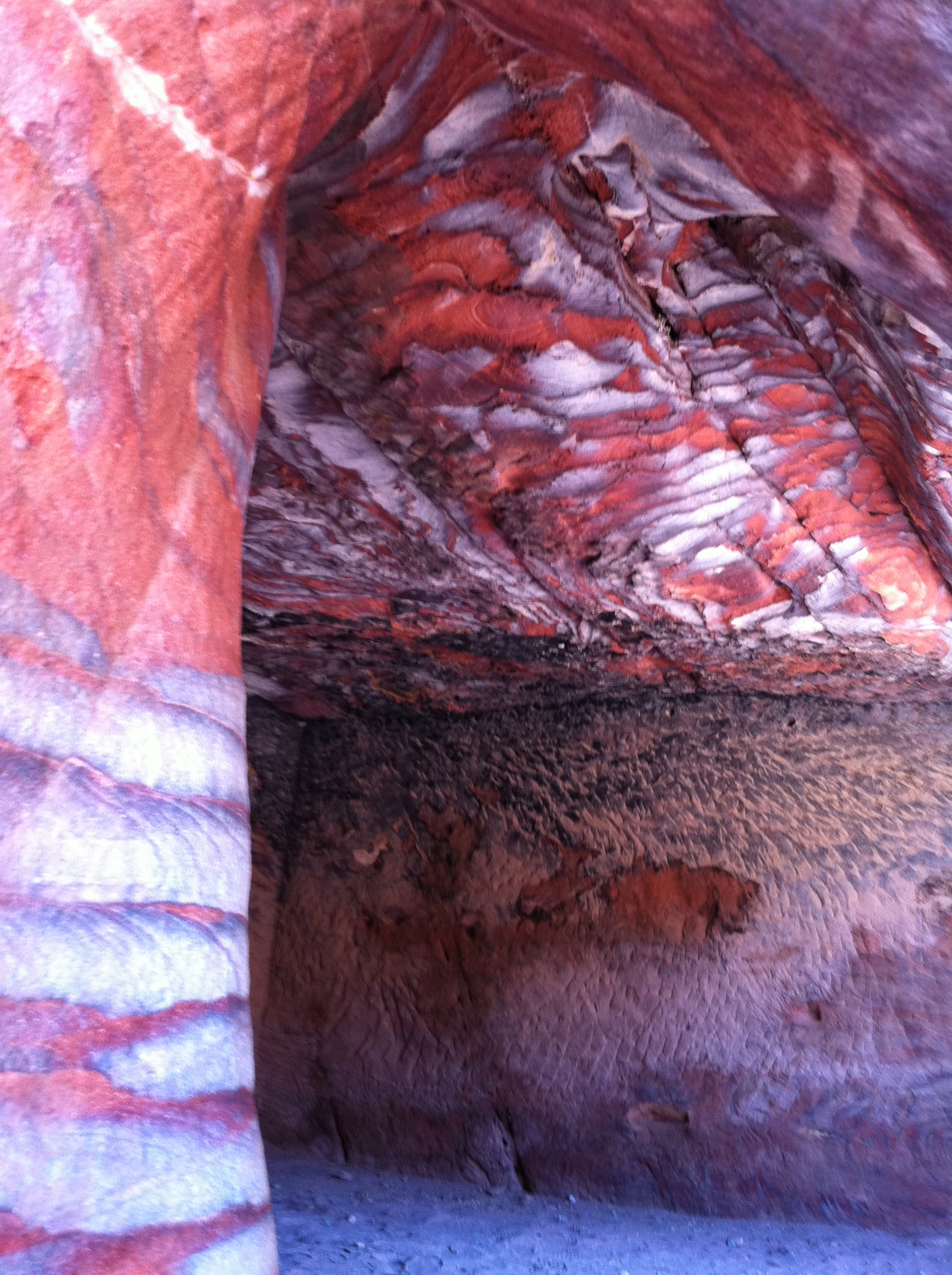
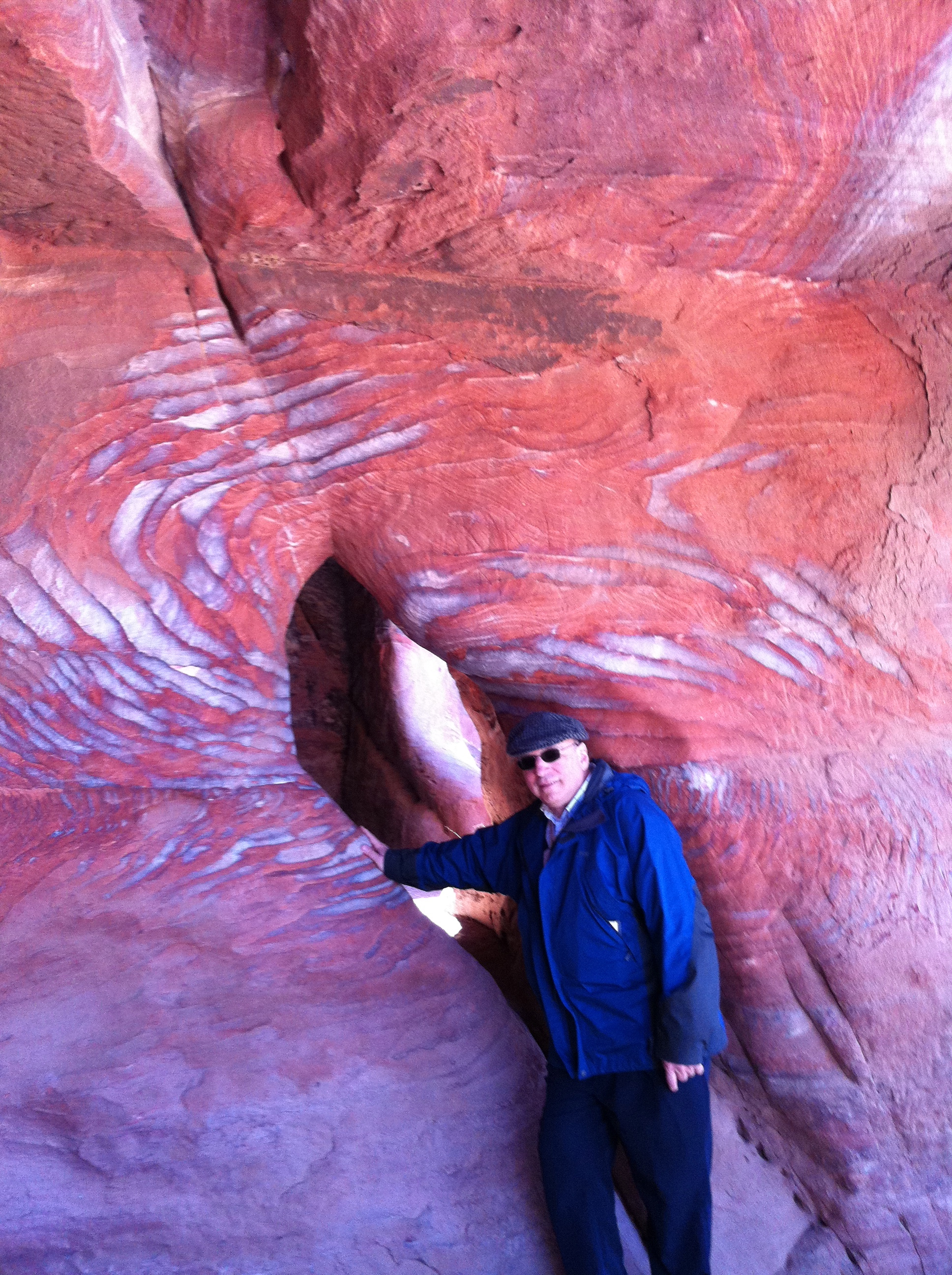
Rock formations, both natural and sculpted 2000 years ago by the Nabateans
There was a Greco-Roman styled amphitheater like others I had seen except that this one was built out of one piece of rock. Apparently it held 6,000 people. Imagine you’re a Nabatean in the first century looking at a piece of rock and thinking I’ll just carve this rock up into “an auditorium with a semicircular orchestra and an ascending horseshoe-shaped seating area with vertical stairways divided into three levels by horizontal passageways.” (from the notes at Petra) The stage wall was added by the Romans to shield the orchestra and as a theatrical backdrop.
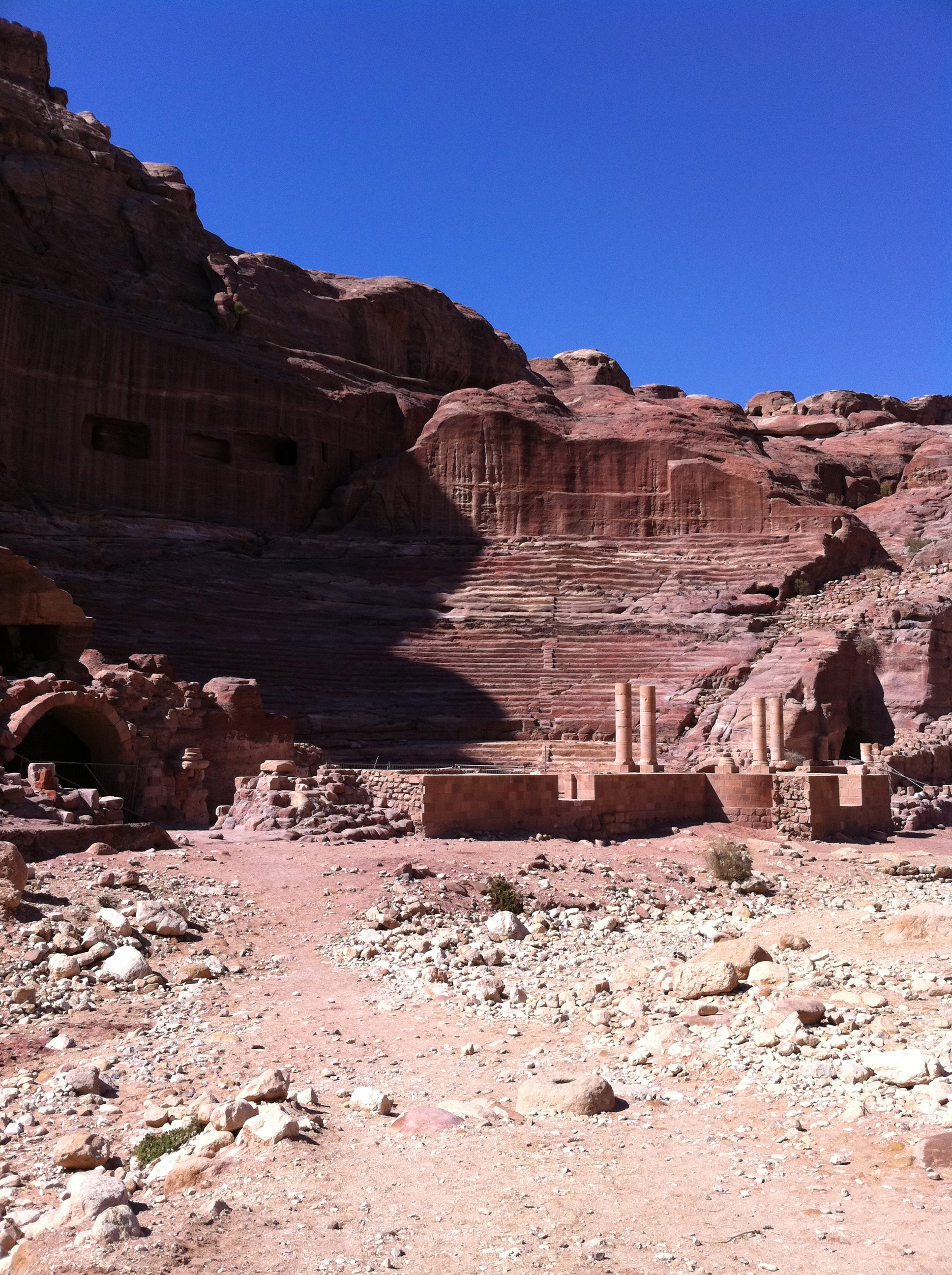

First century amphitheater carved out of one piece of rock
 Tombs near the amphitheater
 View from the above tombs
 I find it hard to believe 80% of Petra is not yet excavated. Here’s a piece of a sculpture just lying on the ground.
I had to buy something from this Bedouin below. He has a stunning appearance. I told him if he came to America there would be women flocking to him. His head dress, the bead on his beard, his hair, and his face are striking. Somehow the t-shirt should be totally out of place but it works.

Striking Bedouin vendor
After lunch at 2 PM Khalid asked me if I wanted to take a donkey up to the top of a mountain to see another famous sculpture called the Monastery. After that we would need to walk back down the more than 600 steps to get back to where we were. Apparently, some tourists have fallen off the donkeys going down and he did not think it was safe.
Whether I took the trip to the Monastery or not, I had to decide how to get back. One option was to walk the four miles we had just came from but this time it would be uphill. The other option was to take a donkey from that spot up the steep hill to the Bedouin village where Raed would pick us up.
My Spanish buddies Rosana and Paloma had walked the whole way yesterday. They climbed the 600 steps up, then took the same treacherous route down, then walked the 4 miles uphill back to the entrance. They had warned me that it was ridiculously tiring. Khalid gave me a few minutes to think about what I wanted to do — climb up to see the Monestary or not and make the other decision about taking the donkey or walking back. After a while I realized I was overwhelmed. I had seen the Treasury and so many other memorable formations that I punted. It was time to go back and nap.
My donkey keeper was a 15-year old named Ahmad. My guide’s donkey keeper was named Rashid. Most importantly, my donkey’s name was Shakira. I never found out if Shakira got her name from the great singer or if it’s a native name. Ahmad said he had just come from school. Our destination was the Bedouin village that was created in the 1980’s after they moved the Bedouins from Petra.
It was a pretty steep climb and I was much more comfortable with the camel. The donkey felt less secure than the massive camel. I’m smiling in the pictures but Khalid had to tell me to relax since he could sense I was tensing up. I was able to relax somewhat after a while. I was certainly glad that the donkey was carrying me up this hill though. Raed, our driver was waiting for us at the top and I had a seamless transition from the ancient mode of transport of the donkey to the automobile.
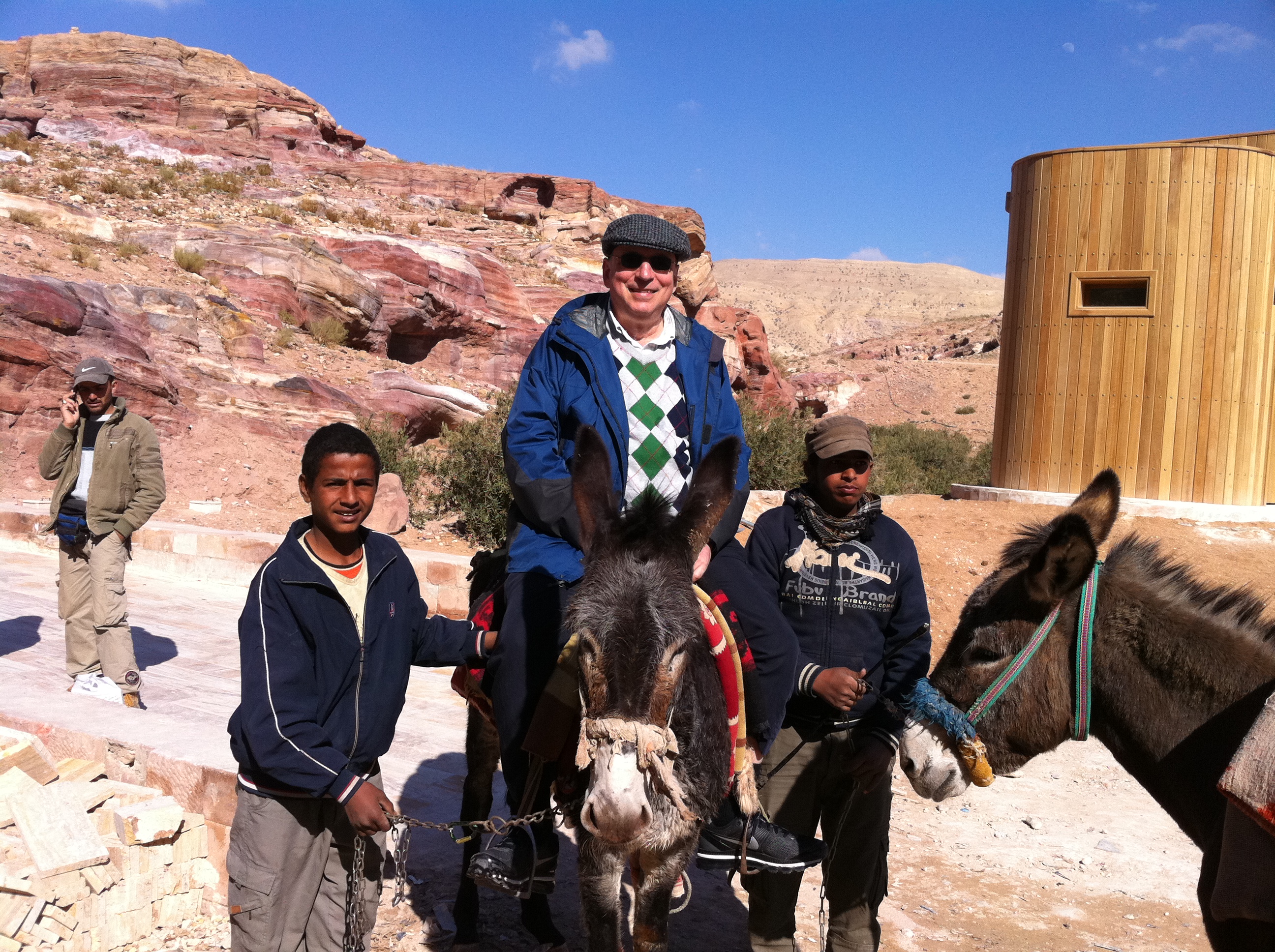 Ahmad holding my donkey named Shakira. Rashid holding the donkey for my guide.
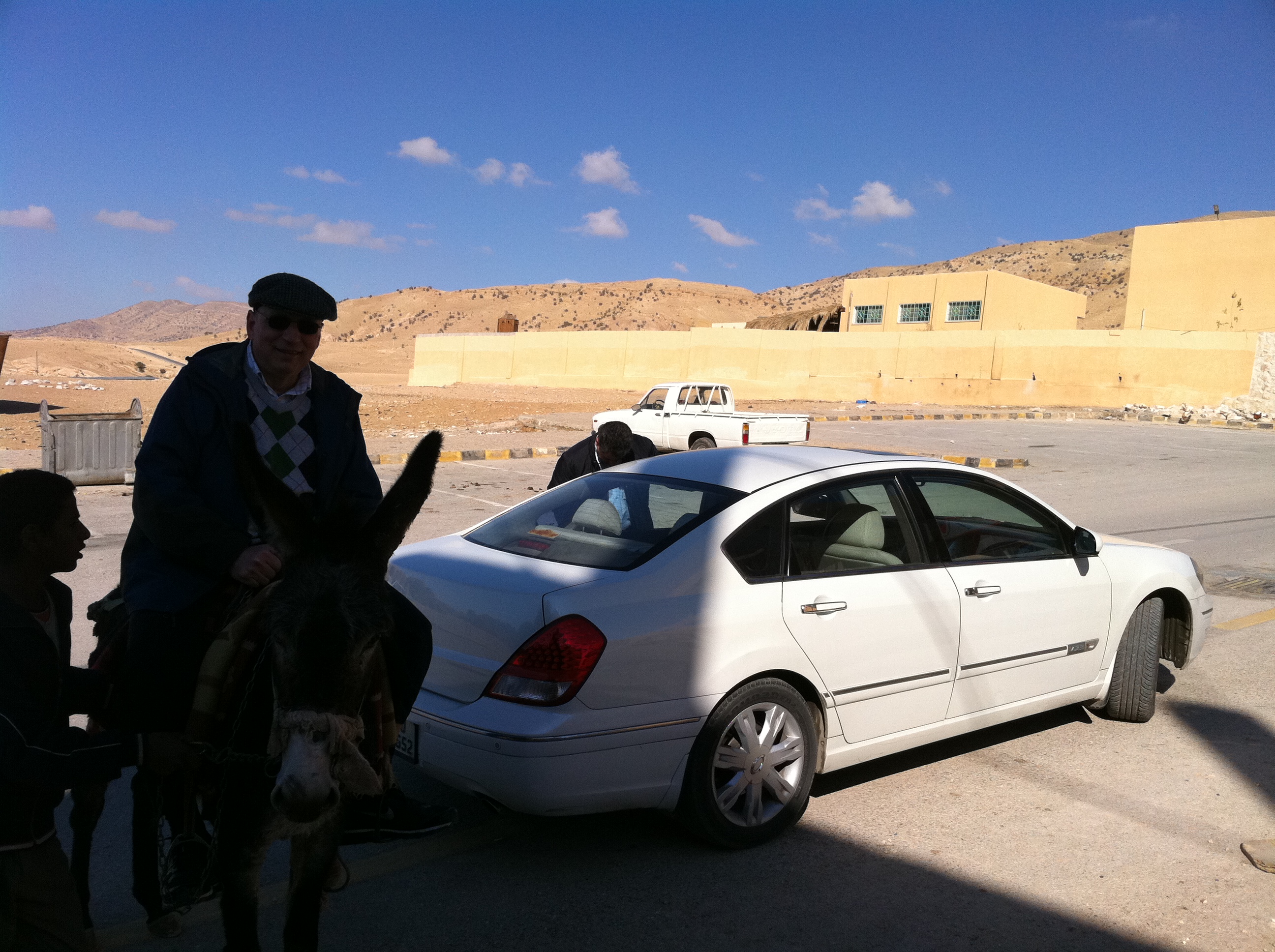 Seamless transition from the donkey to the car. Maybe you can guess why I didn’t take any pictures on the way up.
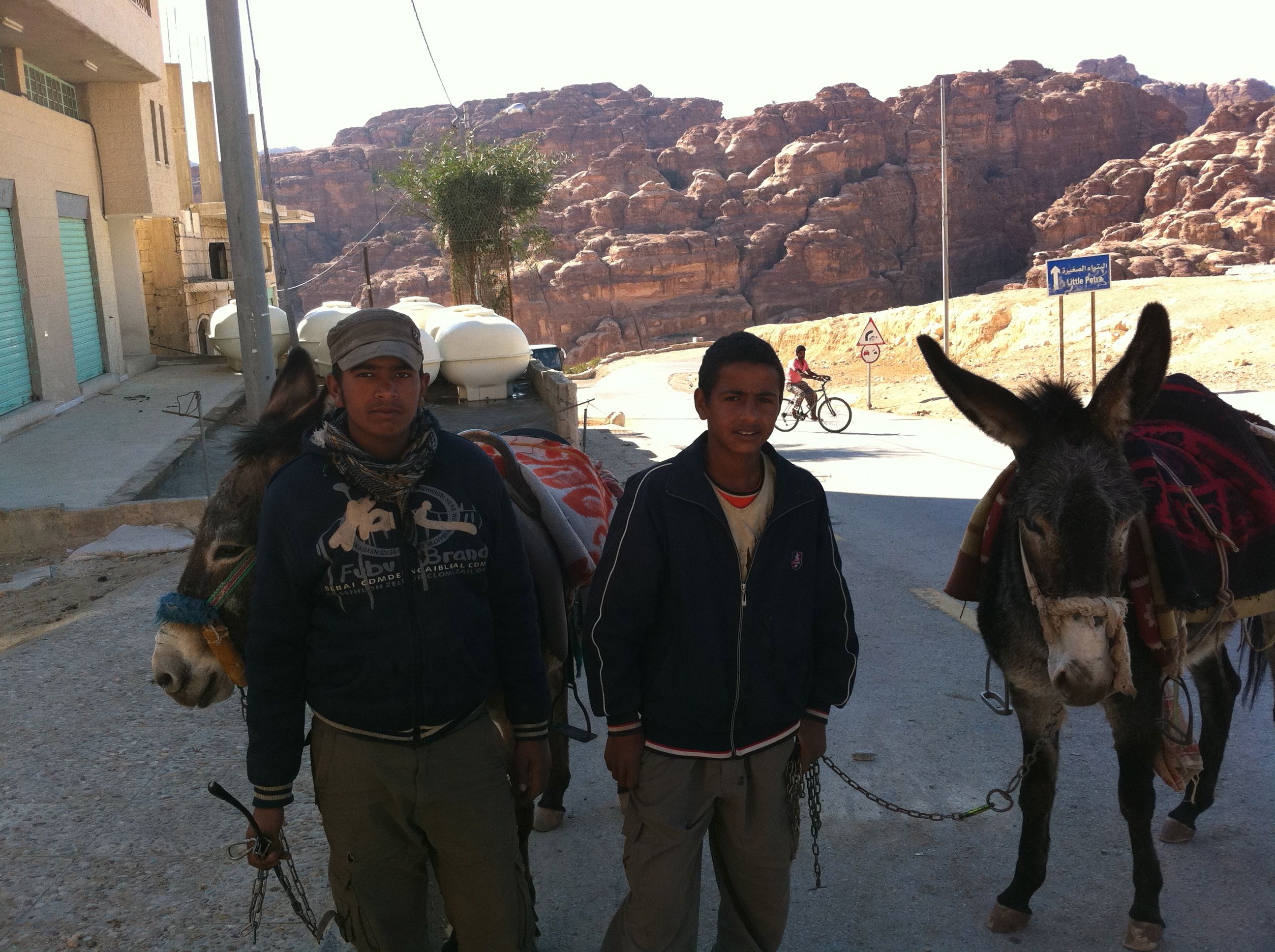 Saying goodbye to Ahmad, Rashid, and Shakira
It was a little nerve racking, especially at first but I’m glad to have done it. It was another memorable experience. I asked Khalid if we could drive around the Bedouin town but he said it would be dangerous. They wouldn’t appreciate people snooping around their town. It was OK to take a donkey up there with one of their guides but not to drive around. I very much respected that. I did take pictures discretely as we were driving the direct route out of town back to the hotel.
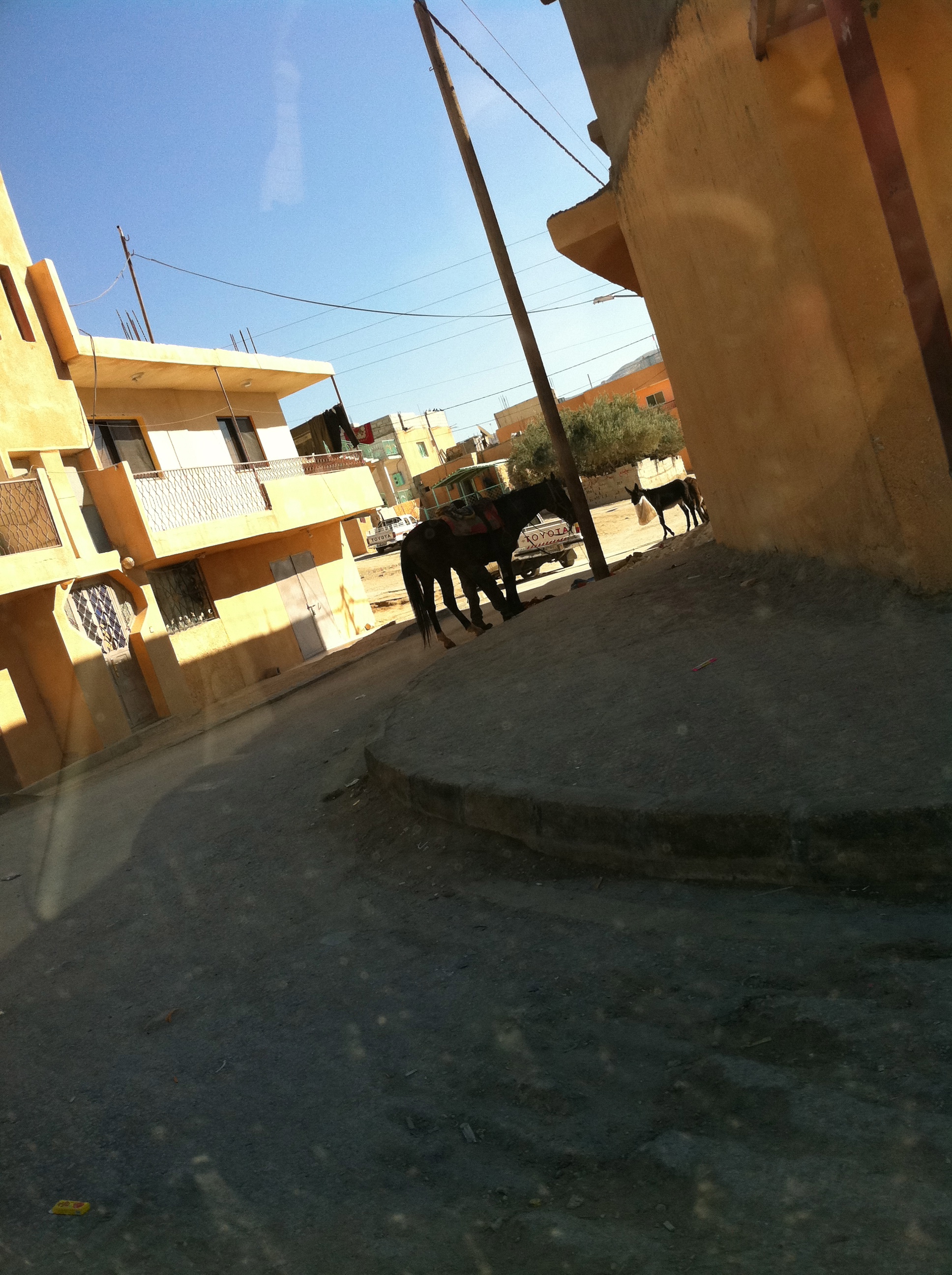
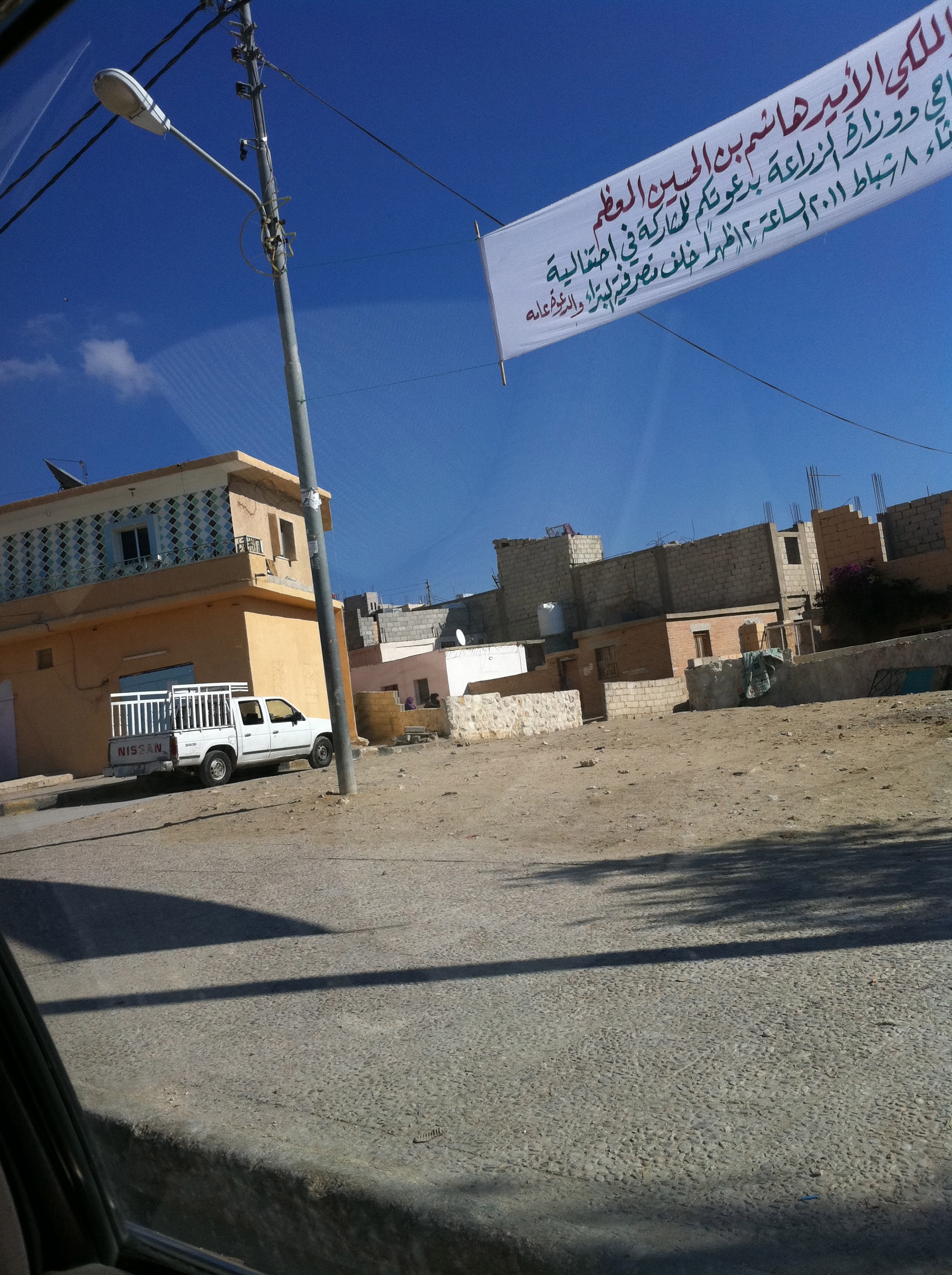


Bedouin town views
I’m really glad to have included Jordan in my itinerary, partly for seeing Amman, Mt. Nebo, and the amazing map but mostly for Petra. It is deserving of its wonder of the world status. I’m very glad not to have canceled when there were minor demonstrations after the events in Egypt and Tunisia.
Nap time.
 feldmanlarry
Leave a comment