I’m writing this on March 4, over two weeks later. I have good notes of where we went and all my pictures, so hopefully I’ll be able to get the flavor of what happened. I remember looking at this day’s itinerary and being a bit worried. As I wrote in an early blog, I don’t have a great feeling about museums. I like to move through them quickly and don’t like to spend time reading long descriptions while standing for a long time. As it turned out, I had nothing to fear, what I saw this day was spectacular and very memorable. Just yesterday, I was at a doctor who instead of talking about my health went on and on about how much he loves Istanbul (of course, I started the conversation about travels, it’s not his fault).
Breakfast had a couple of highlights, one was the view from the restaurant, which was on the top floor with big windows and an open air area. The other was meeting a couple from Japan. He’s a judge and she’s a lawyer. They met while she was arguing a case in his court and were on their honeymoon. I would have liked to talk with them more, they were really friendly and I would have loved to hear more about the Japanese legal system.
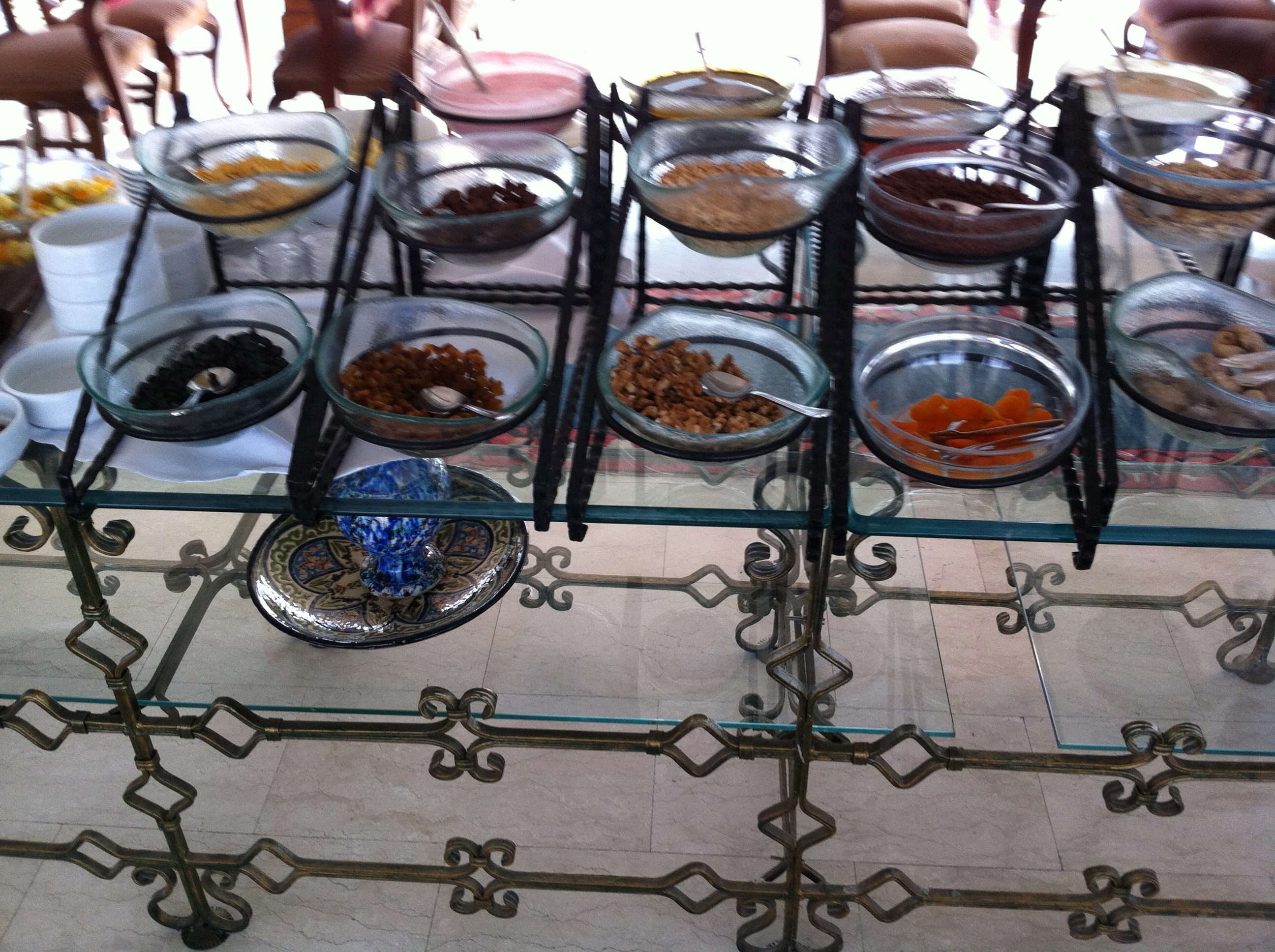
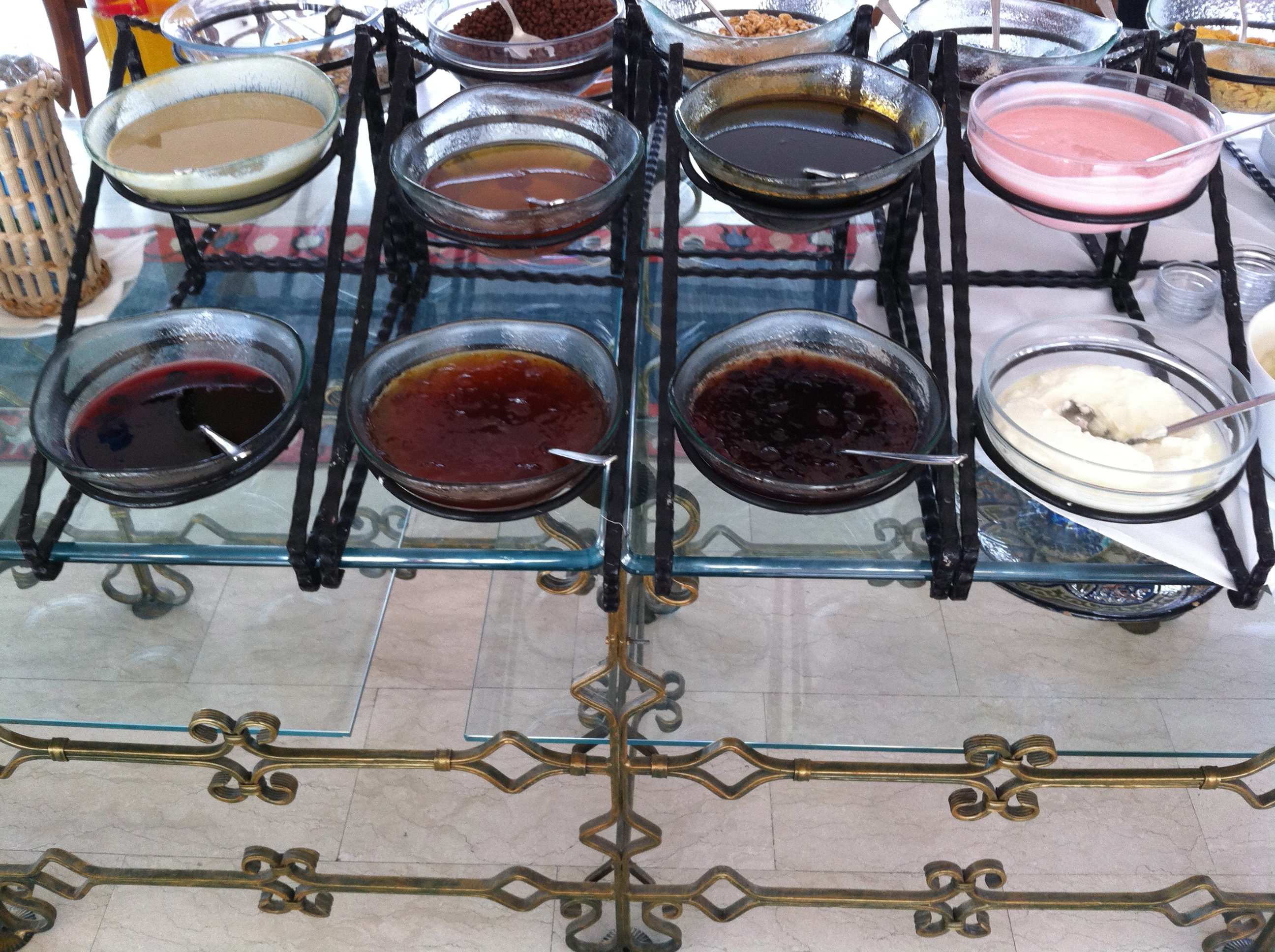 Condiments and toppings from breakfast, glad I didn’t try them all
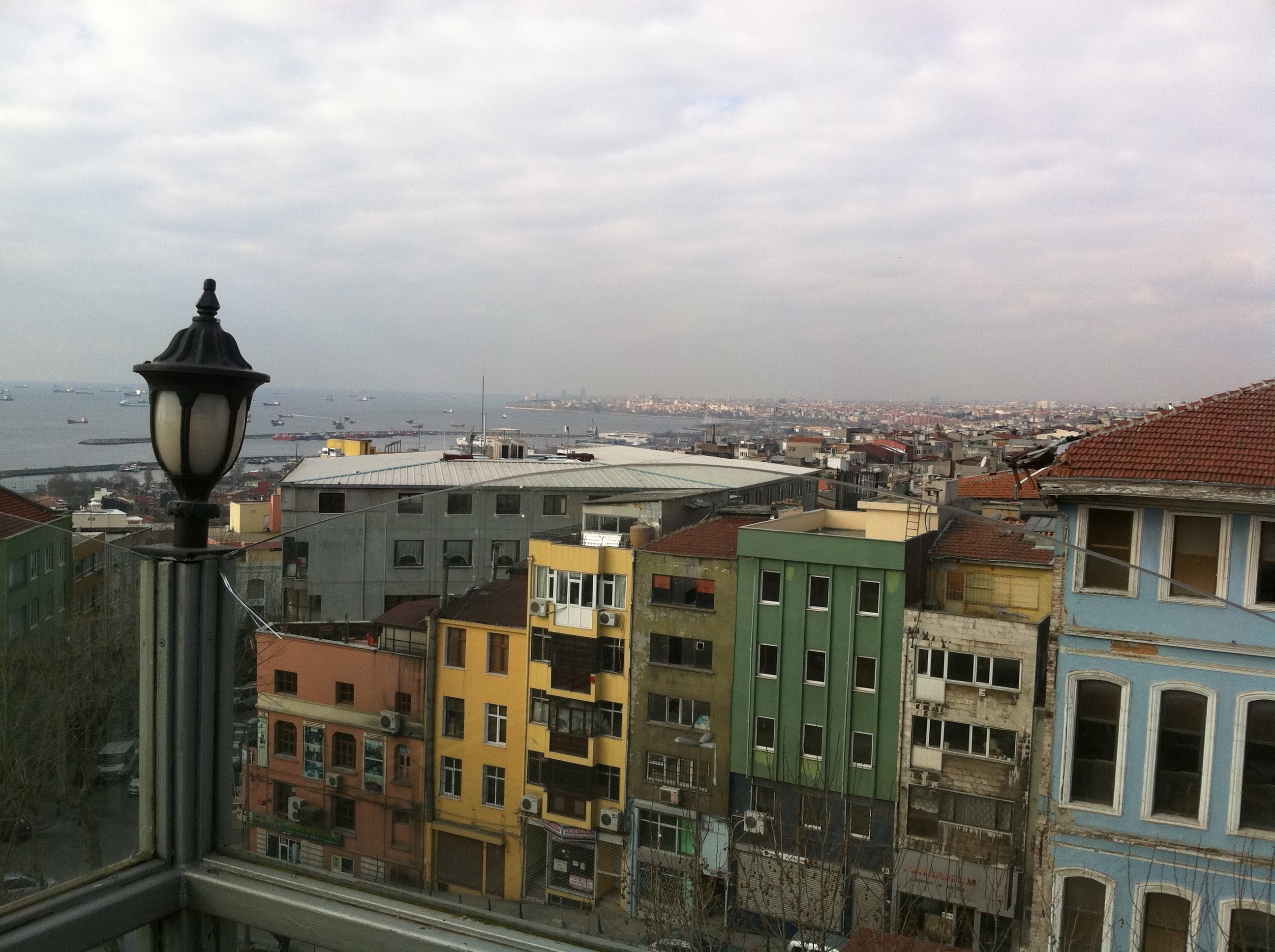
 View from the breakfast room, Bosphorus on top, mosques on bottom
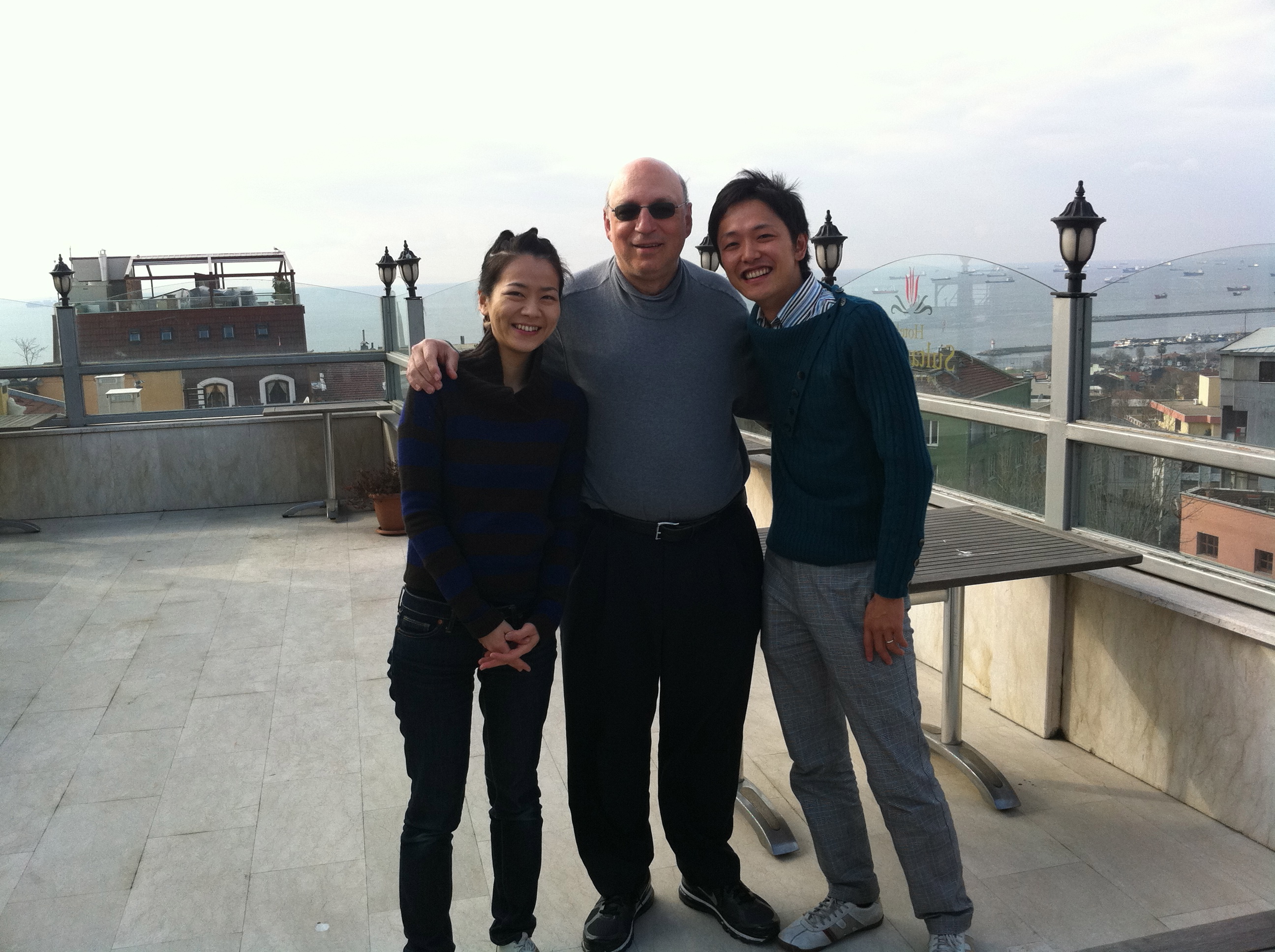
Japanese honeymooners, met while she was arguing cases in his courtroom
I was a little worried since we were not having the driver today. Many of the main attractions of Istanbul were within walking distance of the hotel.
Our first walk was to the Islamic Art Museum. Since the Moslem religion does not allow depictions of faces, they have come up with beautiful patterns in their architecture and art. The calligraphy is beautiful also.
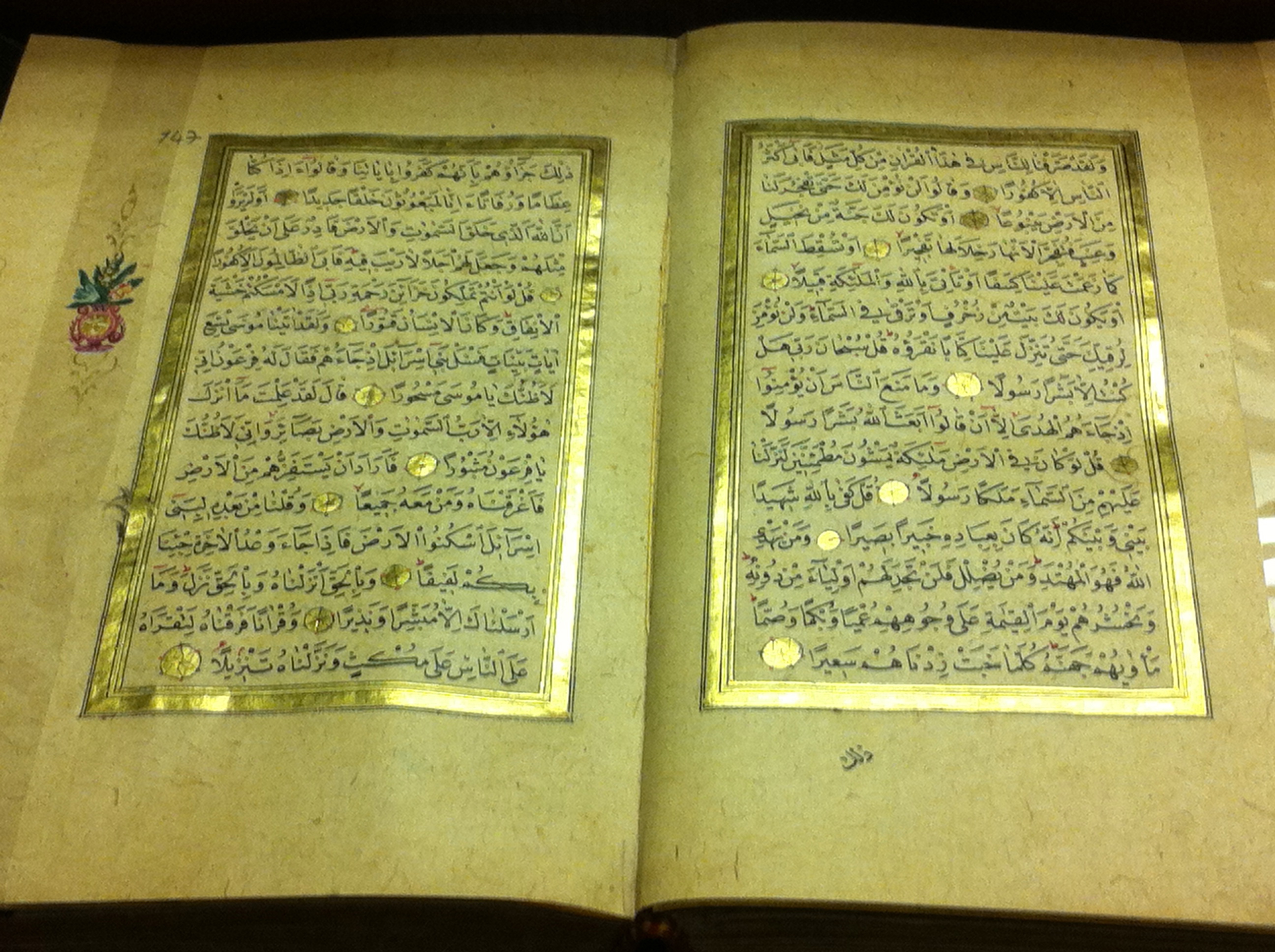
My hotel bill or a page from the Koran done in 1760
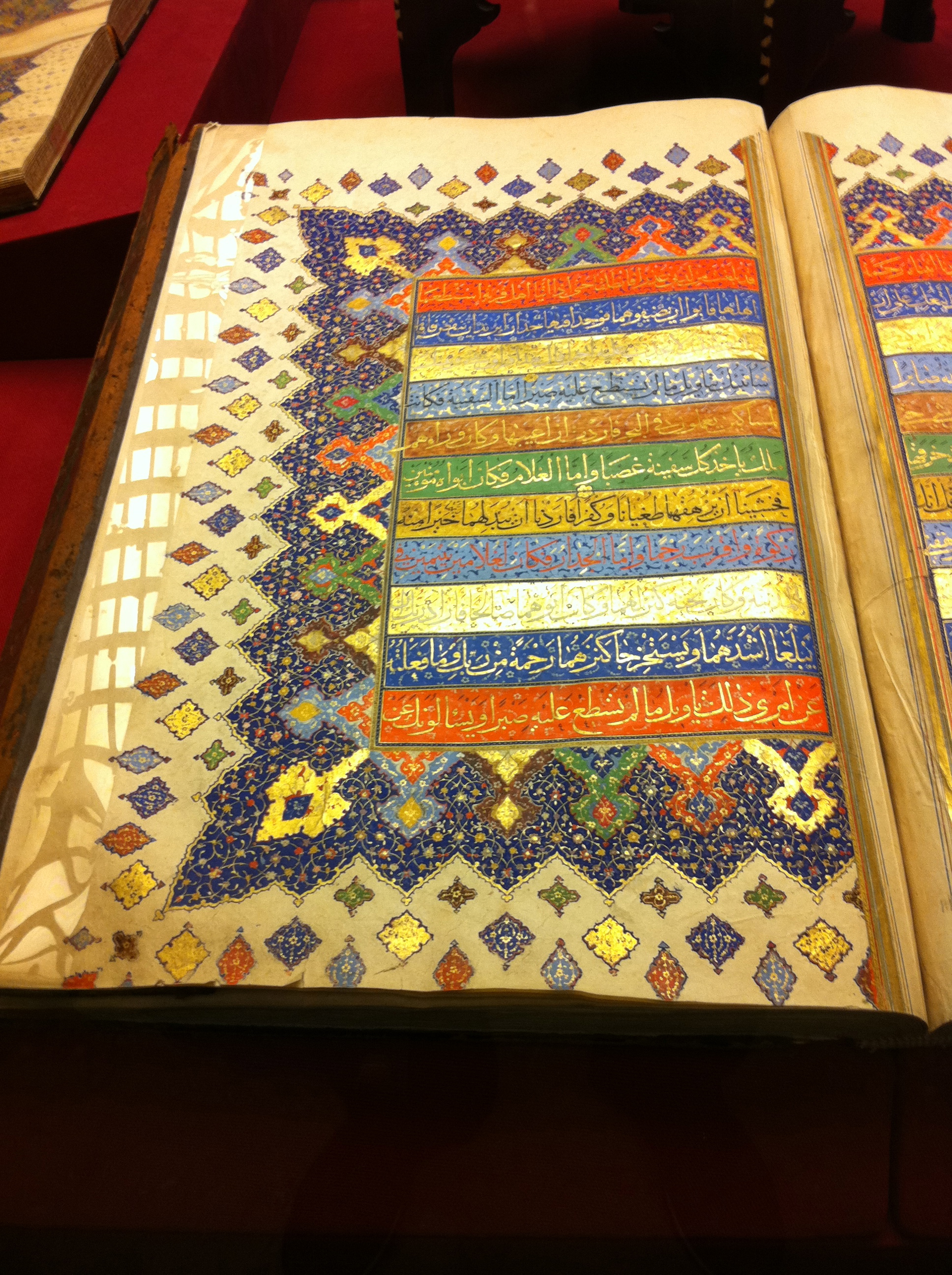
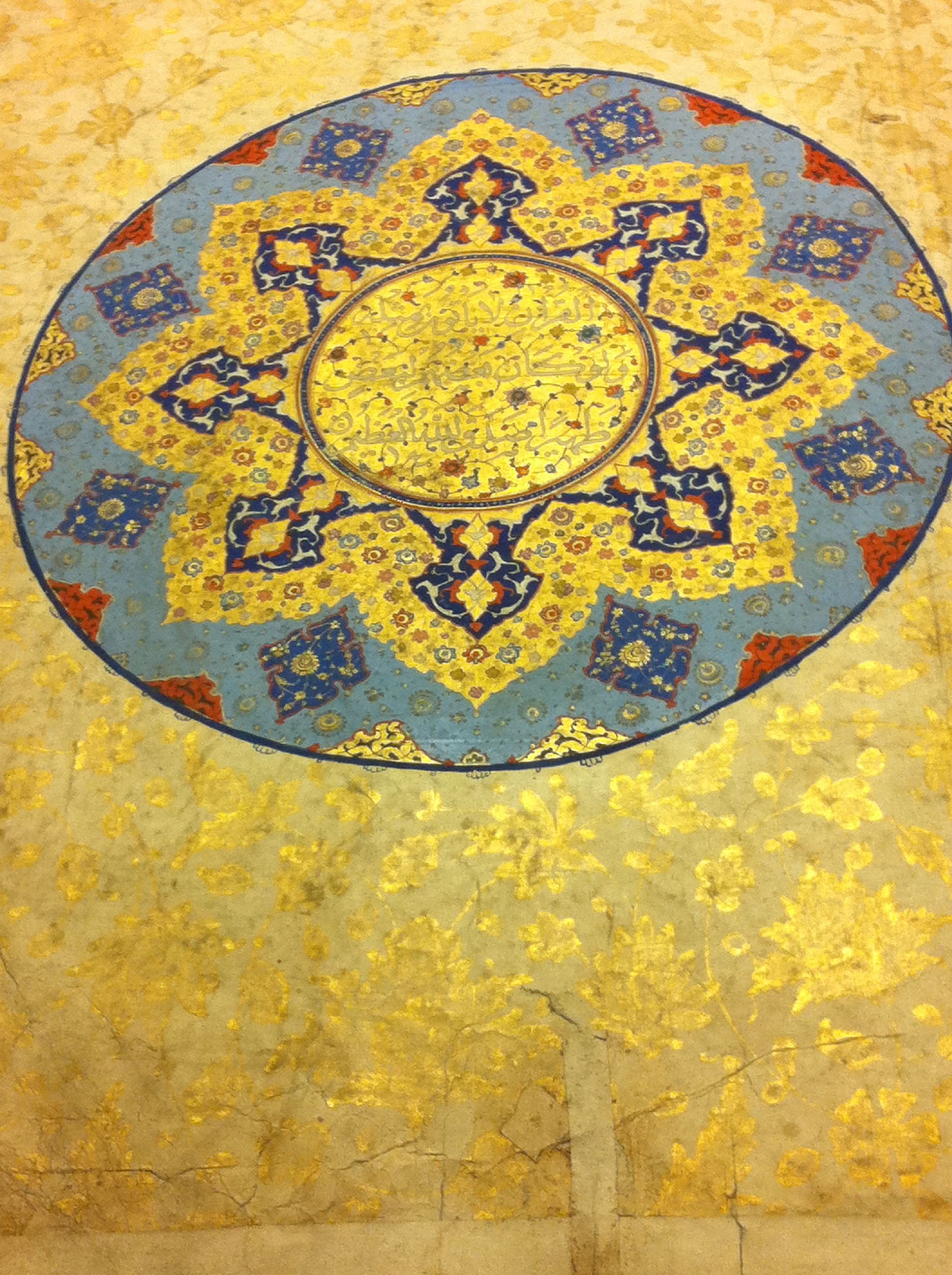
Koran from 1580 (left)
I spent a long time looking at one carpet, in the Lotto style. I had a long conversation in French with a guy from Quebec who was traveling all over the world. I got him to take the picture on the left, since Erdinc had left me to explore the museum on my own.
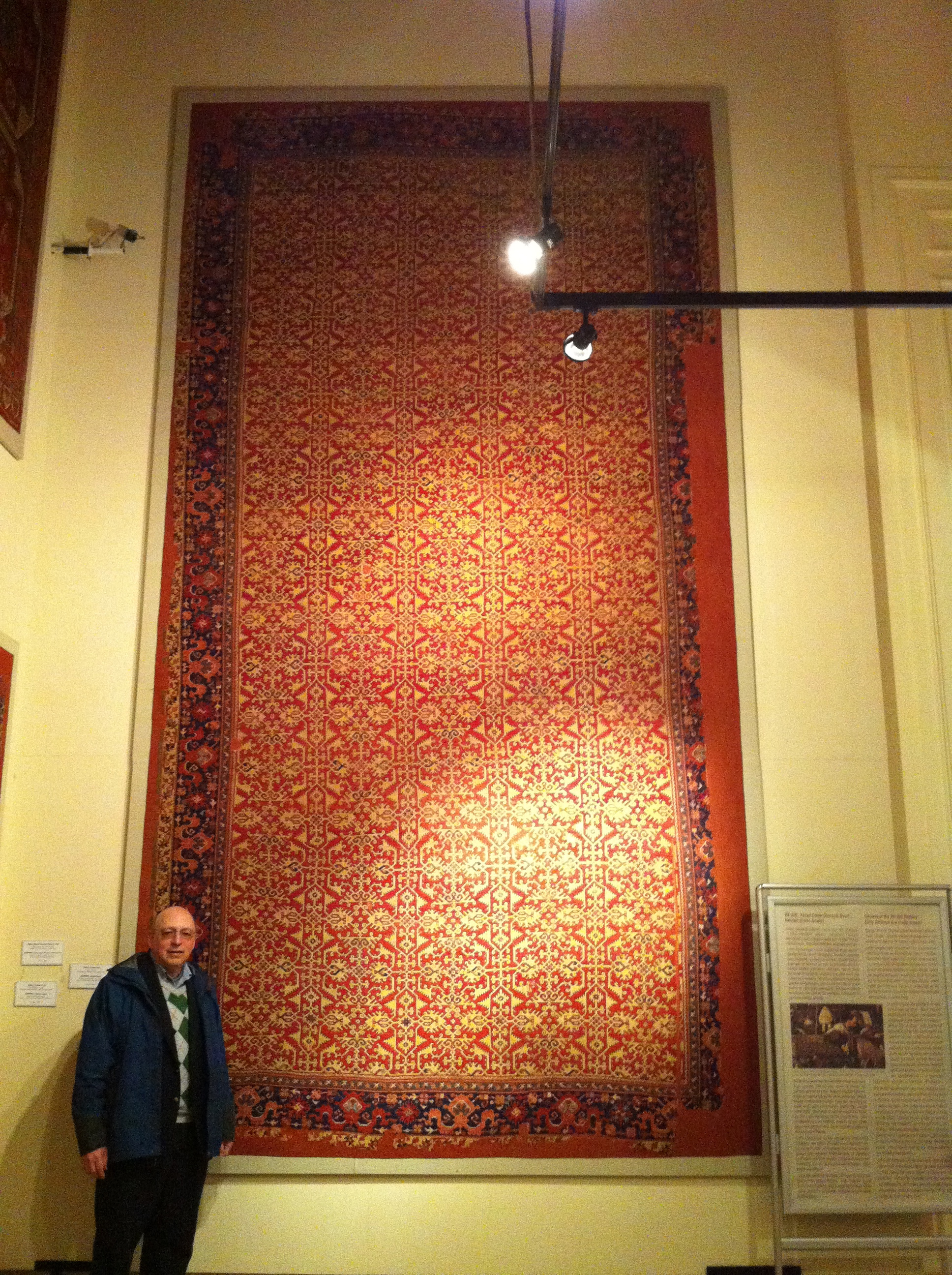
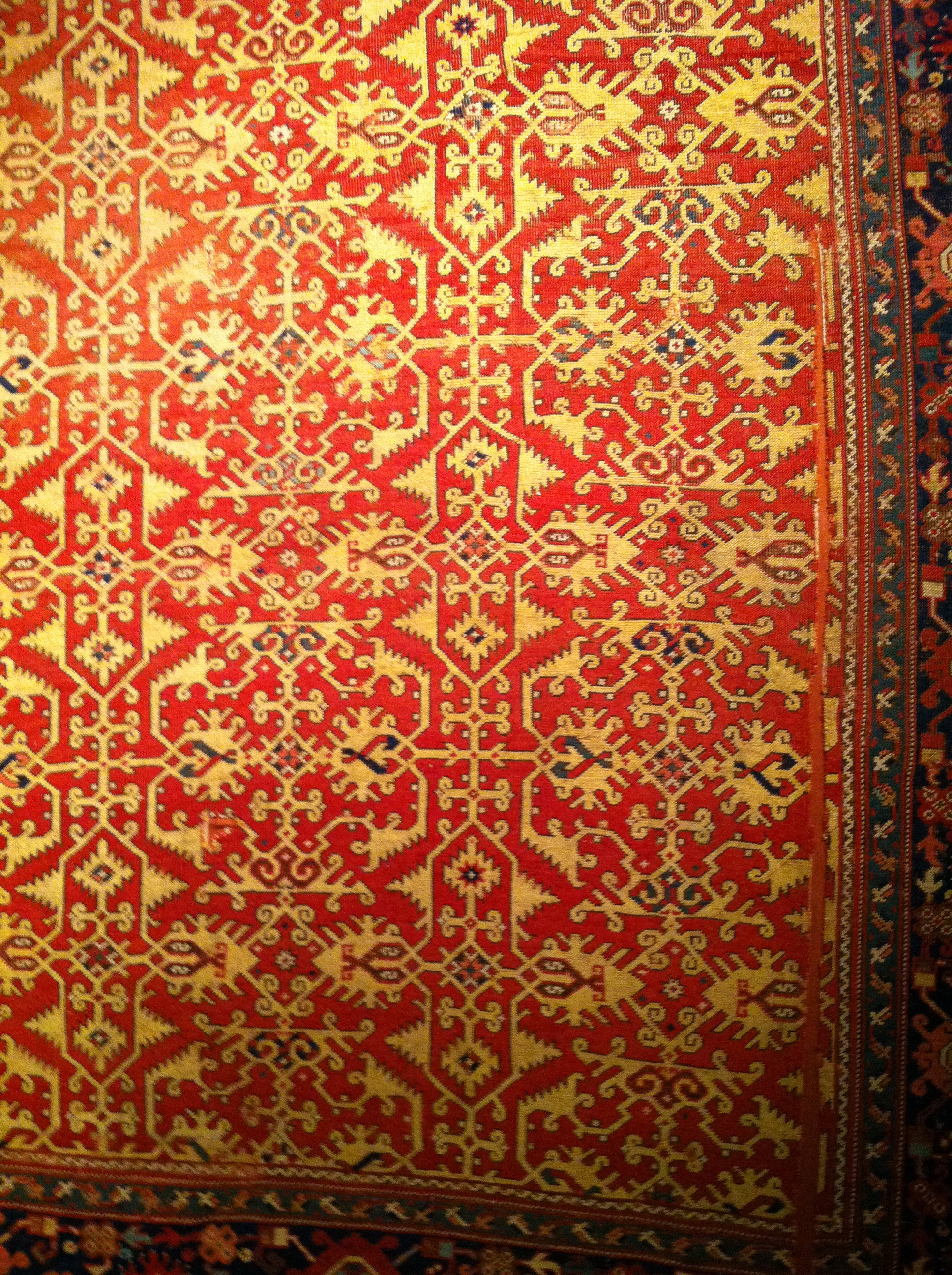
Loto carpet
I’m going to desrcribe what’s going on in my terms then I’ll type up here the description from the museum. The whole carpet is divided into squares. In each square there are repeating octagons. If you put octagons together, you get holes between them so they put diamond shapes to fill those holes. They modified the pattern by putting plant shapes in straight lines to the point where it gets hard to see the original octagons. The same pattern is repeated many times.
In Lotto carpets, the surface is divided into small squares. Each square contains an octagon, and diamonds are placed in the spaces in between. While the octagon and diamond scheme is preserved, plant motifs are geometricized. The composition formed by connecting whole and half palmettes and symmetrically placed pairs of rumi leaves by thin branches covers the whole surface like a web, upon the principle of infinite repetition. With the addition of plant motifs to the composition, it is seen that octangonal motifs somewhat dissipate.”

Diamond in the bottom center separates octagons in a Lotto carpet. The octagons have been “geometrized” by abstract plant shapes.
The best way to appreciate museums for me is to find something that attracts me and spend time with it, rather than try to get it all like I did with these carpets. Lotto carpets are named after the Italian artist Lorenzo Lotto (1480-1556). Here’s an example of a painting with a carpet in this style from Lodovico Carracci in 1590. The painting is called “Two Chess Players” and is located at the Gemalde Galerie in Berlin.
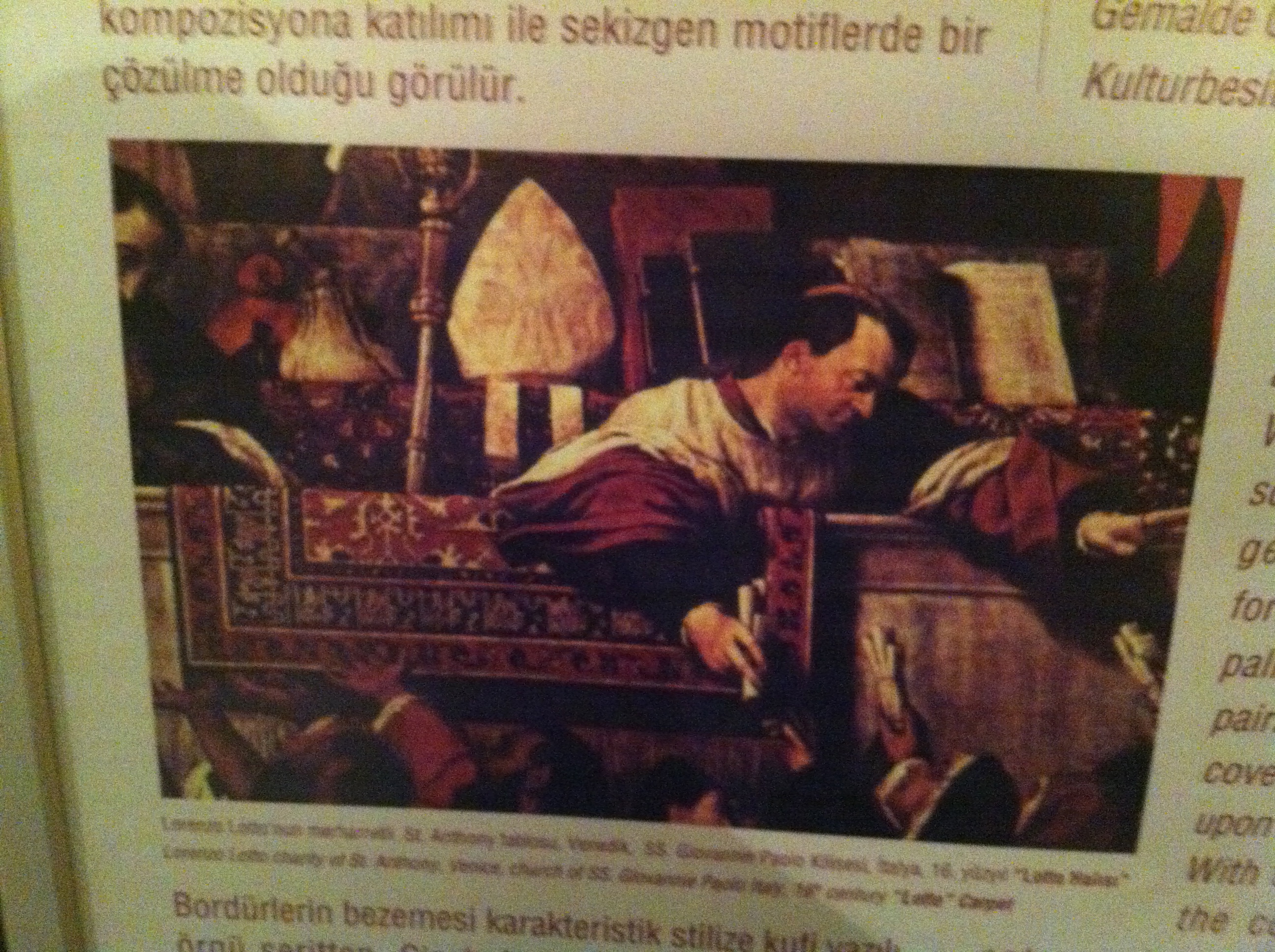
1590 painting with a Lotto carpet
We then moved out to the cold and saw the Egyptian Obelisk in the hippodrome. I also saw the similar obelisk at the Place de la Concorde in Paris. There’s a third one somewhere. Here’s the info from Wikipedia. “The Obelisk of Theodosius is the Ancient Egyptian obelisk of Pharaoh Tutmoses III re-erected in the Hippodrome of Constantinople (in the modern city of Istanbul, Turkey) by the Roman emperor Theodosius I in the 4th century AD.”
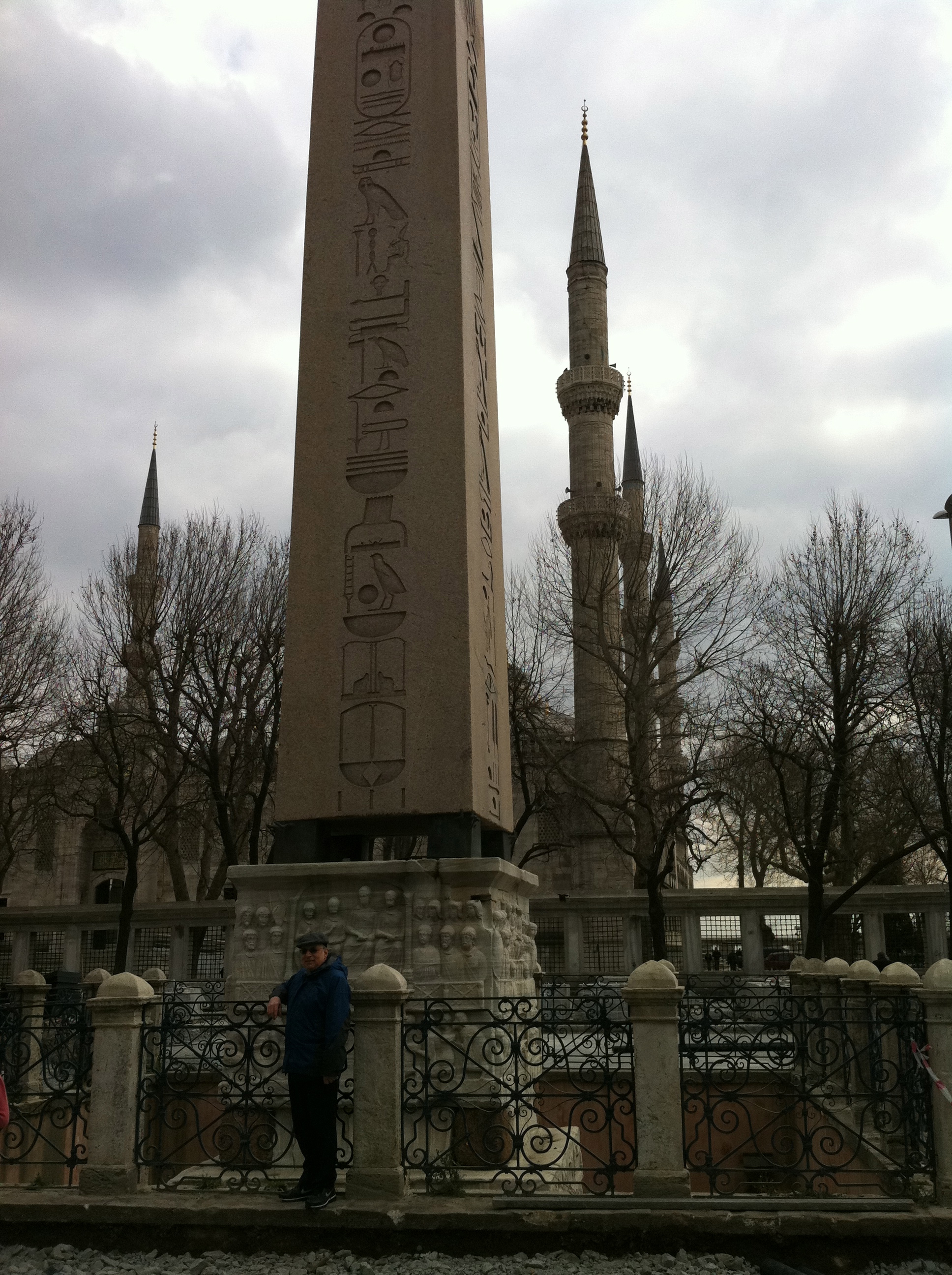
Me in front of the Obelisk (left), and with the top not cut (uncircumcised?) in a picture from Wikipedia (right)
There’s little to say about the Blue Mosque, except that the pictures give no real sense of how beautiful it is. There’s a good reason why it’s called the blue mosque, you definitely feel the blue all around you.

Blue Mosque, picture from Wikipedia


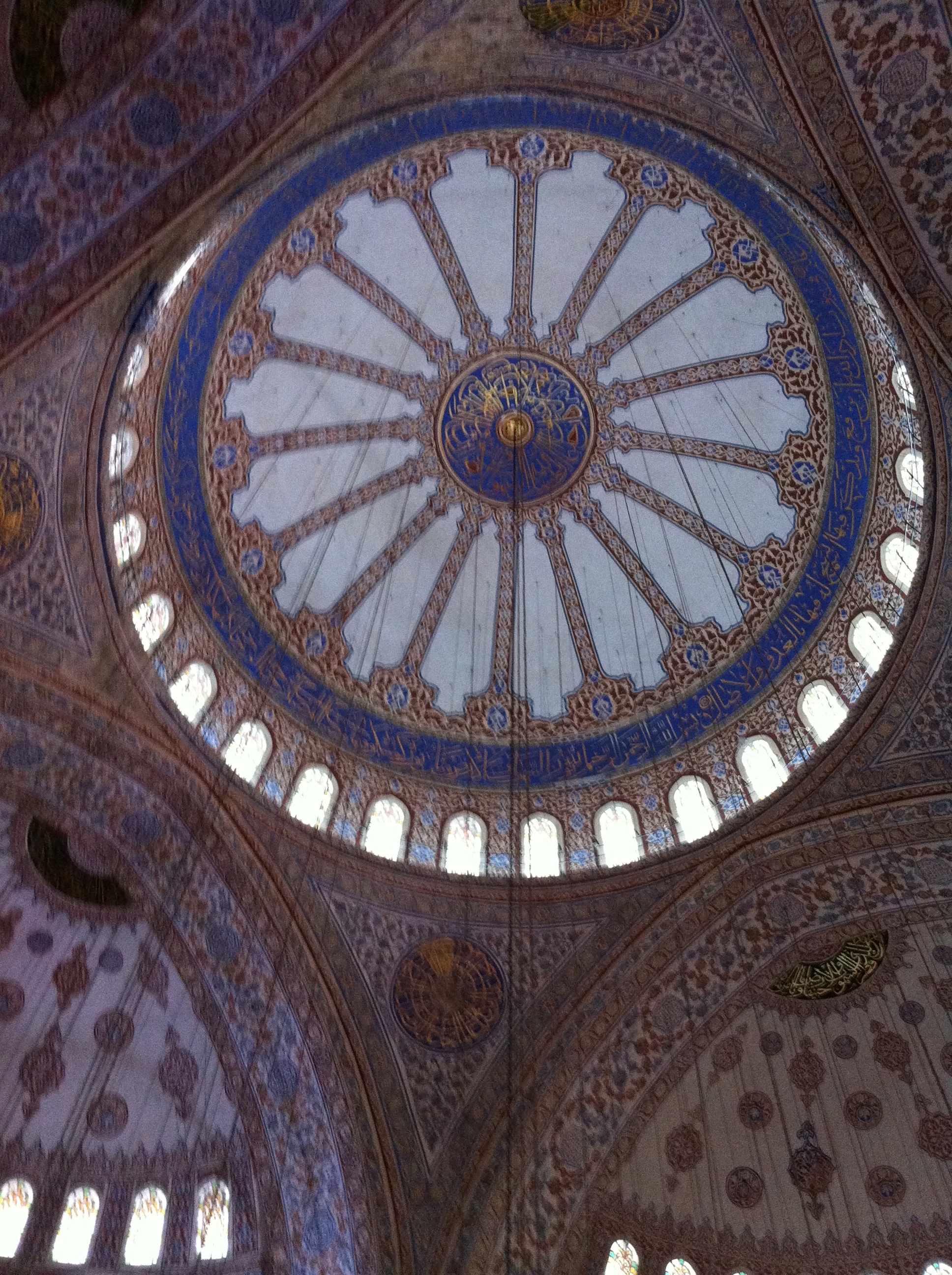

The amazing Blue Mosque, nothing left to say
Erdinc then took me to a pottery studio where the artist below created a piece of pottery from scratch in just a few minutes.


Pottery demonstration
I’ve been taken to many places on this trip where the “opportunity” to buy things were clearly made available. When we moved into our house in 2002, we decorated the house and have had no interest in redecorating since then. My sister will often shuffle things around and she’s always buying new items. Neither Margaret or I really care enough about it to bother. We both feel our house looks fine.
Strangely enough though, I found a piece at this studio that really intrigued me. It was a tessellation of hexagons, with five evil eyes in each hexagon. It’s based on a Hittite design going back 4000 years and can be used as a wine carafe which is easy to clean (although I’m not sure I would ever actually put wine in it). The sun god is represented by the hole in the middle and maybe came around the time that the Hittite’s invented the wheel. It was made by the master potter of this studio. The evil eye apparently is very important in Turkish culture, not to cause evil to others but to protect us from evil.
Here’s the description that the company (İSTANBUL FIRÇA) sent me. I’ve edited it to correct spelling and grammatical errors.
“Dear Larry,
I just want to leave information about your Hittite wine carafe.
4000 years ago the Hittite civilization had lived in Anatolia. They worshipped many gods and the sun god was one of the most important. They created a wine carafe for dedicating their sun god. The pitcher consists of four parts. The center of the pitcher looks like the shape of the sun.
Our family design was created by our Great Grandmother. Basically it has tulips, carnations, and roses designed with evil eyes on quartz/ceramic pottery. But sometimes the artists use their special imagination like your tesselation style pitcher made by Mustafa Mersin.”


The piece of pottery I bought
It was ridiculously expensive — 3100 Turkish Lira plus 200 Lira for shipping ($1965+125). As you have figured out, I ended up buying it. Here’s how the bargaining went the next day (after I had time to think about it and run it by Margaret). Margaret felt I should go ahead if I really wanted to, it was hard for her to get excited about it after only seeing a picture.
Them — 3300 Lira ($2090), everything from here includes the $125 shipping
Them — 2600 TL ($1650)
After I thought about it, I thought I would be willing to pay 2100TL ($1330) so I offered 1600TL ($1015) with the idea that the midpoint of 1600 and 2600 is 2100.
After I offered 1600, he went on a long description of how wonderful the piece was and what a good deal 2600 was.
Here was where I did the one smart part of my bargaining. I worked at a computer store in the early 1980’s when we were the only ones to have the rights to sell the first IBM PC. It was the only computer that used MS-DOS rather than Apple’s OS or the now ancient CP/M. I went to a 2-day sales training session and one thing I learned then that is so important in sales and in teaching is to know when to shut up. In sales, when you ask someone if they want to buy something, you really should take the uncomfortable silence and wait for their answer. If you start talking, they will often feel off the hook and say no. I also believe that it’s easy in teaching to talk for a full class period. It’s much harder and usually much more effective to create a learning situation where you shut up and have students working and / or thinking.
Back to my negotiations, he was hoping I would go up from 1600 before he went down from 2600. My silence got him to counteroffer 2300 ($1460). He went down 300 (from 2600 to 2300) so I matched him and went with 1900 ($1205), up an equivalent 300 from 1600.
He went down only 50 to 2250 ($1425) and I made the mistake of going up 200 instead of matching his 50. I had just offered my final goal of 2100 ($1330) too early in the process. He maybe felt sorry for me and went down 100 to 2150 ($1365). I split the difference and thought we had a deal at 2125 ($1345). Just to make his superiority known, he offered 2128 ($1350) and we shook hands.
When I mentioned what I paid to Erdinc, he said 2000 is a good deal, which is less than what I paid. Possibly I could have offered 100 TL and gotten it for half the price I paid, who knows. I do know that I’m not good at negotiating and don’t enjoy it. My father was an amazing expert at it and considered it one of his favorite sports. Our family lore includes a story that he was having so much fun negotiating in Egypt in the 1950’s that he barely made the boat by seconds.
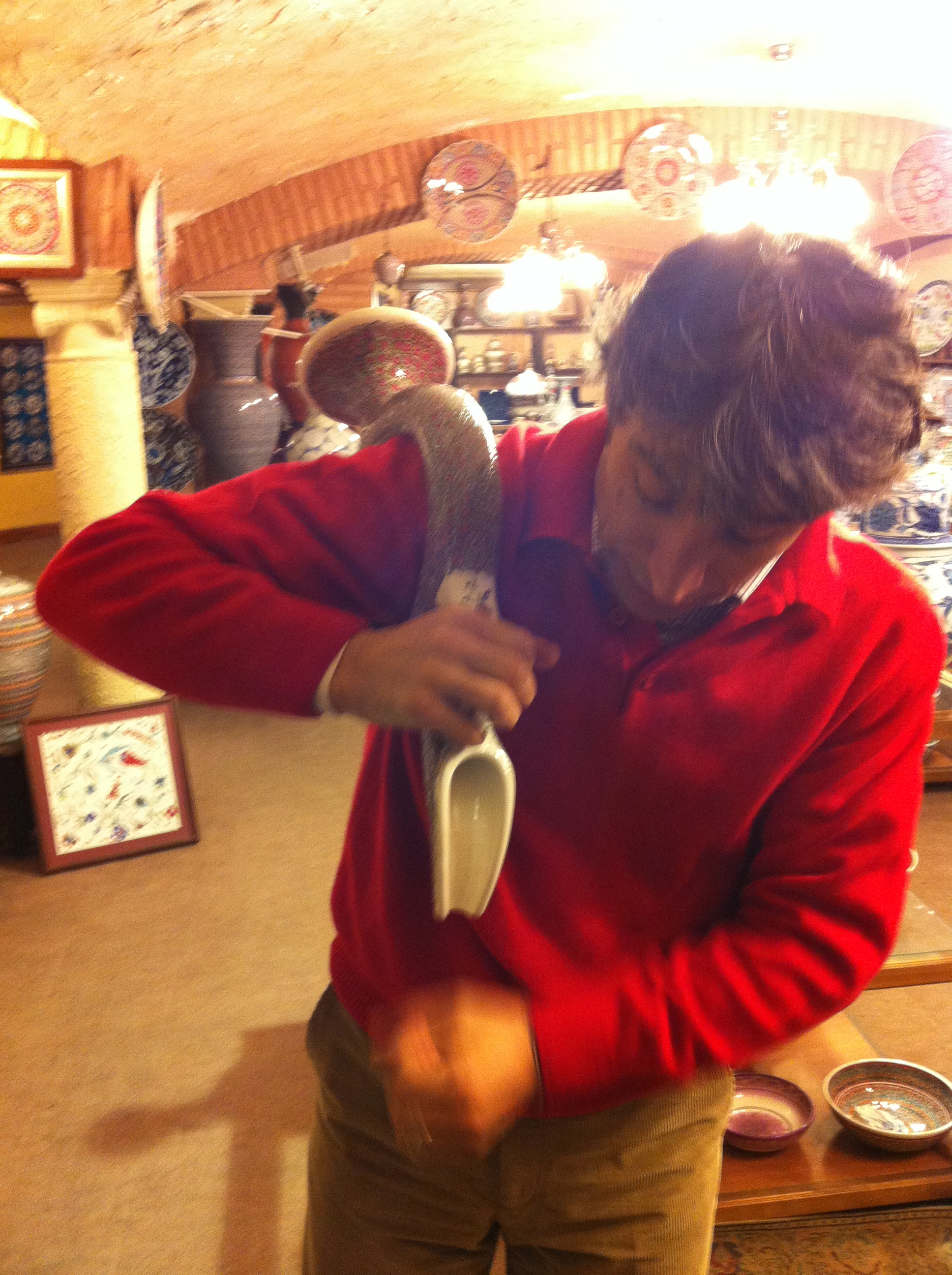
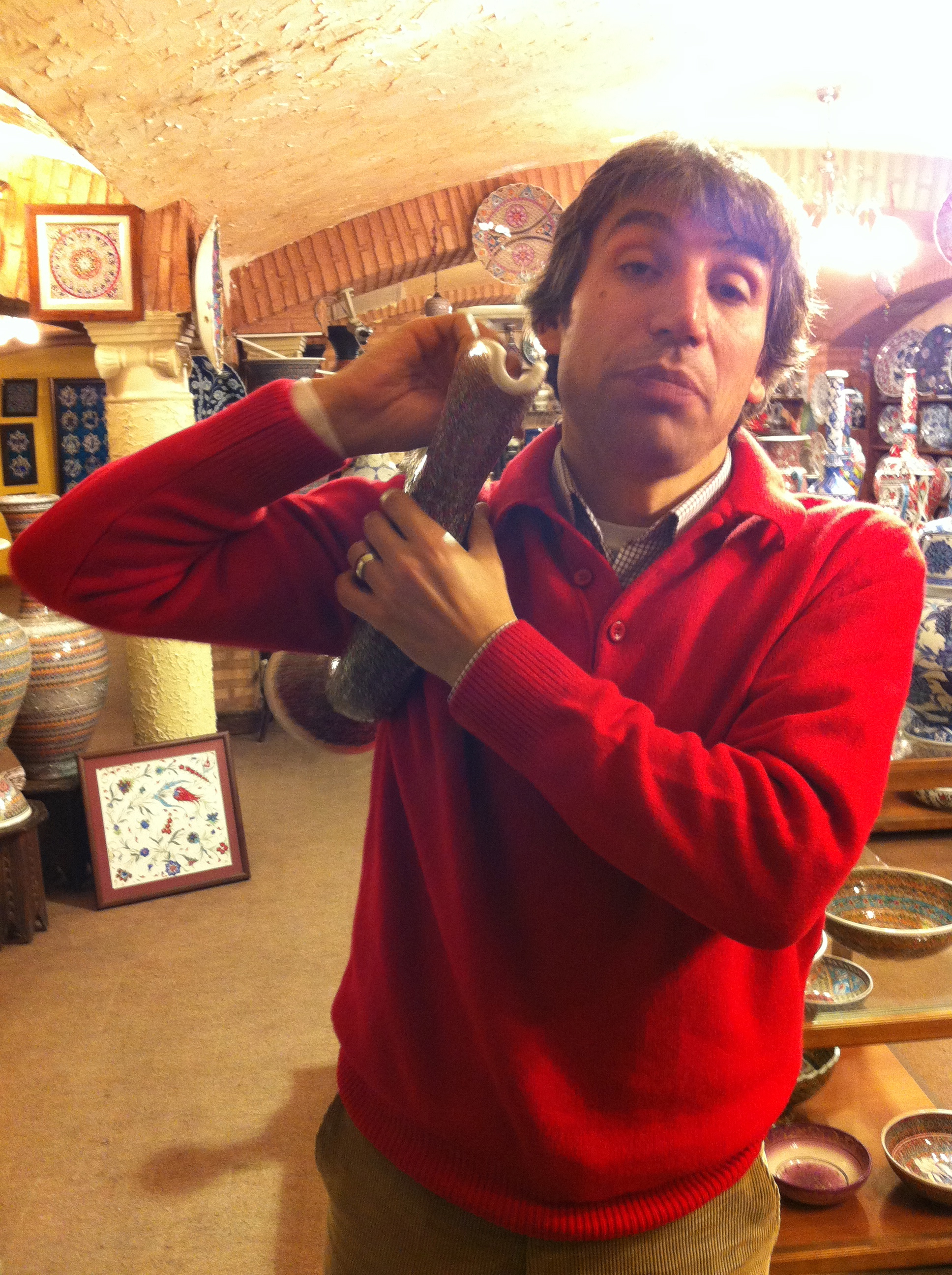
My $1350 piece of pottery in action. Hopefully the evil eyes will keep me from buying too much stuff in the future.
Even after the trauma of negotiating and spending that much money, I’m glad to have done it. It’s the only real piece I bought the whole trip and I do love the tessellations, the evil eyes, the sun god theme, and the wine carafe. It will be an excellent memory.
The Topkapi Palace took a while to go through. All the stories you imagine about a sultan’s palace with his harem and large indoor baths were real here.
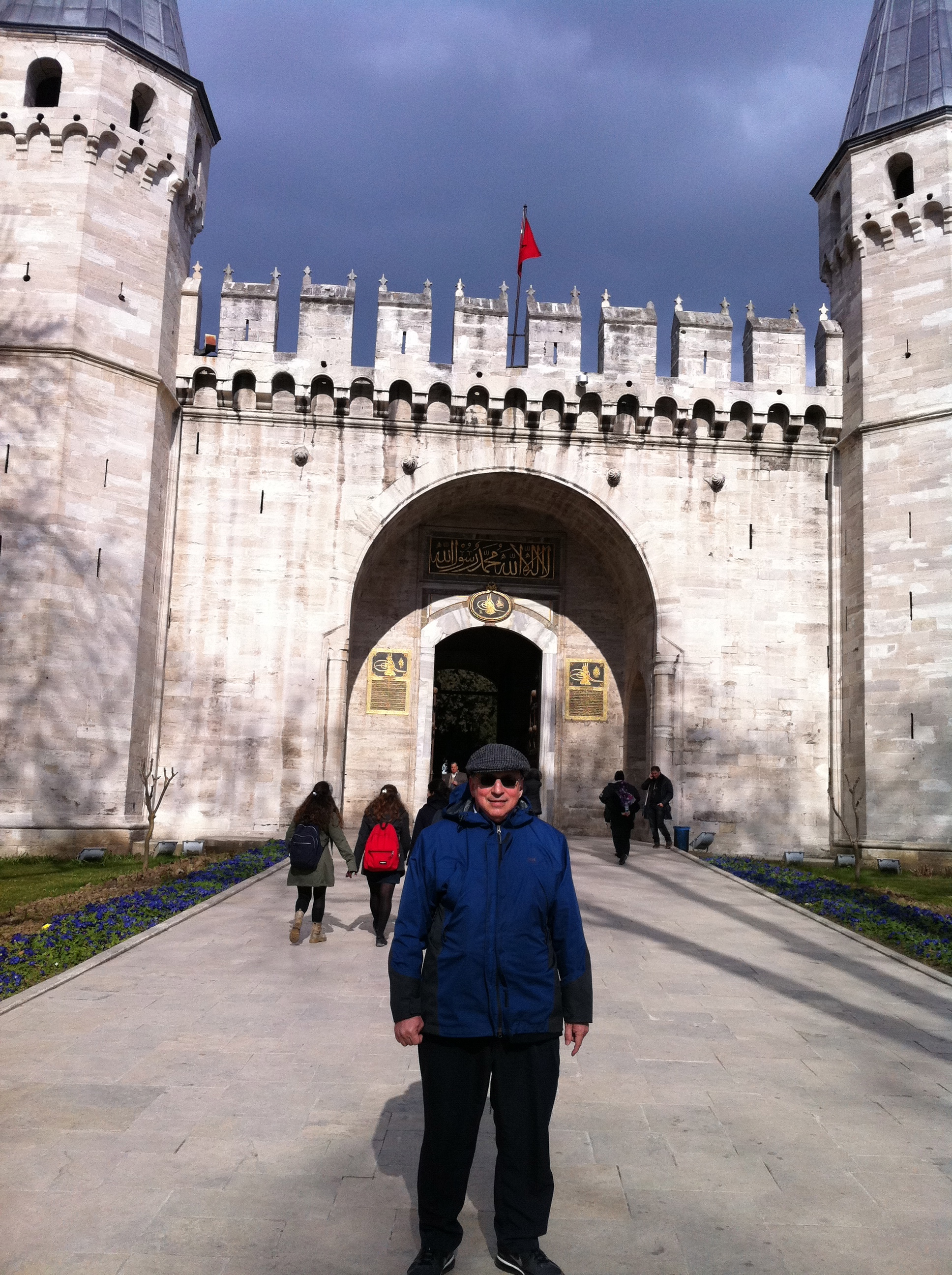

Gate of Topkapi Palace with logo of sultans (left), model of the Palace (right)

Entrance to the Harem, in case you know any women (or Eunuchs) looking for a job

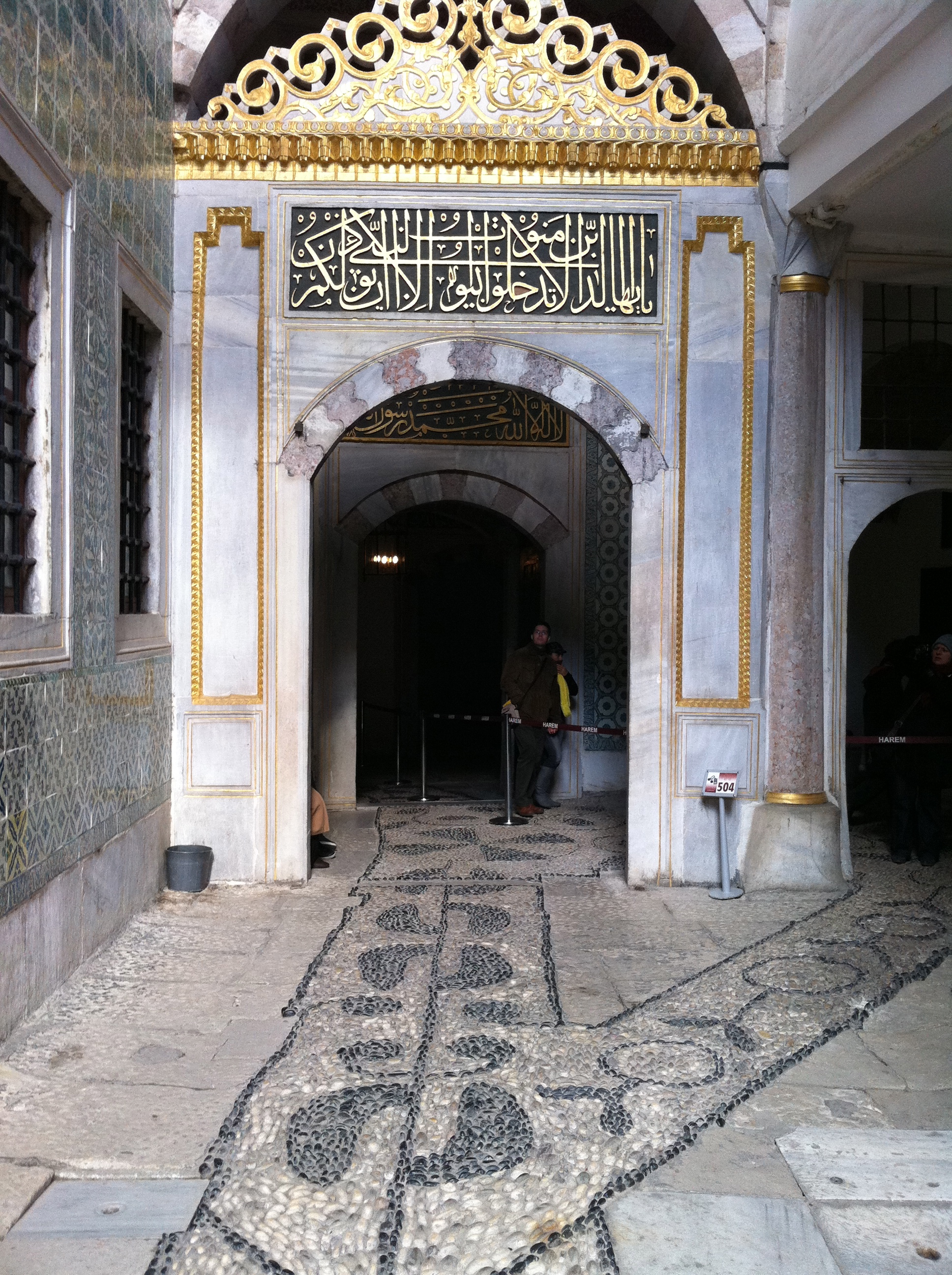
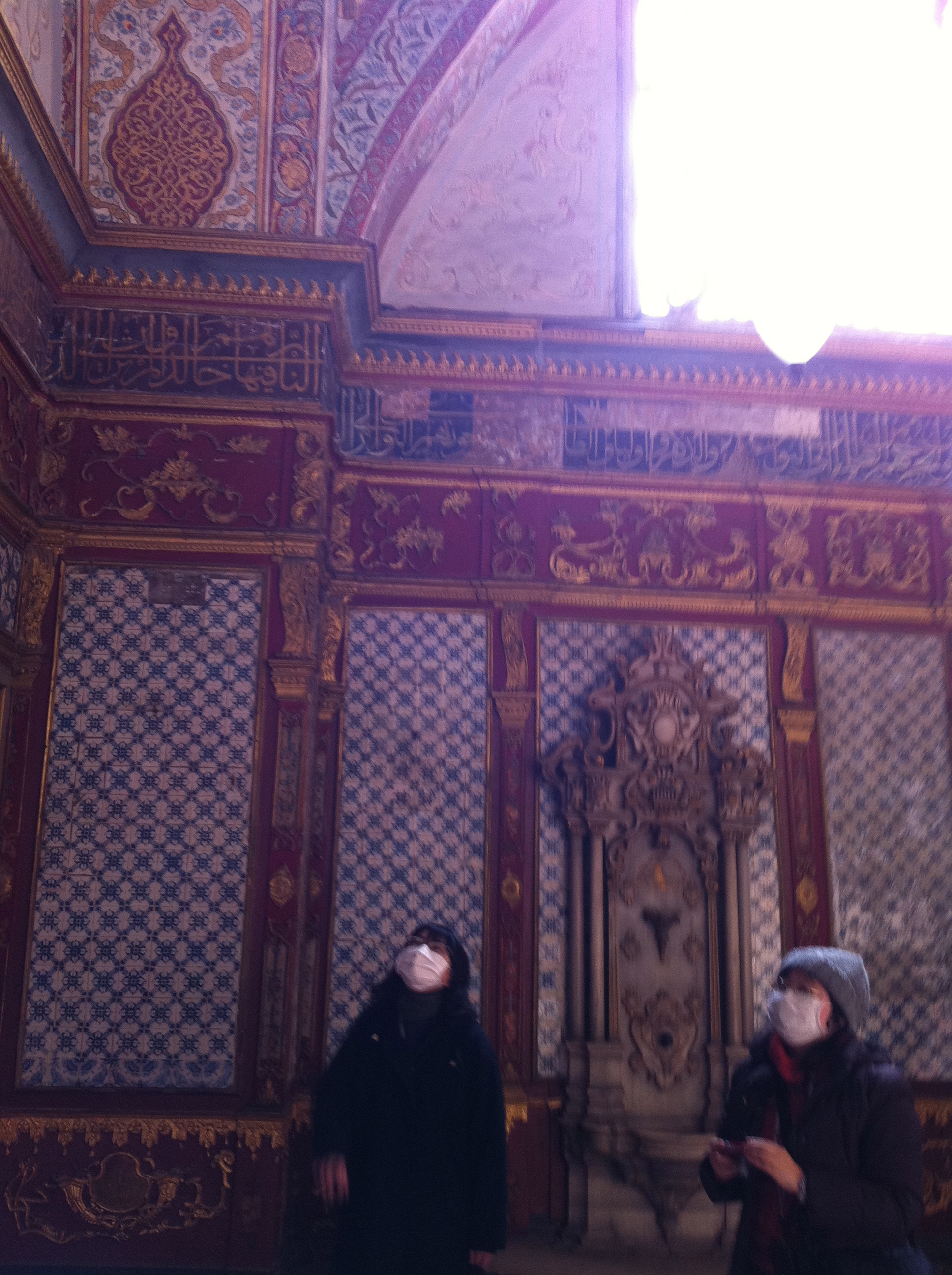
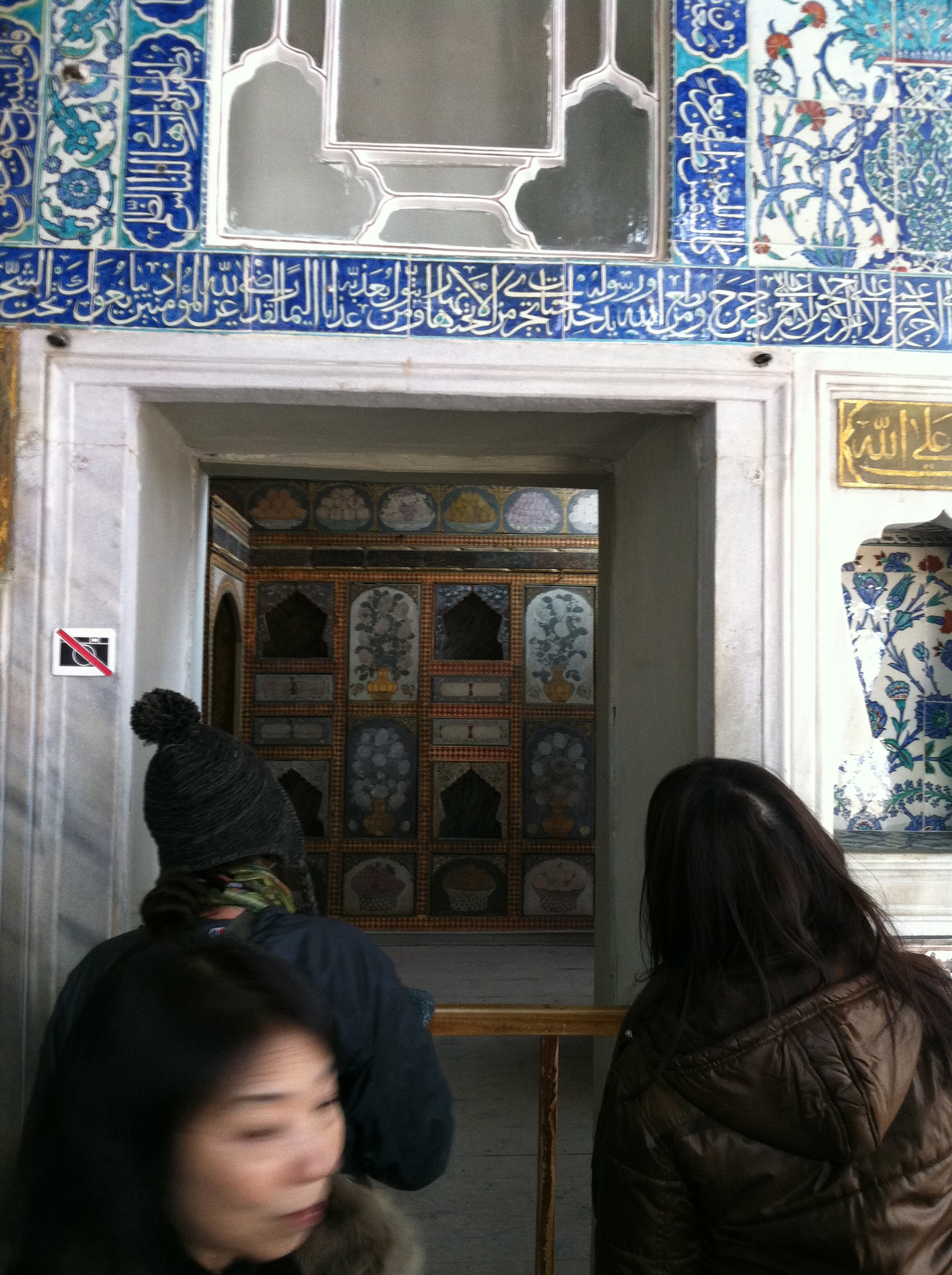
Scenes from inside the Topkapi Palace


Views of the Bosphorus from the Topkapi Palace
Next was the Hagia Sofia or St. Sophia, probably the best known monument in Istanbul and even more famous than the Blue Mosque. It was a church and headquarters of the Orthodox church 360 until 1453 (except for a brief time when it was a Catholic church during the Crusades). Then from 1453 to 1931 it was a mosque. After Turkey became a secular state, they turned it into the museum it is now. It was a bizarre feeling to see Christian icons from over a thousand years ago, rediscovered fairly recently, in what looks very much like a mosque.
According to Wikipedia, it is considered the epitome of Byzantine architecture and is said to have “changed the history of architecture.” It was the largest cathedral in the world for nearly a thousand years, until Seville Cathedral was completed in 1520.
I’m glad I don’t have to make this decision. “Because of its long history as both a church and a mosque, a particular challenge arises in the restoration process. The Christian iconographic mosaics are being gradually uncovered. However, in order to do so, important historic Islamic art would have to be destroyed. Restorers have attempted to maintain a balance between both Christian and Islamic cultures. In particular, much controversy rests upon whether the Islamic calligraphy on the dome of the cathedral should be removed, in order to permit the underlying Pantocrator mosaic of Christ as Master of the World, to be exhibited (assuming the mosaic still exists).” (Wikipedia)
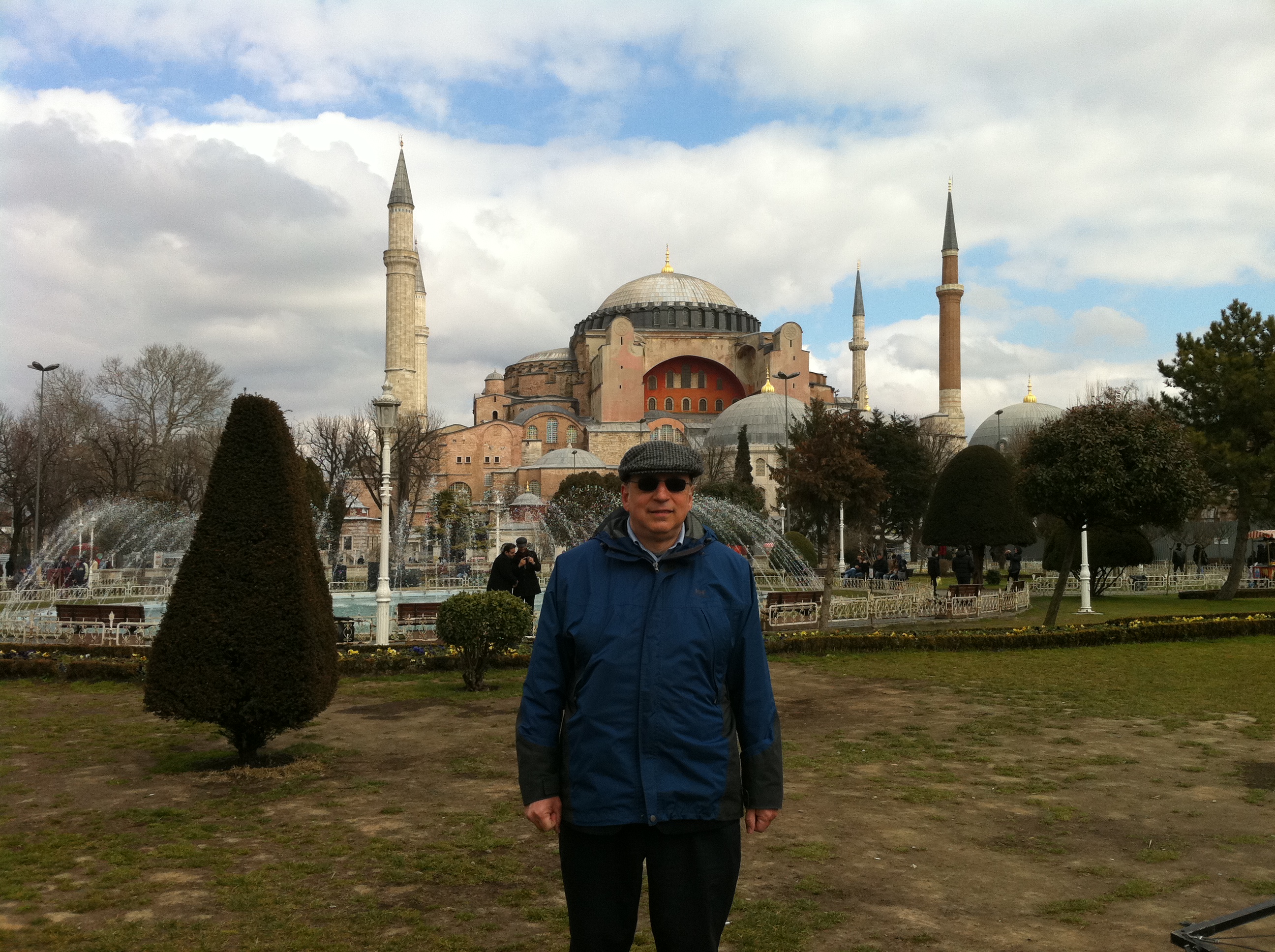
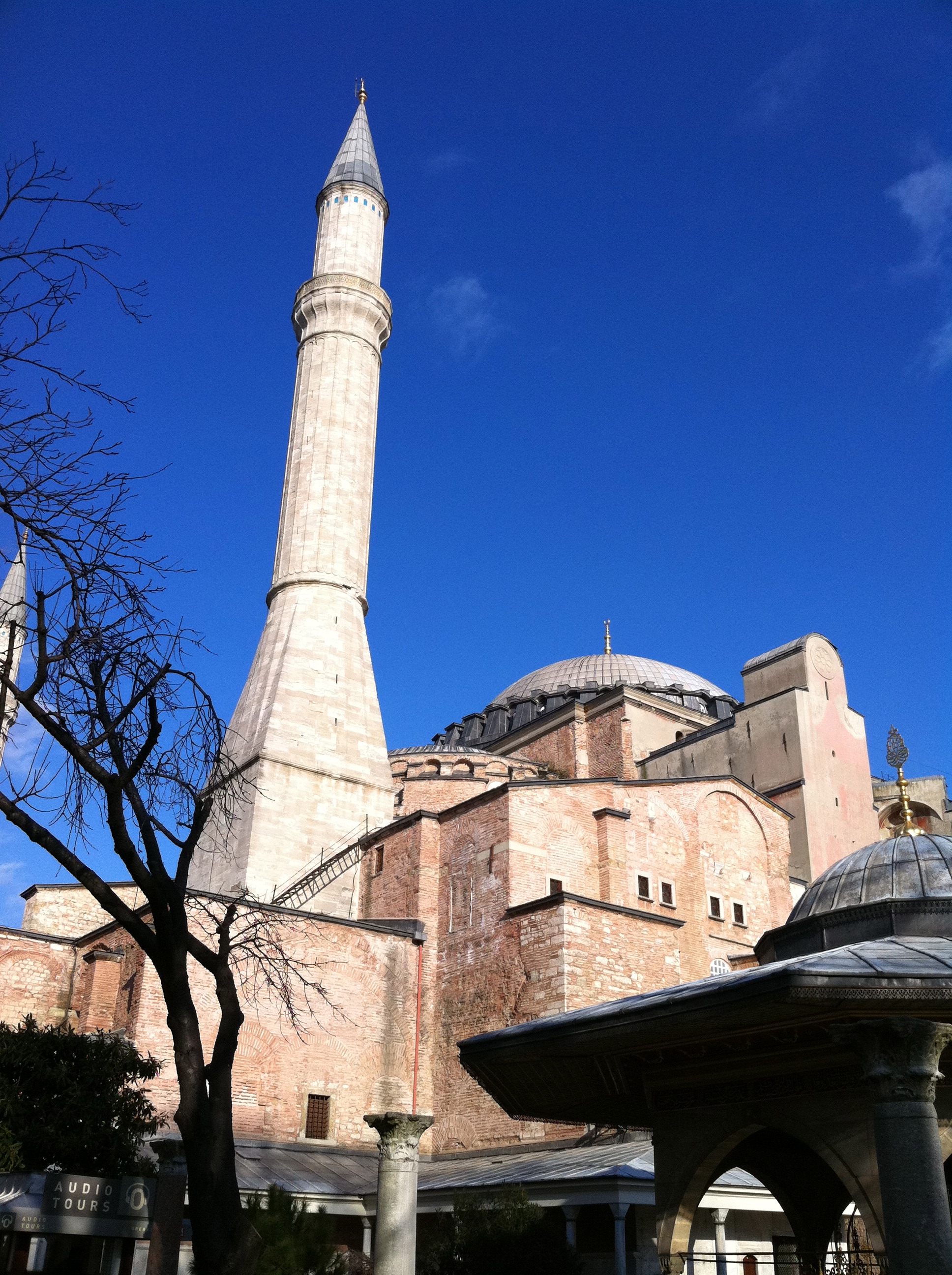
The Hagia Sophia from the outside

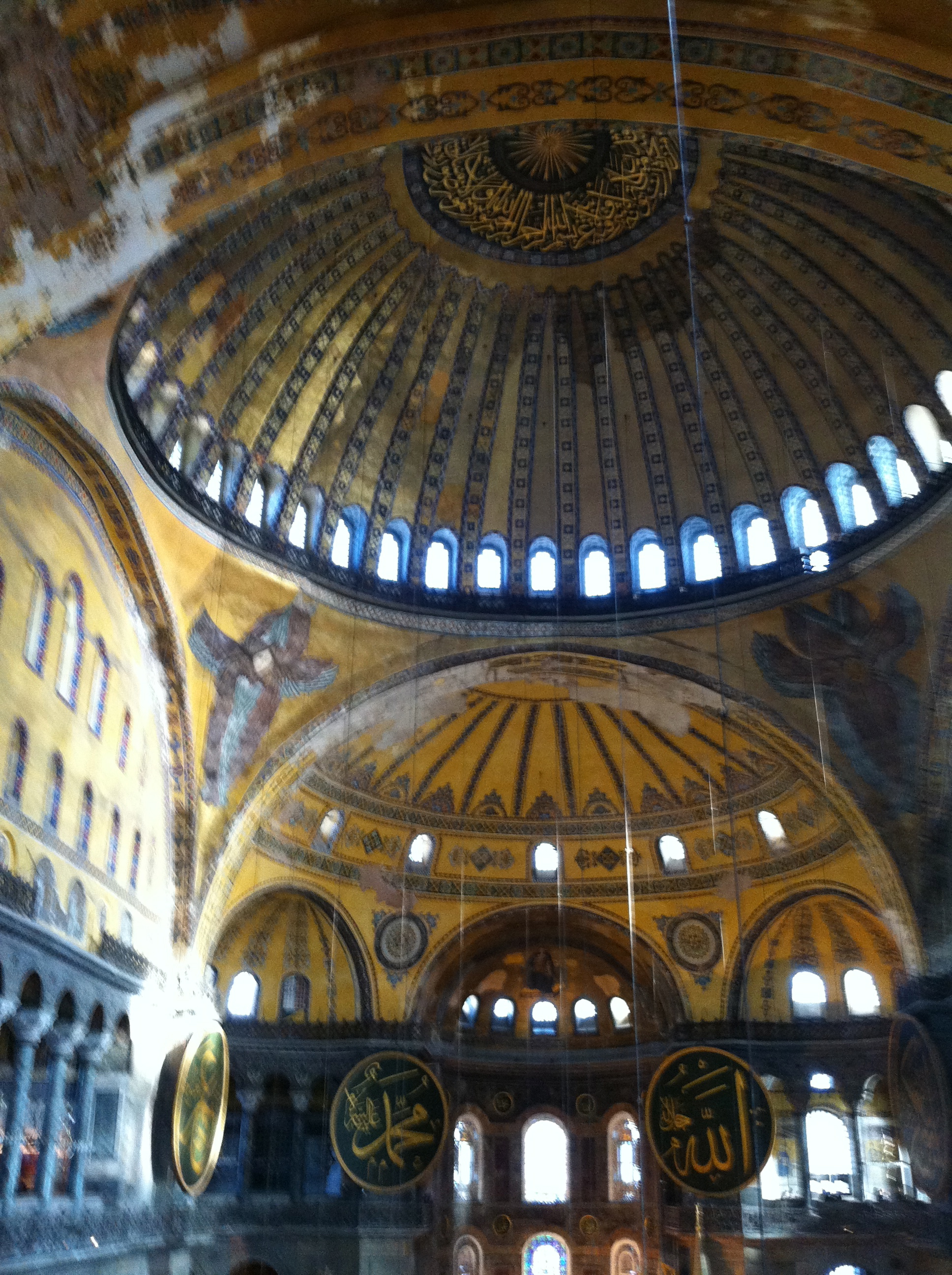
Hagia Sophia from the inside, the dome is 56.6 meters (186 feet) high and has a diameter of 31.87 meters (105 feet). Would it be a good place for ice hockey?

The lights almost look like water lilies from the upper gallery
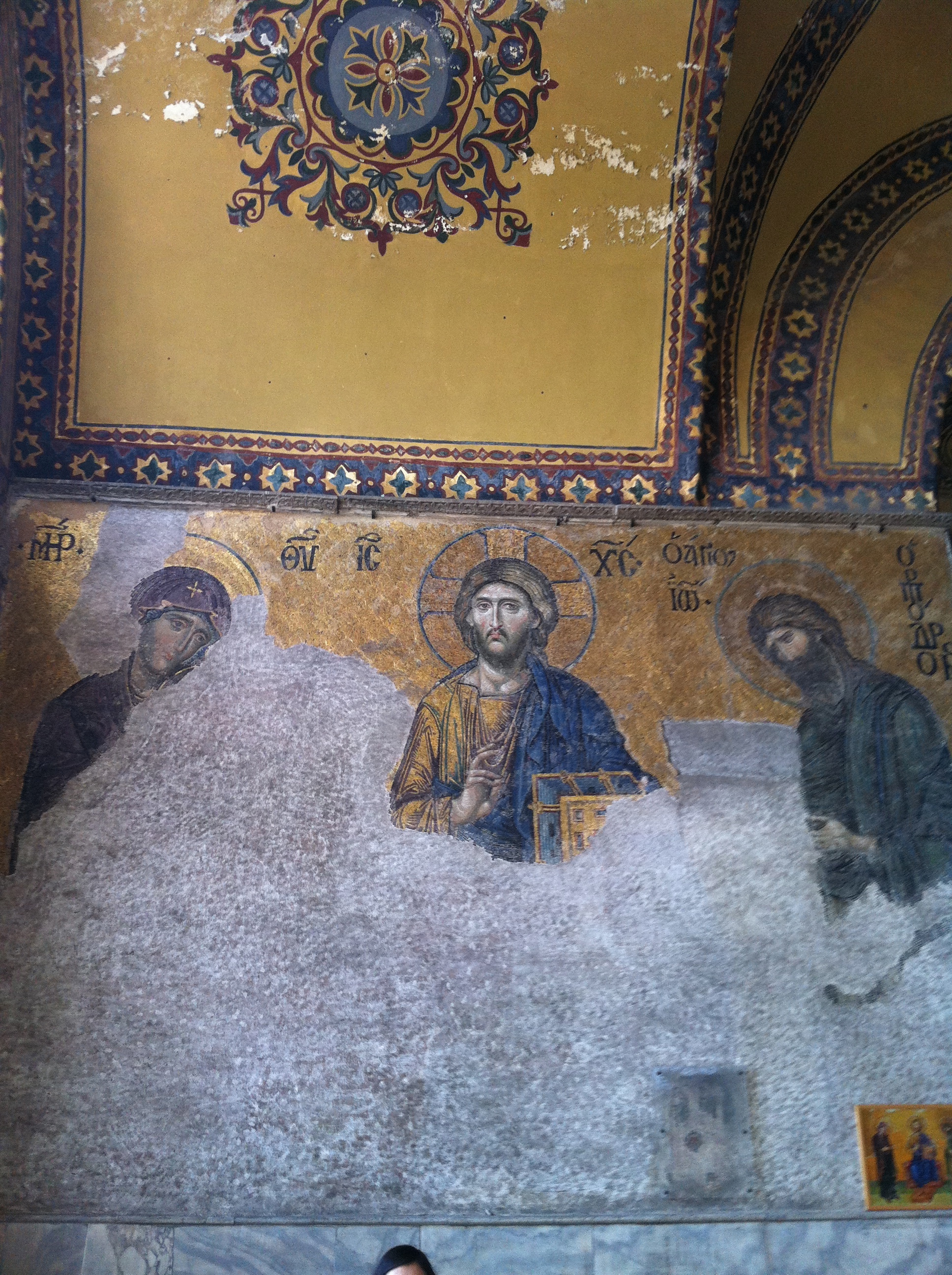

Stunning ancient Christian icons

One of the Seraphin from the Hagia Sofia discovered 6 months ago, representing one of the 4 evangelists (either Matthew, Mark, Luke, or John)
This was really almost too much to see in one day. It was fun walking through the streets of Istanbul, even though it was relatively cold. I would have liked my winter jacket but I had plenty of layers.
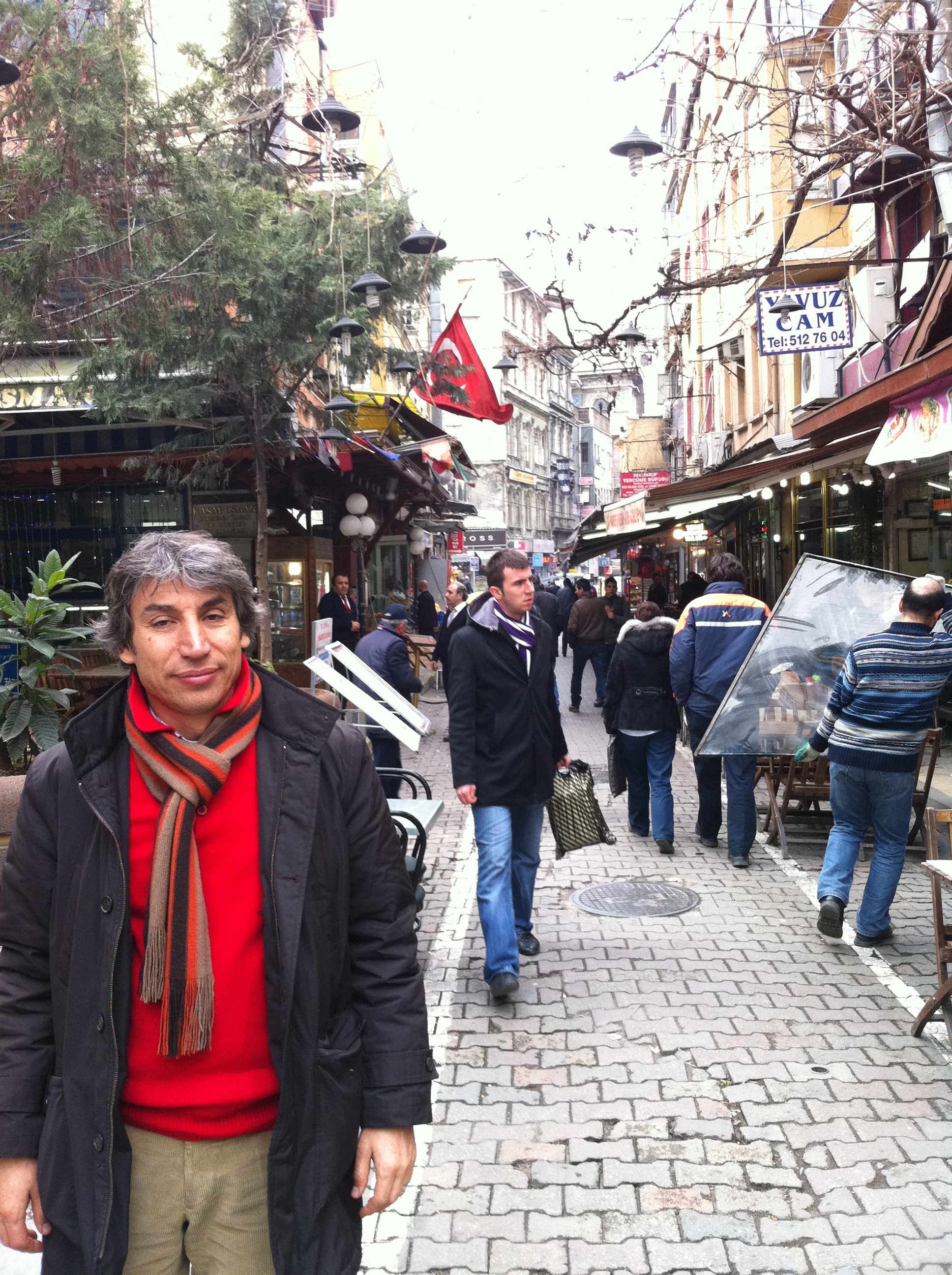
My guide, Erdinc, and an Istanbul street scene
 feldmanlarry

Dec 15, 2011 @ 13:27:34
I think you misread your notes – the painting with the lotto carpet is “The Alms of Saint Anthony” (1542, San Giovanni e Paolo, Venice) by Lorenzo Lotto.
This is one of the most spectacular museums I’ve ever seen.
Cheers,
Norman